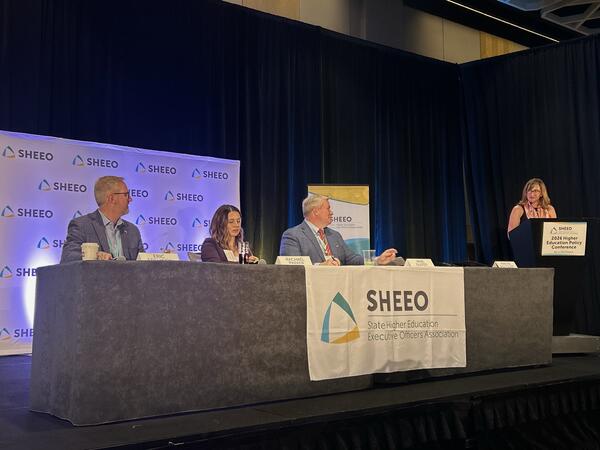
CHICAGO—States and institutions are trying to capitalize on the federal government’s increased focus on nondegree, workforce-targeted credentials but, for many, their data collection systems and current short-term programs don’t meet the federal criteria for funding.
That was an overall message coming out of this year’s State Higher Education Executive Officers Association (SHEEO) Higher Ed Policy Conference. The event, which ran from Monday through Thursday, featured six scheduled panels with “Workforce Pell” in the title, including two at the same time. There were also panels on merging higher ed and workforce agencies and other sessions focused on how to better connect what have traditionally been separate workforce and higher ed functions and expand access to workforce training.
“Workforce Pell is clearly the canary in the coal mine,” said JB Holston, executive director of the Colorado Department of Higher Education, during the workforce-higher ed agency merger panel. He said that, regardless of one’s politics, Workforce Pell represents the path moving forward, and states need to have “interlocking data systems.”
Bennett Boggs, commissioner of the Missouri Department of Education and Workforce Development, got laughs when he said during the same panel: “I don’t think we need to talk more about Workforce Pell.” But he said “the fact that we had the Workforce Development Board in our agency made some things a lot more efficient.” Missouri recently integrated what was the Department of Higher Education and the Division of Workforce Development into a new Department of Higher Education and Workforce Development.