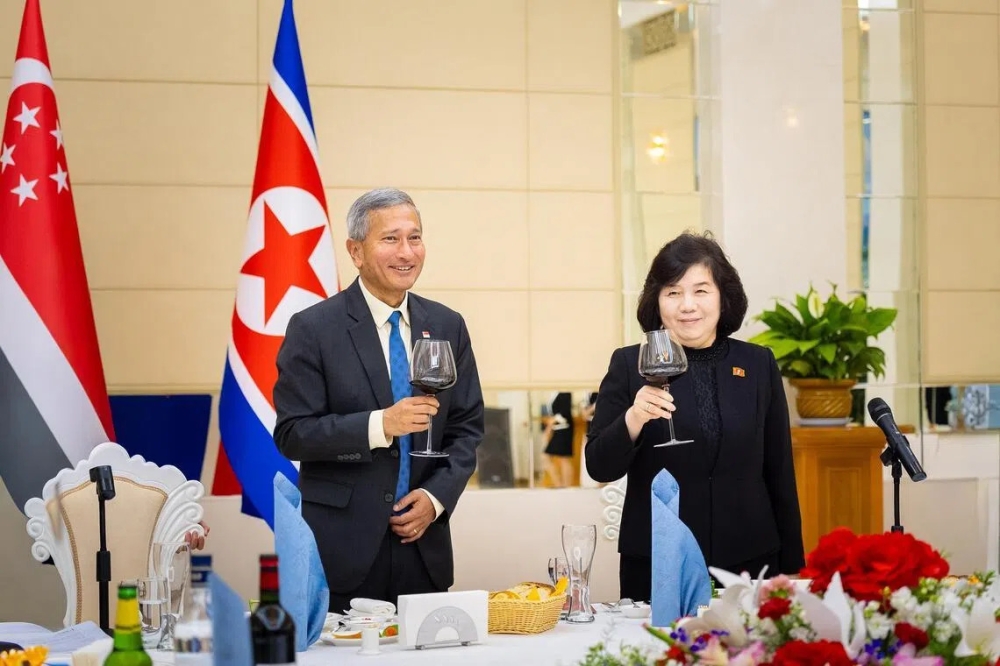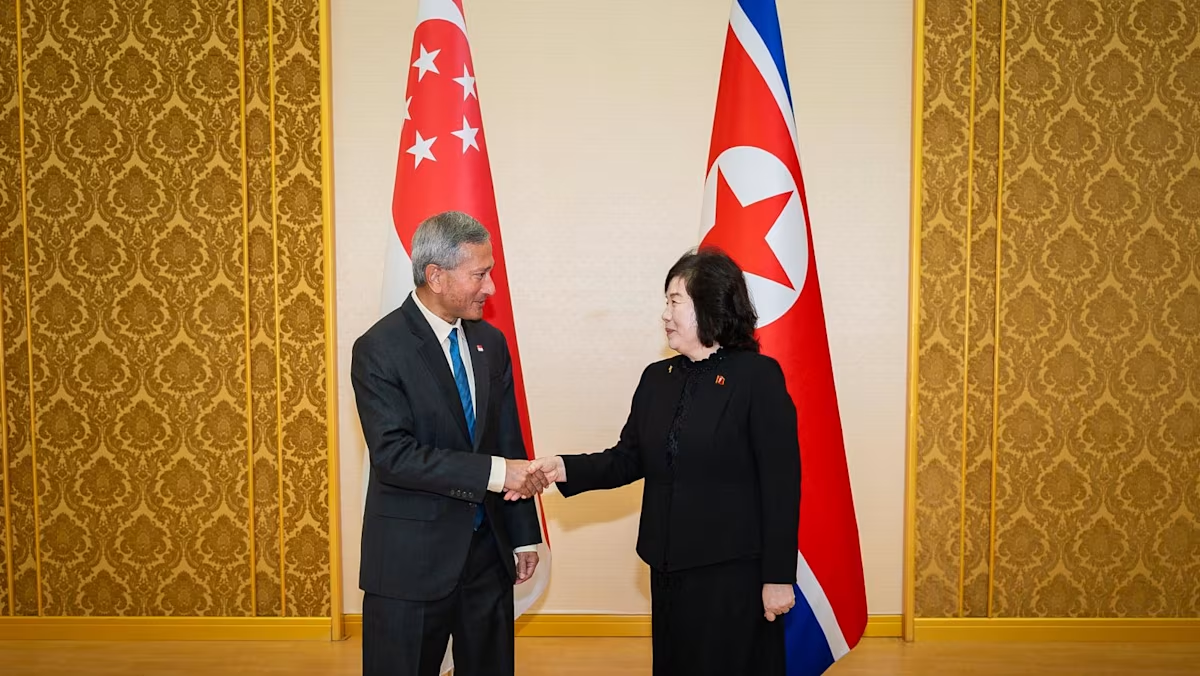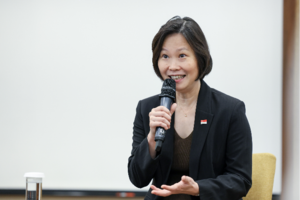
Singapore Minister of State Gan Siow Huang speaks to reporters at the Ministry of Foreign Affairs in Singapore on Thursday. (ASEAN-Korea Center) SINGAPORE — Singapore is willing to contribut to maintaining peace and stability in Asia, including facilitating dialogue with North Korea, but resumption of talks depend on broader geopolitical dynamics, a senior Singaporean official said.Speaking to a group of Korean reporters Thursday at Singapore's Ministry of Foreign Affairs, Singapore Minister of State Gan Siow Huang reflected on Singapore's role as host of the historic 2018 summit between US President Donald Trump — during his first term — and North Korean leader Kim Jong-un while discussing prospects for future diplomacy on the Korean Peninsula.The interview was arranged through a media exchange program organized by the ASEAN-Korea Center, an intergovernmental organization established to promote cooperation and exchanges between South Korea and the 10 ASEAN member states."Our hope is that there will always be channels for dialogue and that there will be peace and stability in the region. We want to do our part as much as possible to facilitate that," Gan said.She stressed, however, that the prospects for another summit or renewed negotiations cannot be viewed solely through the lens of US-North Korea relations."The relationship is a complex one," she said. "Whether such meetings and dialogue could happen again depends on other factors too."Gan pointed to North Korea's growing ties with Russia and China, as well as the broader relationship between Washington and Beijing, as important variables shaping the diplomatic environment."The relationship between the DPRK and Russia, the DPRK and China, and the US' relationships with these countries will all play a part," she said, referring to North Korea by the abbreviation of its official name, the Democratic People's Republic of Korea.Singapore hosted the first-ever summit between a sitting US president and a North Korean leader in June 2018, when Trump and Kim met in the city-state and signed a joint statement committing to establish new bilateral relations, build a peace regime on the Korean Peninsula and work toward the denuclearization of the peninsula.The summit was followed by a second Trump-Kim meeting in Hanoi in 2019, but negotiations collapsed without an agreement over disagreements on the scope of North Korea's denuclearization and corresponding sanctions relief.Since then, Pyongyang has accelerated its nuclear and missile programs while dramatically deepening strategic ties with Russia through military cooperation and expanding political and economic engagement with China. Singapore Minister of State Gan Siow Huang speaks to reporters at the Ministry of Foreign Affairs in Singapore on Thursday. (ASEAN-Korea Center) Gan, who was serving in the Republic of Singapore Air Force at the time, recalled personally receiving Trump when Air Force One landed at Singapore's Paya Lebar Air Base."Singapore was very honored to be able to host that historic meeting," she said, adding that the city-state was chosen because it was regarded as a neutral and safe place.The remarks come as speculation continues over whether the Trump administration could seek to revive direct diplomacy with Pyongyang following Trump's return to the White House last year.Beyond security issues, Gan said South Korea and Singapore should continue expanding cooperation under their strategic partnership, particularly in semiconductors, artificial intelligence and energy.Calling the two countries "like-minded," she said they share a commitment to an open, rules-based trading system despite growing disruptions to global trade."We hope the strategic partnership allows us to lower barriers to trade and open doors for more collaboration in semiconductors, AI, energy and people-to-people exchanges," she said.Gan also encouraged South Korea to play a larger role in the ASEAN Power Grid initiative, saying Korean companies could contribute technology and investment to Southeast Asia's regional electricity network.She also noted that bilateral merchandise trade between Singapore and South Korea had grown 11 percent annually in the past five years, reaching over 70 billion Singapore dollars ($55 billion) in 2025.On civilian nuclear energy, however, she emphasized that Singapore remains at an early stage of evaluation and has yet to decide whether to introduce nuclear power, including small modular reactors."We are really at step zero," Gan said, referring to Singapore's decision to undergo the International Atomic Energy Agency's Integrated Nuclear Infrastructure Review Phase 1 Mission, an assessment designed to help countries determine whether they can make an informed decision on nuclear energy. She said Seoul's experience in nuclear power could help Singapore better understand the feasibility and safety of SMRs before making any future decision.During Lee's state visit to Singapore in March, the two countries signed a memorandum of understanding on cooperation in small modular reactors between Singapore's Energy Market Authority and Korea Hydro & Nuclear Power.The agreement established a framework for joint studies on the potential deployment of SMRs in Singapore, workforce training and capability building, and the sharing of technical expertise and best practices in advanced nuclear technologies. It marked the first civil nuclear energy cooperation agreement between a South Korean nuclear company and a Singapore government agency.Gan, who serves as Singapore's Minister of State for Foreign Affairs and Trade and Industry, previously spent more than three decades in the Republic of Singapore Air Force, becoming the first woman to attain the rank of brigadier general in the Singapore Armed Forces before entering politics. She now also serves as the member of parliament for Marymount Single Member Constituency.
Revival of US-North Korea dialogue hinges on broader geopolitical shifts, says senior Singapore official
SINGAPORE — Singapore is willing to contribut to maintaining peace and stability in Asia, including facilitating dialogue with North Korea, but resumption of ta
879 words~4 min read