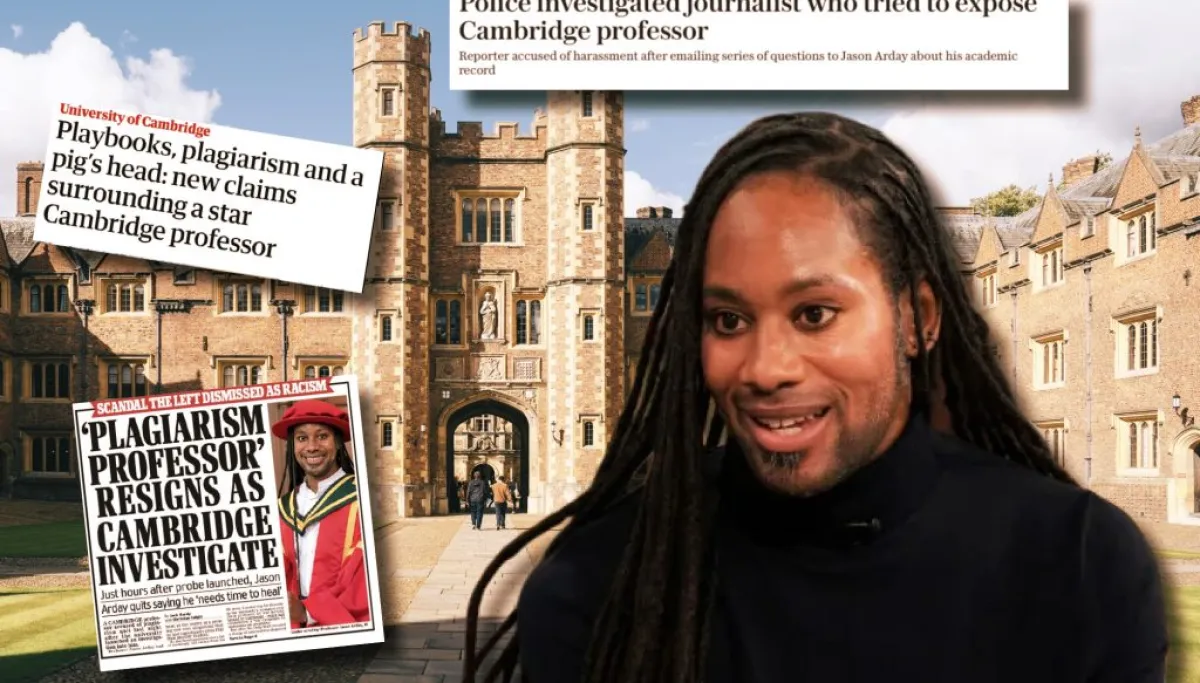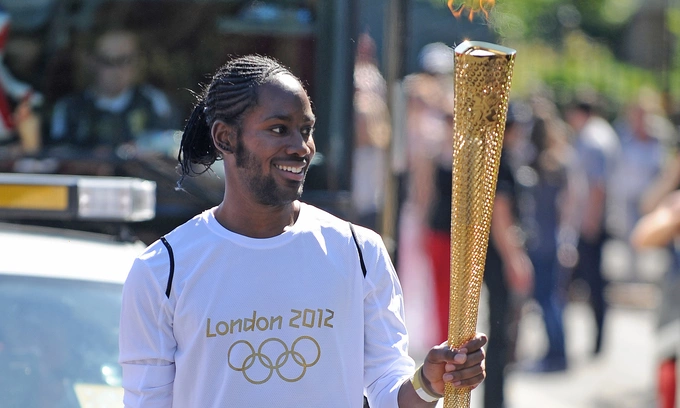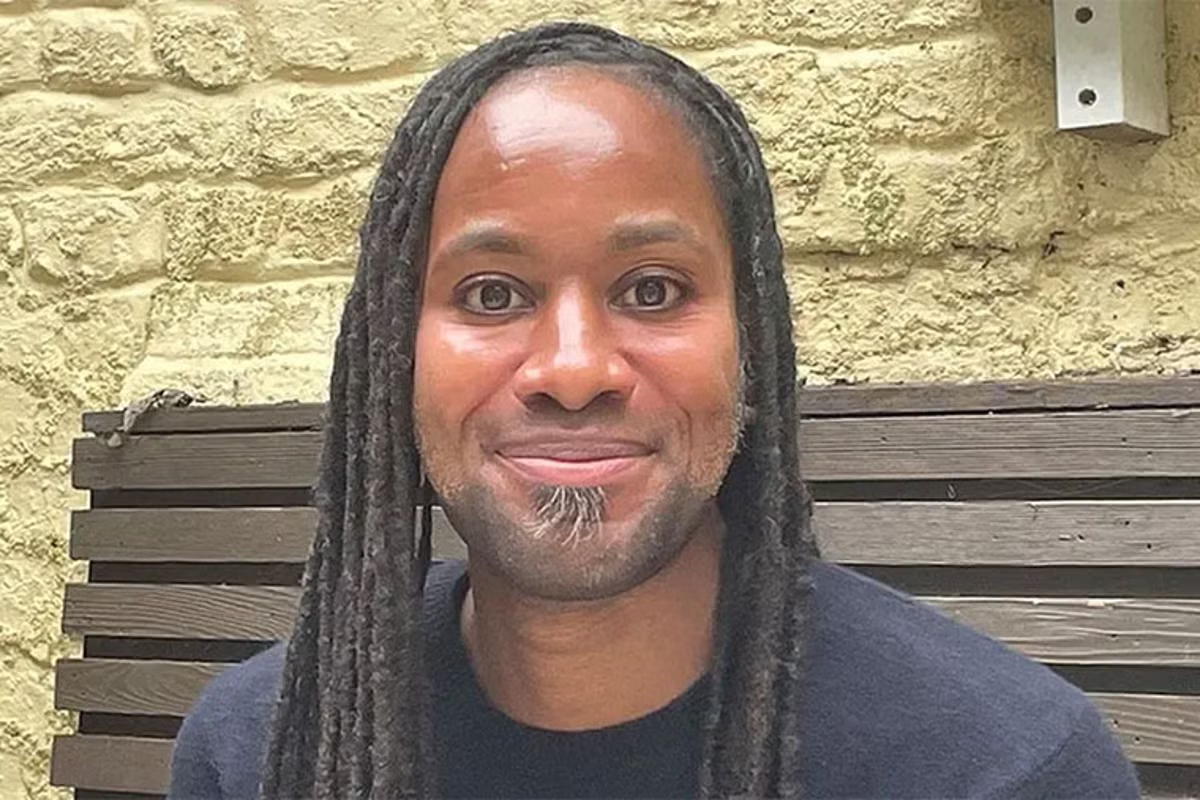
A series of incredible claims made by a Cambridge professor have come under scrutiny after he resigned while being investigated for plagiarism.Jason Arday, 37, made headlines when the venerable UK university appointed him as its youngest black professor in 2023.It seemed a fairytale story, made all the more astonishing by Prof Arday’s stated background.Diagnosed with autism and developmental delays as a toddler, he said he didn’t fully speak until the age of 11, and learned to read and write only as an adult.Critics have since closely examined his academic record and achievements, claiming he was hired as a “poster boy” to address the university’s perceived diversity issues, while defenders have argued that attention on his career is motivated by racism.The controversy initially centred on Prof Arday’s doctoral thesis, which allegedly contained similar or identical passages to other academic works.The furore was made worse when a journalist looking into the plagiarism claims was investigated by the Metropolitan Police and told not to contact Prof Arday — an incident the force has since admitted was a mistake. The many claims of Jason ArdayQuestions surfaced about other aspects of Prof Arday’s backstory, too, such as his claim that he had run 600 miles (970 kilometres) in six days — a feat reserved for record-breaking ultra-runners — and had personally raised £5.5 million ($10.5 million) for charity.Prof Arday later clarified that the 600 miles had been completed over a period of 12 days, not six, and that the fundraising was done as “part of a syndicate of about 100 people” that he couldn’t name for legal reasons.He also said he had once run 30 marathons in 35 days, despite suffering a seizure and a hairline fracture in his leg on the 20th day. Other stories he had told in the past also seemed to unravel — such as his complaint that he had been threatened by a masked man at knifepoint at the university since his appointment, and that a pig’s head had been sent to his parents’ home, prompting a police investigation.The Guardian wasn’t able to find any evidence for those two claims, and the Metropolitan Police told the outlet that no investigation into a pig’s head had taken place. Australia entered the discourse, too, when a viral clip showed the professor telling his students that he loved Home and Away and Neighbours, but saw them differently when he became a sociologist and realised they lacked diversity. “You think, ‘OK well, Australia has an Indigenous population, the first islanders. How come none of them are present in this utopia that’s Summer Bay?’” he said in the lecture.Another widely-shared video from 2023 showed an enthusiastic Professor Hilary Cremin, the head of Cambridge University’s Faculty of Education, clasping Prof Arday’s hands and warmly welcoming him, saying, “We are so lucky to have you”.Arday vows ‘I will return’Cambridge initially stood by Prof Arday amid the accusations of plagiarism, but opened its inquiry into his record this week.“The University of Cambridge has begun an investigation following new information about Professor Arday’s qualifications and honorary appointments,” the university said in a statement. “In order to ensure a fair process, we will not comment further until this has concluded.”Speaking to the Times of London last week, Prof Arday denied plagiarism but admitted to some “mistakes” in his work, arguing he was being wrongly “portrayed to be a liar and a fantasist and an academic fraud”.He also alleged the “campaign to unseat me from my position” was “racially motivated”.Prof Arday resigned shortly after the Cambridge probe had commenced, saying in a statement that the “relentless accusations, speculation and public commentary have taken a profound toll on me and on those I love”.“To become the youngest Black professor in the University’s history was something I could scarcely have imagined as a child growing up with a diagnosis of autism, unable to speak until I was eleven years old,” the statement said.“Sadly, the years since my appointment have also been marked by an unrelenting level of public scrutiny and personal attack. “While criticism is an inevitable part of academic life, what I have experienced has gone far beyond scholarly disagreement.”Prof Arday concluded that this was “not the end of my work”. “It is simply the end of this chapter. I need time to heal. I need time to simply be myself again. And when that time comes, I will return.”Simon & Schuster’s UK publishing arm is set to release Prof Arday’s memoir Great and Unfortunate Things, with the publisher reiterating this week that it was “proud to publish” his story.Prof Arday claimed he was paid “1.4 million” for the book — whether in pounds or US dollars wasn’t clear — but the publisher has declined to confirm the figure. The Atlantic obtained an advance copy and Mr Arday’s original book proposal and, comparing the two, found several inconsistencies. In the proposal, Prof Arday described being hit by a car and left in a coma with locked-in syndrome while he was a teenager. He then “miraculously” awoke from the coma after several months; an episode that never appeared in the book.A bout of testicular cancer mentioned in the proposal was also left out, although the book described Prof Arday as having survived two brain tumours.
Humiliated woke professor slams Aussie TV
A series of incredible claims made by a Cambridge professor have come under scrutiny after he resigned while being investigated for plagiarism.
872 words~4 min read