RBI: The right ‘interest’call
| Photo Credit:
Galeanu Mihai
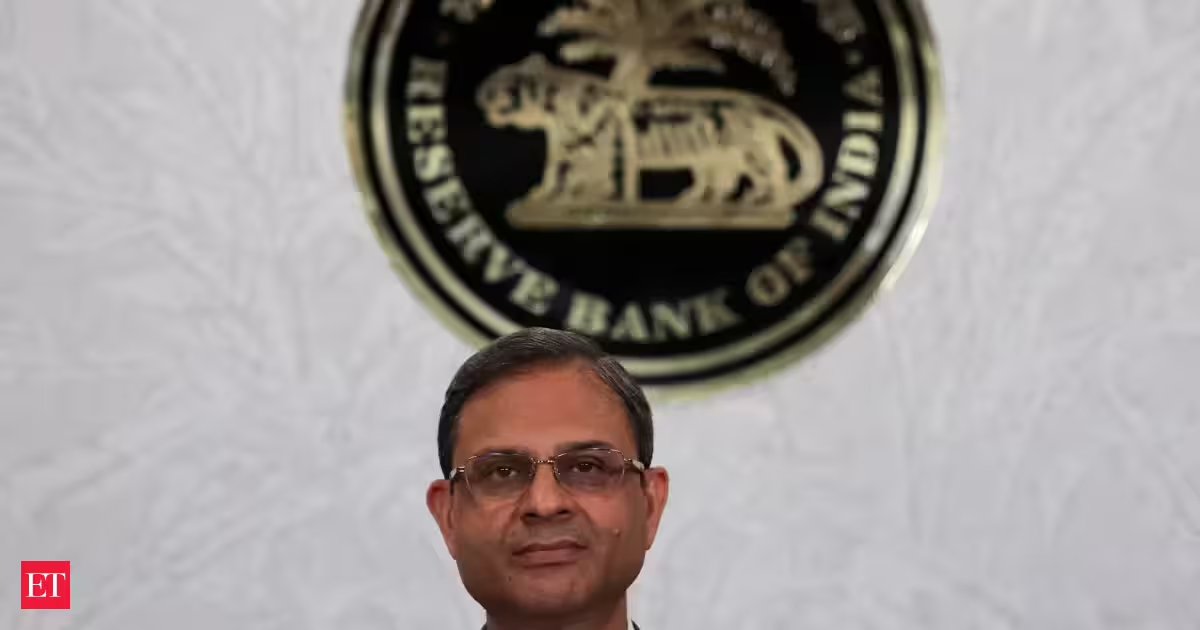
The Reserve Bank of India’s move to harmonise the interest rate framework on advances across all regulated entities — announced by Governor Sanjay Malhotra on August 5 — is a welcome step towards transparency and consumer protection.Notably, the Governor clarified that the proposal will not force Non-Banking Financial Companies (NBFCs) to adopt the external benchmark-linked lending rate (EBLR) regime used by banks; the immediate intent is narrower — standardising operational practices such as day-count conventions and benchmark reset dates.Prudent measureThis restraint is prudent. But as the RBI drafts its final directions for public comment, it must resist any future temptation to extend uniform benchmarking to the NBFC universe, which resists a one-size-fits-all template far more than the banking sector does.Unlike commercial banks, which draw on relatively low-cost Current Account Savings Account (CASA) deposits under uniform regulatory rails, NBFCs are inherently heterogeneous in liability structure. They depend on a mix of bank term loans, commercial paper, non-convertible debentures, and multilateral funding.An upper-layer housing finance company raising long-tenor bonds at competitive rates operates in a wholly different cost environment from a middle-layer microfinance institution or a gold-loan company borrowing short-term from banks. Were asset pricing ever mechanically linked to an external benchmark like the repo rate, a lender whose wholesale funding costs lag or remain fixed would face a genuine Asset-Liability Mismatch the moment yields fall — compressing Net Interest Margins precisely when the sector can least absorb it.Varying risksSecond, the diversity of asset classes drives risk-based pricing, which is the lifeblood of non-bank lending. A loan secured against gold carries a fundamentally different risk weight, cost structure, and recovery profile from unsecured credit to informal micro-enterprises or long-gestation infrastructure funding. This pricing flexibility is what allows NBFCs to serve unbanked and subprime borrowers that banks routinely bypass. Any future move towards rigid reset timelines or benchmark caps, however well-intentioned, risks choking credit flow to exactly these vulnerable segments.Third, accounting variations under Ind AS complicate comparability further. Differing Expected Credit Loss provisioning models, derecognition treatment on securitised assets, and divergent fee-income recognition policies mean headline profitability across two NBFCs can be deceptive. Comparing a vehicle financier with a tech-led digital lending platform on raw financial statements is comparing apples with oranges.The RBI’s calibrated approach so far — harmonising operational conventions without forcing EBLR adoption — strikes the right balance. As it finalises its draft directions, the final framework should stay differentiated by regulatory layer, asset class, and liability profile, with adequate spread flexibility preserved. Transparency and consumer protection are essential goals, but they must be pursued without undermining the structural viability of a sector that reaches borrowers banks cannot.The writer is a retired senior finance professionalPublished on August 7, 2026