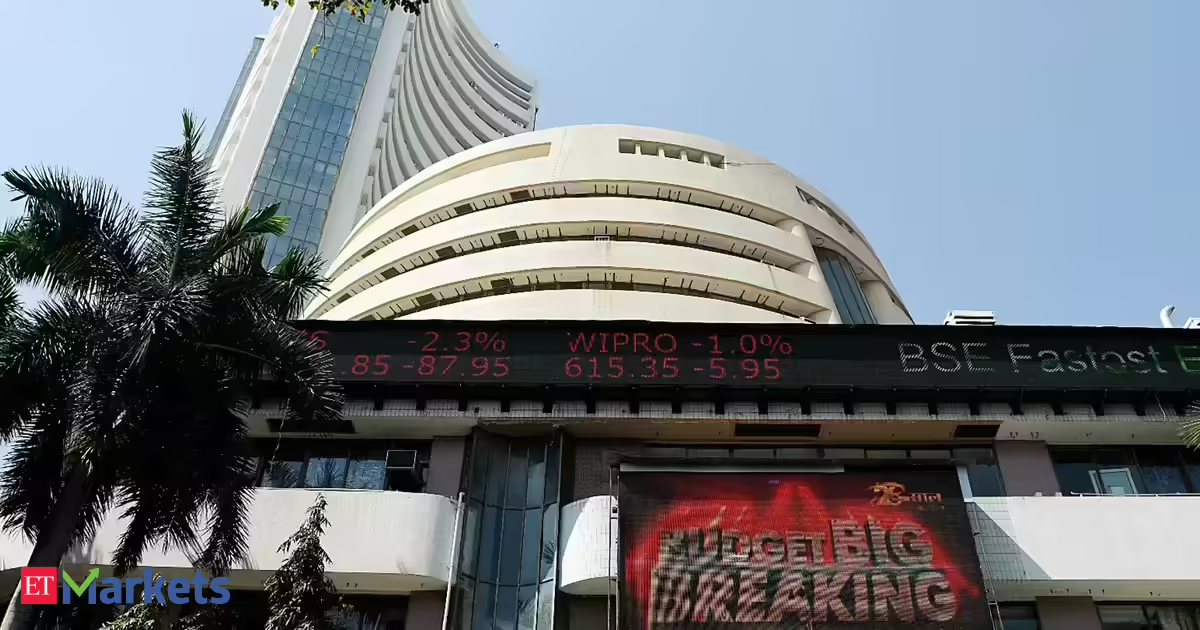
Mumbai: The BSE benchmark Sensex's first weekly expiry since the implementation of the new closing auction session saw spurts in the index like the moves seen in its peer Nifty over the past three days, though the magnitude was lower.Market participants said that while unusual moves continued to dominate, these would be the new normal until liquidity improves.On Thursday, the Sensex ended at the day's high of 78,954.76, up 0.48% over Wednesday, while the Nifty closed almost flat. Nifty was up as much as 0.2% earlier in the day.Read more: Most active funds beat benchmark indices last year: Motilal Oswal Study"Once again on Sensex expiry, we saw virtually no decay in options premiums," said Samir Doshi, CEO, Marwadi Shares and Finance. "Sensex options witnessed an unusual spike in implied volatility to 41-42% during the day, higher than the levels seen during the Jane Street episode, which is an extremely rare occurrence, especially in the absence of any market moving news."Participants had earlier expressed concerns about Sensex's expiry, after the spurt seen in Nifty, because they believed it would be even easier to move the index given its low trading volumes.AgenciesOn Thursday, even after the CAS session began, options premiums remained elevated, said Doshi."We also saw a large order in ICICI Bank, suggesting a clear attempt to influence the index into the close. Meanwhile, cash market volumes in the final half hour were just around ₹120 crore, well below the typical ₹400-500 crore," he said.Chandan Taparia, head, technical and derivatives research, Motilal Oswal Financial Services said that while markets have seen sharp spurts in the indices over the last four sessions, first in the Nifty and now in the Sensex on its expiry day, the magnitude of these moves has been narrowing with each session."The key anomaly, however, continues to be the absence of theta decay in options premiums," said Taparia. "We believe this could become the new normal, given the heightened uncertainty around the CAS session."On Thursday, the 79,000 call premium surged from around ₹100 to ₹330 before collapsing to zero in the final half hour, Taparia said, citing an example of the volatile moves. The new closing auction process lasts about 20 minutes, from 3.15 pm to around 3.35 pm. During this period, the exchange first collects buy and sell orders and then matches them to determine a single official closing price for the stock. Under the previous system, a stock's closing price is based on the average price of trades done in the last 30 minutes, between 3 pm and 3.30 pm."This environment makes life significantly harder for option writers while favouring option buyers," said Taparia. He said, as market liquidity improves, these day-to-day spurts should gradually moderate."Resolving this issue will require broader participation and coordination from mutual funds, market makers, brokers and investors," said Doshi.
Weekly Expiry: Sensex mirrors Nifty's swings, but with milder spurts
The recent weekly expiry of Sensex showcased unexpected surges in the index and heightened options premiums. Traders observe that such fluctuations are now standard until liquidity conditions improve. Notably, substantial implied volatility spikes arose without impactful news. Significant trades in ICICI Bank hinted at efforts to sway the index's trajectory. This market landscape creates challenges for option writers while benefiting buyers.
TL;DRAI
Sensex expiry under new closing auction saw option premiums spike to 41-42% implied volatility with zero decay, signaling liquidity fragmentation. The CAS flaw penalizes option writers; systemic risk requires broader participation to restore normal pricing mechanics.
468 words~2 min read