Point a model at your repositories, ask why something broke, and you get an answer. Coherent, names a mechanism, shows you how it got there. The working is the problem rather than the reassurance. It looks the same whether it ends at a value in a record or at what usually happens, and only one of those is evidence.
I ran the same question at four levels of evidence, on two systems, across three models. The question was never find me a bug. It was always this already happened, work out how. The pass that worries me is the one just short of enough evidence. There is enough there to build a real hypothesis, and not enough to tell a real one from a plausible one. Two of its guesses sent me to look at things I had not checked. One was a dead end. The other was a real problem I had not known about, and nothing in either answer told me which was which.
A good guess costs the same to chase as a real one. You find out which it was at the end.
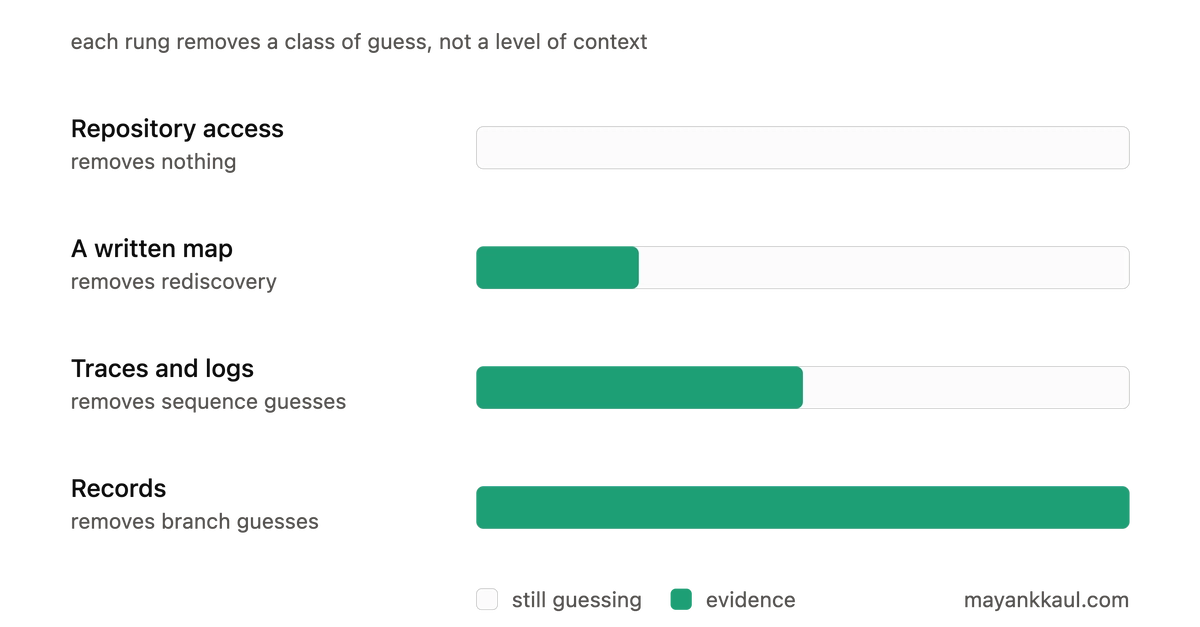
The four rungs, and what each one removes
I stopped thinking about this as adding context. Each rung takes away something the model would otherwise have to guess at, and that is the more useful way to look at it.