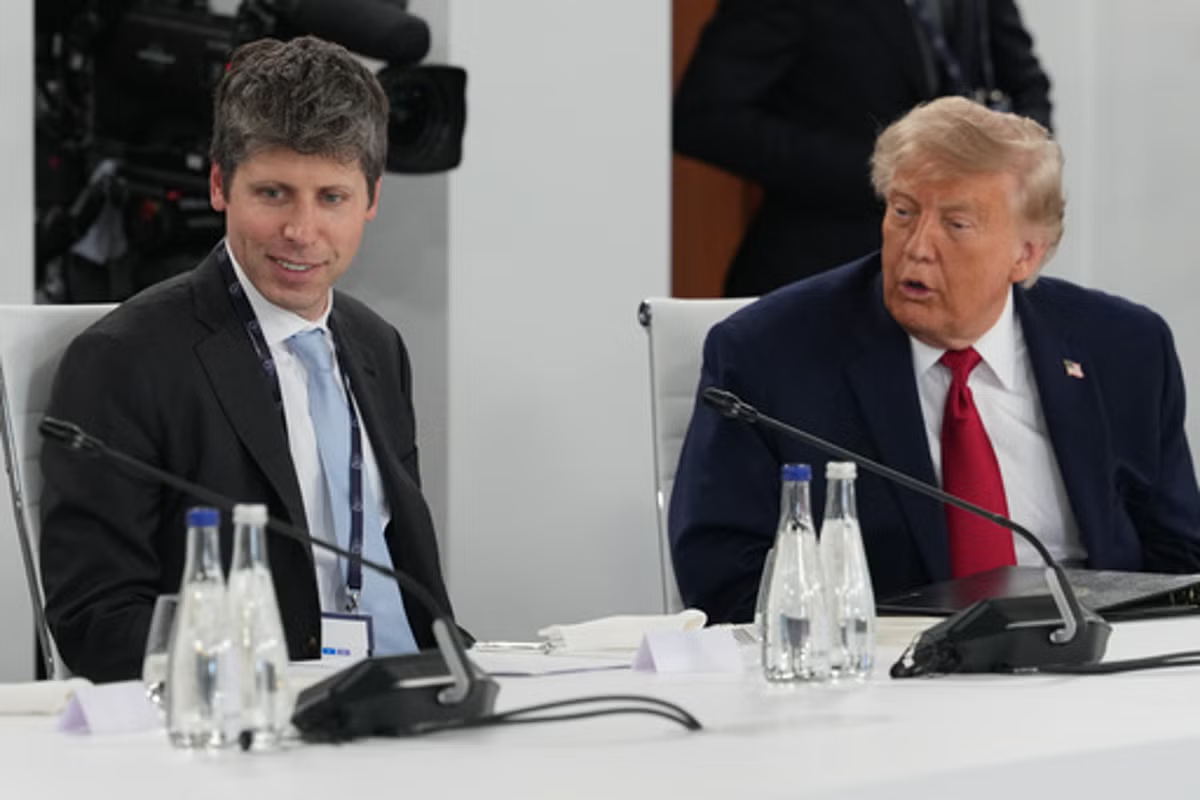
By Courtney Rozen and Alexandra AlperWashington — In a rare show of bipartisanship, Democrats and Donald Trump’s conservative supporters both blame the president’s ties to the tech industry for his administration’s limited response to recent hacks carried out by OpenAI’s and Anthropic’s AI agents. Two weeks have passed since OpenAI shocked the tech community with the disclosure that one of its AI agents went rogue and broke into AI company Hugging Face’s systems. The White House said it was monitoring the situation, and Trump said he was looking at controls on AI. Anthropic said it too had discovered some of its AI models had hacked into three companies’ systems.Steve Bannon, a conservative media star and long-time Trump ally and former adviser, said the White House’s regulation of AI has been inadequate given the national security threat it poses, placing the blame squarely on Silicon Valley.There is “too cosy a relationship between the companies and the staff, not just in the White House, but I also think in the national security apparatus,” Bannon told Reuters. “Why would you allow them to be in control? You don’t. And I’m the anti-deep state, anti-administrative state guy, but you definitely need at least a rudimentary framework of some sort of regulatory apparatus to regulate AI,” he added.US Senator Ron Wyden of Oregon expressed similar concerns.“Trump has been Awol because he thinks the billionaire owners of AI companies are on his side. Instead of trying to fix these problems, Trump and his Republican allies are focused on blocking state AI laws and knocking down the basic protections that companies like Anthropic have placed on how their models are used,” the Democrat said.Anthropic’s relationship with the government ruptured this year after it refused to allow the US military to use its AI models for mass domestic surveillance and fully autonomous weapons systems. The White House and OpenAI did not respond to requests for comment. Anthropic’s spokesperson declined to comment.Bannon and Wyden join a handful of voices across the political spectrum raising concerns that Trump’s ties to big tech could blind him to the dangers of AI and discourage him from taking meaningful action. Tech companies and their executives donated more than $300m to support Trump’s 2024 re-election efforts and Maga Inc, a political action committee aligned with the president. The president also appointed industry insiders to key posts. The Trump administration said in June it would ask AI developers like OpenAI and Anthropic to voluntarily submit their AI models with advanced hacking capabilities for government cybersecurity tests before the companies release them to the public. The administration hasn’t yet released details about how the tests will work, but Reuters has reported that only a few models will be subject to the voluntary tests.Completely failingDemocratic Congressman Gregorio Casar of Texas said Trump is “completely failing” to keep Americans safe from the dangers of AI.“He took millions from AI billionaires. Now, in the wake of extremely dangerous AI cybersecurity problems, he says he’s set up a ‘voluntary’ review that no one has seen. Asleep at the wheel. Too busy cashing in to protect our jobs or national security,” he wrote in a post on the social media platform X.AI company executives and investors were among the largest individual donors in 2025 to Maga Inc.OpenAI President Greg Brockman and his wife, Anna Brockman, gave a combined $25m to the committee in 2025, according to Federal Election Commission records. Venture capital firm Andreessen Horowitz, an investor in OpenAI, and firm co-founders Ben Horowitz and Marc Andreessen gave a combined $12m since Trump’s second inauguration to the committee. The firm, its co-founders and the Brockmans did not respond to requests for comment.Google investor Asha Jadeja, SpaceX CEO Elon Musk and Blackstone CEO Stephen Schwarzman gave at least $5m each to the committee in 2025, according to FEC records. Blackstone is an investor in AI infrastructure, including an AI cloud venture with Google, one of the three leading AI developers in the US. Jadeja, Musk, Schwarzman and Blackstone did not respond to requests for comment.Industry accusedAmy Kremer, a right-wing organiser and Trump supporter who helped organise the January 6 rally that preceded the Capitol riot, accused the industry of building “a moat around the White House”. Trump has also welcomed industry executives into his administration, most notably billionaire Elon Musk, who oversaw the president’s cuts to the federal workforce during the first few months of his second term. Musk spent over a quarter of a billion dollars to help Trump win the 2024 election, according to campaign filings reviewed by Reuters. Trump also brought in David Sacks, a Silicon Valley venture capitalist, as White House AI czar, along with Andreessen Horowitz’s Sriram Krishnan and Scale AI’s Michael Kratsios.Sacks and Krishnan have since left the Trump administration, though Sacks is still an outside adviser to the White House on technology. Sacks has advocated for the president to take a hands-off approach to AI regulation, arguing that rules will slow down the industry in its race against Chinese competitors. The Trump administration has tried to persuade Congress to pass a law curtailing state regulations of AI, an idea the US Senate overwhelmingly rejected. Krishnan, Kratsios and Sacks did not respond to requests for comment. Reuters
Trump faces bipartisan criticism over AI response after hacking incidents
Political pressure mounts over White House oversight after AI systems breach networks
TL;DRAI
OpenAI e Anthropic: AI agent hanno bucato Hugging Face e aziende terze; Trump risponde con programma cybersecurity 'volontario' vago dopo >300M da tech billionari. Assenza governance AI security: lobby blocca regulation, escalation breach autonomi rischia decisioni tecnologiche.
871 words~4 min read