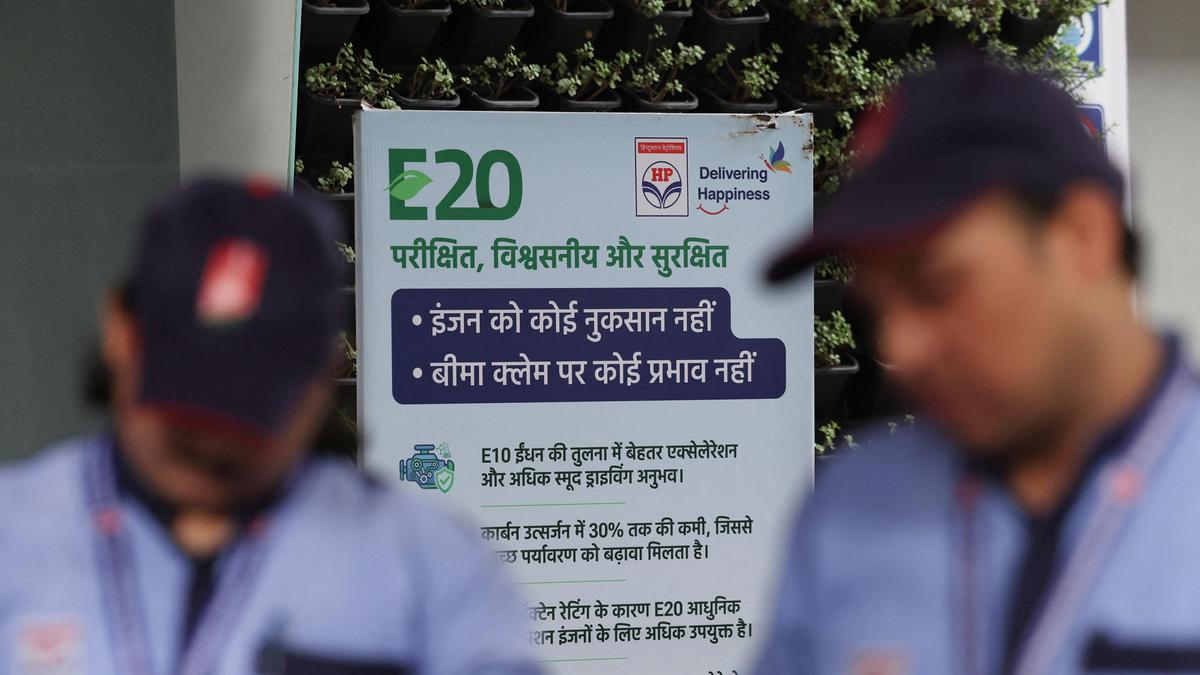
Workers stand near a signboard with information on E20 petrol at a Hindustan Petroleum fuel station in New Delhi,
| Photo Credit:
India has not offered any concessions or commitments to the US on ethanol imports for fuel blending in the ongoing bilateral trade negotiations, the Commerce Department said on Thursday. Further, no ethanol is being imported from the US for use in blending with fuel, it added.“India’s fuel blending programme and ethanol procurement continues to be governed solely by India’s domestic policy requirements,” the statement asserted.Government reiterates domestic sourcing policyThe clarification comes amid controversy over the government’s push to make E20 — petrol blended with 20 per cent ethanol — the default fuel at retail outlets. Opponents have raised concerns about reduced fuel efficiency, potential compatibility issues for older vehicles, and the lack of consumer choice, while the government argues that the transition is necessary to improve energy security and reduce emissions.In its statement, the Commerce Department maintained that any suggestion of a policy change to permit large-scale imports of fuel ethanol from the US was misleading. It refuted news reports that alleged that India was importing, or planned to import, large quantities of ethanol from the US for blending with petrol.“As per the domestic policy framework, ethanol used for fuel blending under the Ethanol Blended with Petrol Programme is sourced entirely from domestic producers. There is no import of ethanol for fuel blending from the US,” it said.Trade talks continue amid evolving US policyThe India-US joint statement on the framework for the interim trade agreement, announced on February 7, 2026, did not include ethanol among the products on which India agreed to work towards tariff reduction or elimination.“India will eliminate or reduce tariffs on all US industrial goods and a wide range of US food and agricultural products, including dried distillers’ grains (DDGs), red sorghum for animal feed, tree nuts, fresh and processed fruit, soybean oil, wine and spirits, and additional products,” the joint statement had said.The two countries continue to negotiate the proposed interim trade agreement. The talks have become more complex after the US Supreme Court struck down the Trump administration’s reciprocal tariffs, following which the Office of the US Trade Representative (USTR) initiated Section 301 investigations into the trade policies of several countries, including India.Published on August 6, 2026