Story audio is generated using AI
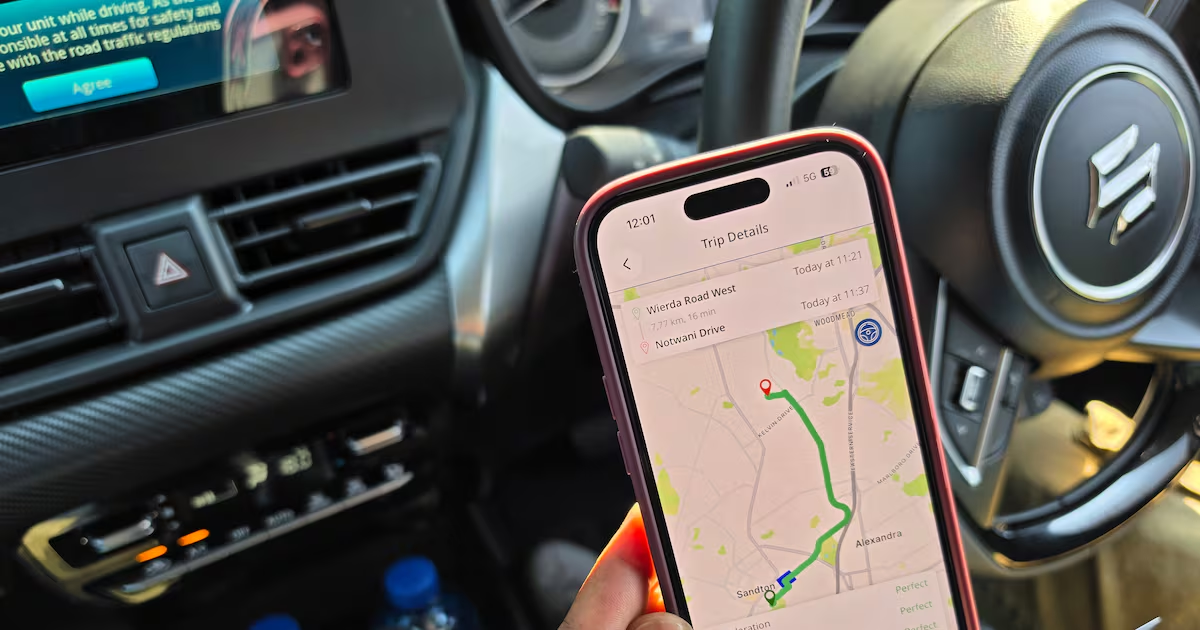
Is it me or are insurance ads everywhere these days? You can’t drive for more than 5km without seeing a billboard. Or watch a YouTube unboxing video without having to hit skip on a promise of lower premiums. No, I haven’t joined the ranks of media personalities urging you to take out a policy. But I did recently attend a Discovery Insure event where the company punted its Vitality Drive offerings for motorists. Part of the company’s package entails a telematics system with an impact alert. It’s cheerfully outlined in a new commercial, which starts off with a guy in an upside-down car very calmly narrating the benefits of Discovery Insure. Certainly not how I imagine I’d react in a car whose wheels were facing the sun. “The best claim is the one that never happened,” said CEO Robert Attwell. “We are for road safety in South Africa, lower loss rates and lower mortality — we are for those who protect what matters most.”My first question to Atwell was: can the information from the telematics system be used to repudiate a claim? We wouldn’t be the fastest-growing short-term insurer in the country if we started losing the trust of our clients by declining claims because of how they drive— Robert Attwell, Discovery Insure CEO“We are firm within our written material that we use telematics data only to confirm time and location of the incident,” he said. “Knowing time and location of an incident enables things like impact alert, which means getting to you faster.“We wouldn’t be the fastest-growing short-term insurer in the country if we started losing the trust of our clients by declining claims because of how they drive.”Attwell couldn’t provide specifics on repudiation statistics for Discovery Insure. “It would be similar to the industry average, there’s no indication that it’s worse or better than anyone else.”Attwell noted that driver behaviour is ultimately the cause of accidents on our roads. Among the interesting slides of the presentation was a section about sleep quality and its effect on driving. The company said quality sleep can reduce accident risks by as much as 36%.Research shows sleep deprivation has an impact on driving competence. (Brenwin Naidu) Part of the day’s activities included a loop around Johannesburg while using the smartphone app tracking driving behaviour. Car people are competitive, so with this in mind, and the knowledge that “big brother is watching” via smartphone app, we set off determined to be as smooth as possible. My take is that being a good driver isn’t solely about handling a car at the limit (that kind of thing is important in the right environment of course). It’s really about: having the good sense to drive according to road conditions;being prudent with speed limits;being aware of other vehicles;being steady in modulation of the controls; andstaying focused on the task of driving, avoiding distraction.Abrupt braking is detected by the app, as is hard acceleration and cornering. Oh, each time you handle your phone, it knows that too.The first leg of the trip was from Discovery’s shiny head office (ah, so that’s where those escalating medical aid premiums go) to a location in Gallo Manor to see the company’s Pothole Patrol in action. We put the system to the test in a range of Suzuki Fronx models. (Brenwin Naidu) Believe it or not, the score was perfect after that short leg of nearly 8km. Acceleration, braking, cornering, speeding and cellphone use — the headings under the app — were all recorded as perfect (and in green font).Truth be told, you have to drive in exaggeratedly smooth fashion to achieve that. Ideally that’s how we all should drive — finessing the brakes and using one-toe operation of the accelerator. But in the real world, when you sit 10km/h or 15km/h under any prescribed speed limit, you’ll have a very aggravated person in a Toyota Avanza sitting on your rear bumper, even if it’s the left lane you’re occupying. There’s a section on the app that lets you pick whether you’re driving or are a passenger. Apparently you need to remember to check “passenger” if you decide to use an e-hailing vehicle or ride passenger with a friend, otherwise it will track you based on their styles. And that discovery led us to another learning: the company has different Vitality Drive tiers.Within the first month of joining the Vitality Drive programme, Discovery Insure clients reduce their accident risk by 15%. They also experience a 57% lower road fatality rate than the South African average— Eddie Maluleke, media relations manager We were using the basic “phone-only” monitoring system (less accurate because it uses the phone only, not the phone in addition to a monitoring system installed on the vehicle). My colleague and I were running our phones (Honor 90 Lite and iPhone 16) simultaneously on the drive back. And bizarrely, they registered two different ratings for the same drive. Media relations manager Eddie Maluleke said logistical reasons meant the phone-only option had to be showcased. “While our ideal setup combines the telematics device with the app, we were sourcing vehicles from multiple PR fleets and it wasn’t practical to install telematics devices in them,” she said.Data from one phone used during our drive didn't match with another phone running the same app simultaneously. (Brenwin Naidu) “The purpose of the day was to showcase the broader Discovery Insure experience rather than the app itself. Had the focus been specifically on the app experience, we would have used the appropriate setup to demonstrate that.” According to Maluleke, fewer than 1% of Discovery Insure’s clients use the phone-only option. “The Vitality Drive programme has consistently demonstrated that changing behaviour delivers measurable improvements in road safety. Within the first month of joining the Vitality Drive programme, Discovery Insure clients reduce their accident risk by 15%. They also experience a 57% lower road fatality rate than the South African average.”“Discovery Insure’s safest drivers (those who consistently reach Diamond and Gold status on the Vitality Drive programme) experience almost 50% fewer accidents and close to 40% lower accident severity than average drivers.”Discovery head of technical marketing Saqib Hossain said the phone-only offering was part of the Vitality Drive with the Core plan. “Many sensors on the phone help in determining driving behaviour. In a phone-only based programme, a key one is the phone’s gyroscope to determine the device’s orientation relative to the vehicle,” said Hossain. The moral of the story? Yes, the presence of a telematics monitor can influence your driving style, most likely for the better, prompting extra mindfulness — but remember to scrutinise those terms and conditions“Some smartphones do not have a gyroscope. Without this hardware, the app cannot determine the phone’s orientation as precisely, which reduces the accuracy of detected driving events. “How the phone is used during a journey can also affect the results. If it is repeatedly picked up, rotated or repositioned, the app may temporarily lose track of its orientation relative to the vehicle, independent of whether the phone has a gyroscope or not.“In this instance, rather than incorrectly recording driving events, the app waits until it has confidently re-established the phone’s position before scoring events during the trip — it can still record phone usage while driving in this mode though.” “The full Vitality Drive programme combines data from both the mobile app and an in-vehicle sensor, providing a more robust, reliable and consistent view of driving behaviour.”It will cost you more, however.The moral of the story? Yes, the presence of a telematics monitor can influence your driving style, most likely for the better, prompting extra mindfulness, but remember to scrutinise those terms and conditions.Ideally not from an upside-down car.