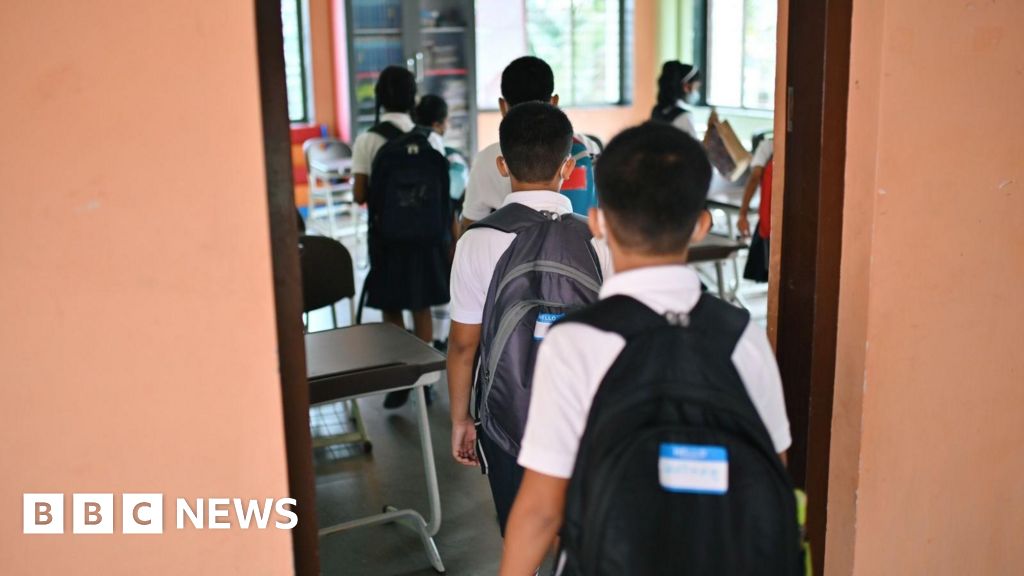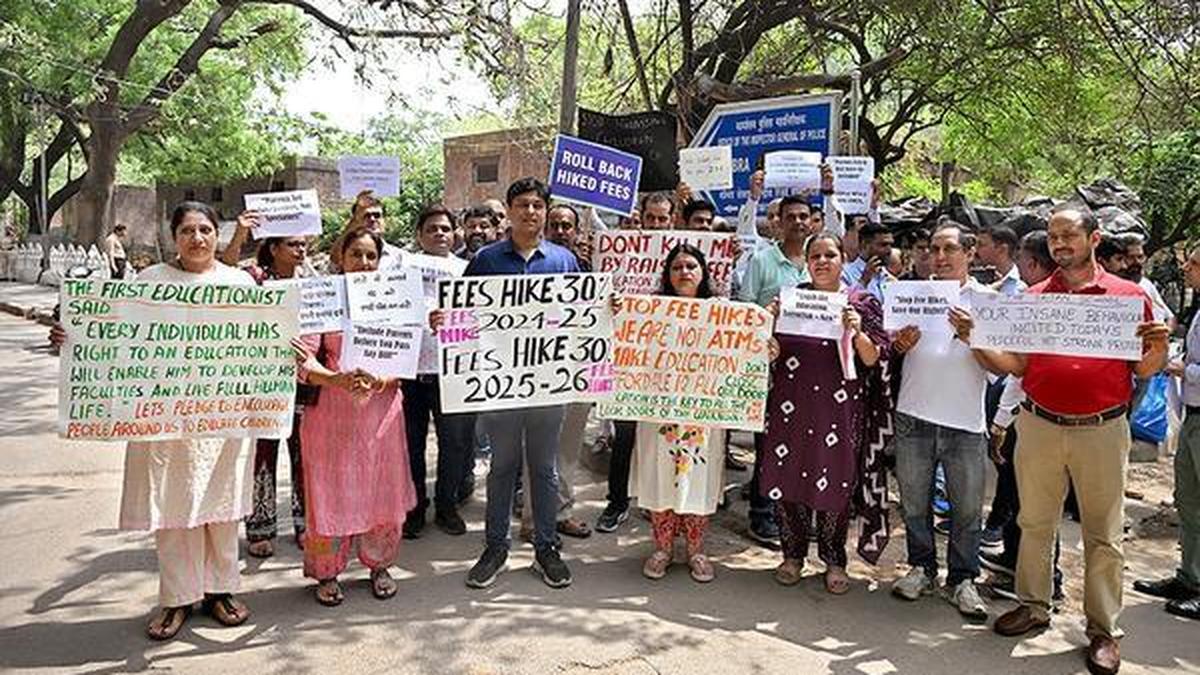
On April 24, 2026, Neelam Verma walked into a private school in Hardoi, Uttar Pradesh, to query a ₹1,300 fee her daughter’s school was demanding. She left humiliated. The school’s principal was caught on video screaming “shut up” at Ms. Verma no fewer than ten times, calling her a “bloody fool” and “gawar” (illiterate) and threatening to strike her daughter’s name from the register. The clip spread across X in hours. An FIR was eventually lodged under the Bharatiya Nyaya Sanhita and the SC/ST Act, and she was barred from entering the school pending an investigation.(Sign up for THEdge, The Hindu’s weekly education newsletter.)The Hardoi incident is not a story about one principal’s temper. It is an unscripted illustration of the power asymmetry at the core of India’s private school economy, where parents are structurally captive, fees are functionally unregulated, and there is no recourse available. This followed, Delhi’s Chief Minister issuing a stern warning against the “single-vendor diktat” through which private schools force parents to buy books and uniforms from designated shops at marked-up prices, and with the Delhi High Court judgment on May 22, fundamentally reshaping the architecture of fee regulation, which shows that this is not a problem of bad apples. It is a systemic failure.Numbers behind the angerA 2025 national survey by LocalCircles, covering parents across 301 districts, found that 81% of parents with children in private schools had experienced a fee hike exceeding 10% in a single year. Forty-four percent reported hikes between 50% and 80% between 2022 and 2025. The report also found that 93% of surveyed parents believed their state governments had failed to effectively curb excessive fee hikes by schools. In Delhi, parents of students at DPS Dwarka protested outside the school and the Directorate of Education (DoE) after fees were raised by amounts that, according to parent groups, pushed annual costs beyond ₹1.5 lakh for primary education.These are not protests about luxury. The scale of the burden is evident from the NSS Comprehensive Modular Survey on Education, 2025, which found that the average per-student expenditure in non-government schools stands at ₹25,002 annually, nearly nine times the ₹2,863 spent in government schools. In urban areas, course fees alone average ₹15,143 per student per year, with textbooks and stationery adding another ₹2,002, before other charges. The same survey notes that 95.7% of students in private unaided schools pay course fees, and that 95% of school education is funded entirely by other household members, with government scholarships covering just 1.2%. These are not abstractions but the economic realities. Fee hikes are forcing families into debt or out of private schools entirely, and they are happening against a backdrop of almost complete legal incoherence.Courtroom in every directionConsider the extraordinary regulatory situation Delhi finds itself in right now. The judgment pronounced by the Delhi High Court just a few days ago in DPS v. Government of Delhi, holding that private unaided schools do not need prior approval from the DoE to raise fees at the start of a session, but if increased mid-session, approval is required. The DoE’s habit of sitting on fee proposals, some dating to 2016-17, was ruled a “misconceived exercise”. The judgment is legally sound: Section 17(3) of the Delhi School Education Act, 1973 requires only a filed statement of proposed fees, not prior sanction.But here is the irony the judgment does not address: Delhi’s government had, in 2025, already passed the Delhi School Education (Transparency in Fixation and Regulation of Fees) Act, 2025, which created School-Level Fee Regulation Committees (SLFRCs) comprising parents, teachers, and a DoE observer, designed to approve or reject fee proposals for three-year blocks. Over 800 private schools challenged this Act in the Delhi High Court. The High Court refused a full stay in January 2026, but the Supreme Court subsequently ensured the law would not apply to the 2025-26 academic session. So, the pre-existing regulatory regime (DoE prior approval) has been judicially invalidated. The replacement regime (SLFRCs under the 2025 Act) is under challenge. And the parents are standing in a school courtyard with no law that actually protects them.What the law simply does not coverThe conversation about fees almost always focuses on tuition, but tuition is only part of the story. The vendor-capture racket, in which schools designate a single shop for books, stationery, and uniforms at prices well above market, has required repeated executive interventions, and there is no central legal provision explicitly making it unlawful. Development fees, building funds, ‘voluntary’ contributions, annual charges, and transport fees operate in a near-total legal vacuum. The Right to Education Act, 2009, is wholly silent on fees in private unaided schools. It mandates 25% EWS reservation under Section 12(1)(c) but leaves the other 75% entirely to market forces and state legislation, which varies wildly. Parliament has legislated in detail on higher education, on medical admissions, on coaching institutes, but has produced no national framework for what a school may charge a child in Class 3.Exit, voice, and no loyalty leftAlbert Hirschman’s framework that consumers in a failing market have three options: “exit, voice, or loyalty” maps with uncomfortable precision onto India’s private school situation. Exit is difficult: for lower-middle-class families, transferring schools means disrupting social networks, losing academic years, and often entering a government school system that decades of state neglect have made the option of last resort. Voice: the democratic channel has been systematically blocked. As the Hardoi incident demonstrates, a parent who raises her voice is told to shut up; in schools across Delhi, students are reportedly barred from class over unpaid fees. The United Parents’ Voice memorandum sat unread for weeks. What remains is a forced loyalty pay or lose your child’s seat, which is not loyalty at all but captivity.This is not just a regulatory failure but a story of what happens when the state progressively retreats from public education. India has hovered around 3.1-4.6% of GDP for education spending for two decades, well short of the 6% recommendation, a goal that every major policy document since the Kothari Commission has endorsed. Then it watches the private sector fill the vacuum without building the institutional infrastructure to discipline it.What regulation must actually look likeThe lesson of Delhi’s regulatory carousel is that India has been trapped in a binary: either the state controls every fee revision (which courts correctly find overbroad and often legally unauthorised), or schools control everything (which produces incidents like Hardoi). Neither is constitutionally mandated, nor does it work. A workable framework must abandon both poles.Three interventions are necessary. Parliament should amend the RTE Act to define “fees” comprehensively, including development funds, vendor-linked material costs, and transport, and mandate uniform public disclosure of audited accounts in standardised formats. Transparency, not prior approval, should be the regulatory default. An Education Cost Index should be in place, linking permissible annual hikes to an audited basket of real input costs: teacher salary revisions, infrastructure maintenance, and utilities, replacing ad hoc judicial tests of “profiteering.” Lastly, a permanent, independent fee ombudsman, not the same directorate that both regulates and, as Delhi demonstrated, ignores proposals for years, must be constituted with time-bound adjudication powers, accessible by individual parents.(Yashweer Singh,Penultimate Year B.Sc. LL.B. (Hons.) Student, Gujarat National Law University, Gandhinagar)
Why parents feel trapped by private schools
Explore the systemic challenges parents face in India's private school sector, highlighting fee hikes and regulatory failures.
1,201 words~5 min read