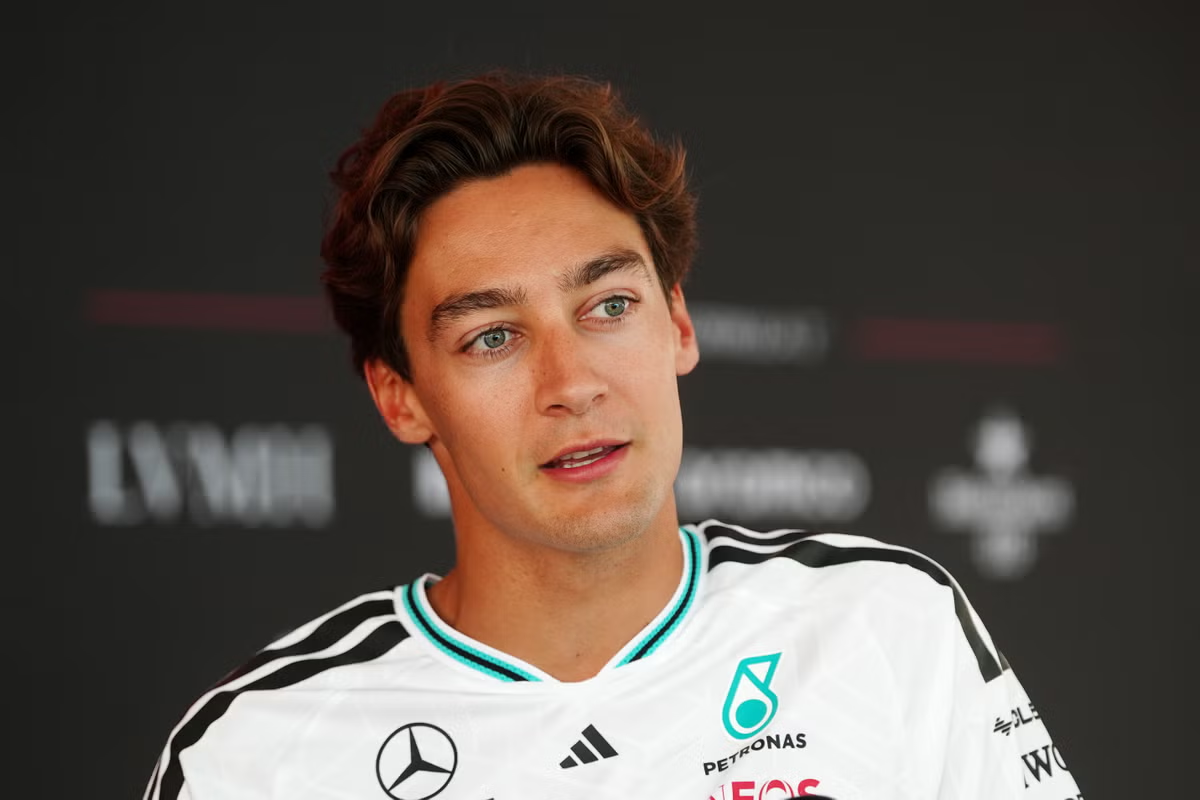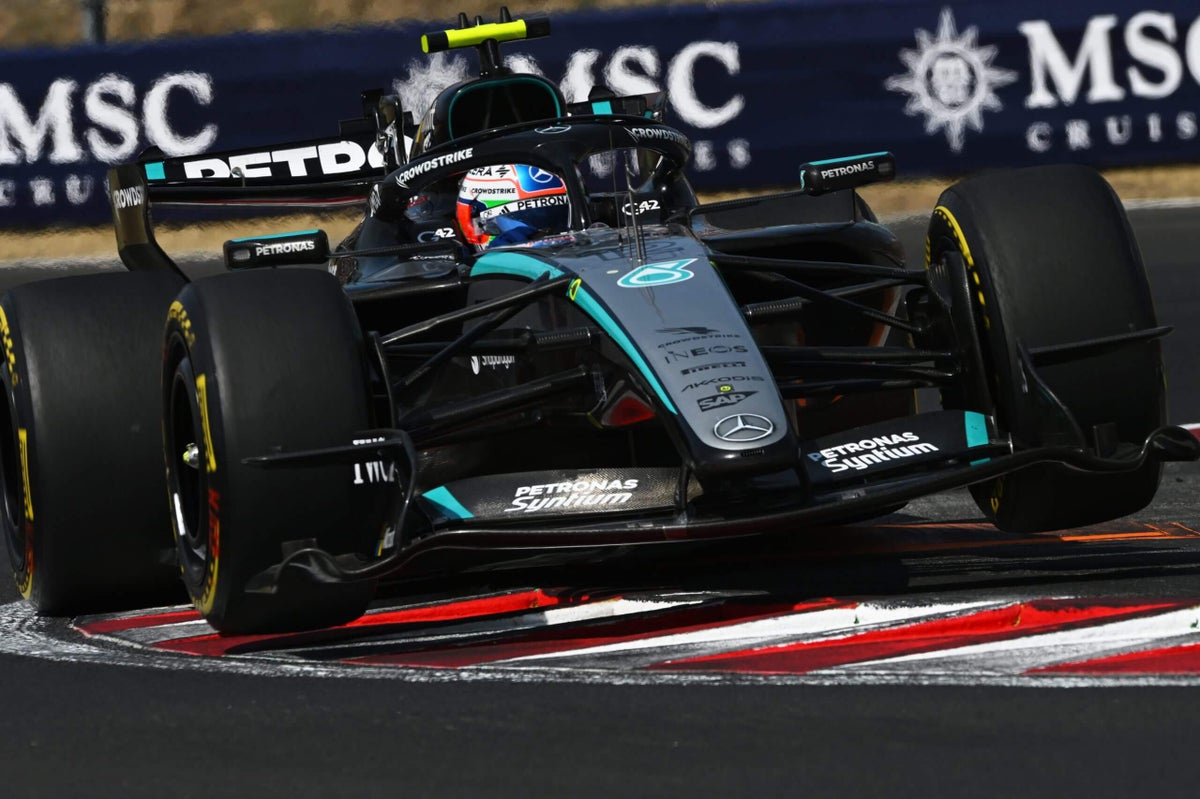
After his sterling performance to win the Belgian Grand Prix last month, Kimi Antonelli was firmly back in control of the Formula 1 drivers’ championship.The 19-year-old had been on another level compared to the other contenders throughout the race weekend at Spa and, with his main title rival (and Mercedes teammate), George Russell, being spun out on the race’s opening lap, the buffer between them was back out to 50 points.But when Antonelli saw his father, Marco, afterwards, he already knew what he was going to hear.“He said, ‘Congrats, but…’ — always a but!” Antonelli recalled with a smirk, “‘… if I see you doing another track limits for nothing, I’m going to stretch your neck like a chicken!’”Antonelli laughed as he recalled his dad’s hyperbolic words in Hungary a few days later, but understood there was a serious point behind it all. Because a weakness around track limits has been the only flaw in the young Italian’s impressive 2026 campaign.“It’s something I definitely need to work on,” he said.In just his second F1 season, Antonelli has soared. Gone are most of the rookie mistakes, the lack of confidence in Mercedes’ car and the performance gap to Russell.He’s met every single challenge to not only become an F1 race winner for the first time, but put himself on course to become the sport’s youngest ever champion.But his father’s mostly-joking threat does carry a degree of truth. Getting better at improving track limits should be a point of reflection for Antonelli junior through F1’s ongoing four-week summer break, which began after he finished third in the Hungarian GP on July 26.Track limit violations have been a recurring and at times thorny F1 issue through recent years.The sport’s governing body, the FIA, has routinely taken steps to better police drivers trying to gain time by pushing the envelope on certain corners, ensuring that they instead stay within the confines of a track, especially when completing overtakes.Track limits are typically defined by the white lines that run either side of the asphalt that makes up a circuit’s layout. Drivers are not allowed to put all four wheels fully across the white line, or the lap will be invalidated.There are certain turns or sequences on the F1 calendar where corner trajectory makes it harder to stay within track limits, however. For example, the final two downhill right-handers in Austria are ripe for drivers to run wide, with a litany of penalties dished out a couple of years ago at this sequence that led to extra curbs being introduced to deter them from doing so.At some of the slower tracks, with tighter turns and chicanes, cutting across a corner even by mistake and without gaining any time will automatically go down as a track limits breach.These errors can be very costly in qualifying. If a driver is deemed to have gone off the track, their lap time will be deleted. This happened to Antonelli on his first Q2 run in Hungary, putting more pressure on to nail his second lap and ensure safe passage to the final stage of qualifying. He made it through in eighth place.Kimi Antonelli on a painted curb highlighting F1’s track limits requirements at the 2026 Hungarian GP. (Clive Mason/Getty Images)But track limits sanctions are applied differently in the races themselves. Drivers are permitted to exceed track limits three times, at which point they will be shown a black-and-white warning flag. A fourth breach then results in an automatic five-second time penalty.Antonelli was hit with this penalty in the British GP at Silverstone early last month, when he committed four track limits breaches in under four minutes in the race’s closing stages.When Pete Bonnington, his race engineer, informed him of the penalty, Antonelli was frustrated: his car was broken, making it harder to control and keep within the white lines. And he had also gone off the track when running slowly as a result, not gaining any time.That did not matter to the stewards. The penalty dropped Antonelli from ninth to 15th in the race’s final classification and cost him two points in the championship.It wasn’t the only time Bonnington had warned him about track limits this year. He got on the radio after Antonelli got a second strike in Belgium a couple of weeks later, urging greater caution.In Canada and Austria, Antonelli was shown a black-and-white flag for three infringements, after which point he managed to rein himself in and avoid a penalty. But he also picked up further five-second penalties in the Miami sprint race (costing two more points as he was dropped down the order as a result) and the Barcelona race (which was negated by his late retirement).“I look back at Spa, and the two track limits (breaches) I did were very stupid,” Antonelli said. “I was like, ‘What the heck am I doing?’ It was a bit like that in Barcelona as well, and Miami.”Antonelli is the worst offender on the grid when it comes to track limits breaches in grands prix this season. Through the opening 11 GP races of the season, he’s had 22 laps deleted, with Australia and Japan being his only clean slates with no breaches recorded.This puts him one ahead of Lance Stroll, the Aston Martin driver, who is on 20 deleted laps. Stroll accrued six breaches at Silverstone alone, the final three of which combined for 15 seconds of penalties.A video showing Stroll wrestling to make his Aston turn at Copse corner, only to run beyond the white line, went viral on social media as it summed up his team’s struggles with the car this season. But Mercedes has one of the best-handling cars in the current field.Antonelli and Stroll are far clear of the rest of the grid.Carlos Sainz is third on 14 breaches, ahead of Lando Norris with 13. Gabriel Bortoleto (12) and Alex Albon (10) are the only other drivers in double digits. Russell has only three to his name, while bottom of the table is Valtteri Bottas, whose single track limits deletion in races came in Montreal.Kimi Antonelli ahead of the sprint race at the 2026 Miami GP. (Clive Mason/Getty Images)But why has Antonelli been such a repeat offender? A lot of it comes down to his aggressive driving style, in which he tries to use every single bit of track he can.He’ll carry as much speed as possible into a corner and just wrestle with the car when it slides. This is something that means he can gain time on teammate Russell, who does not work his steering wheel so hard, but often causes him to run over the white line at a corner’s exit with at least a couple of wheels because every slide takes a car slightly wider.Antonelli can take comfort in the fact he has routinely listened to Bonnington and generally responded when he’s received the black-and-white flag warning, recognizing the need to be more careful.As he looks to tighten up his performances going into the second half of the season, Antonelli knows it is something he needs to address and become better at judging when is the right moment to take an extra bit of risk and when to instead leave more of a margin.“Sometimes in a race, I might need to use them (the permitted three track limits strikes),” Antonelli said. “But if I use them when I don’t need to, then I might find myself in trouble. So, for sure it’s something that I’m working on.”There has been very little wrong with Antonelli’s start to 2026.His step up compared to last year has exceeded all expectations, as he’s harnessed his exciting driving style to unlock more performance from both himself and the car.Now, it’s about working on the finer details as part of bringing the title home, starting with kicking his track limits habit to ensure it could not be at all costly for the championship run-in.
Kimi Antonelli has raced to a commanding F1 title lead. But one flaw is costing him points
Kimi Antonelli has put himself in pole position to win the 2026 F1 world title. But he still has a flaw to fix that is costing him points
1,318 words~6 min read