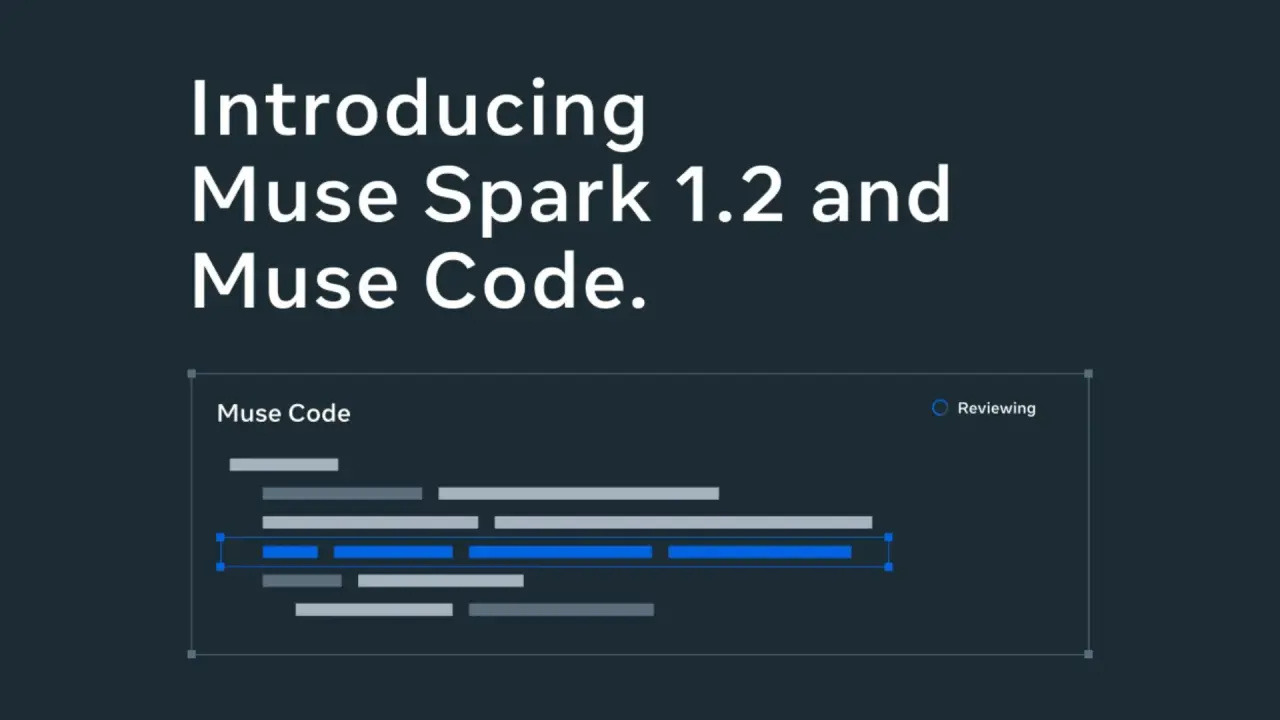
For nearly three years, Meta built its AI reputation around giving models away. From Llama to Code Llama, the company's pitch was that open models would accelerate innovation and ultimately benefit everyone. Now, it's taking a very different approach. On August 5, Mark Zuckerberg unveiled Muse Code, Meta's first terminal-based AI coding agent built by Alexandr Wang's Meta Superintelligence Labs. The product itself isn't particularly surprising. Every major AI lab now has a coding agent. What makes Muse Code stand out is its pricing model, which offers developers discounts of up to 21x if they agree to let Meta use their prompts and completions to train future models.What Muse Code doesMuse Code is a terminal-first coding agent designed for software engineers working on large codebases. It installs on macOS and Linux with a single command and deliberately avoids a graphical interface or IDE plugin. Instead, developers interact with it entirely through the terminal.For larger engineering tasks, Muse Code breaks work into multiple sub-agents running in parallel inside isolated worktrees. Unlike many existing AI agents that create fresh workers for every request, Meta says these agents persist throughout the session, reducing repeated context gathering and lowering latency during complex, multi-step workflows. Every model call, approval, tool execution and code edit is written to a local append-only event log, allowing interrupted sessions to resume without restarting from scratch.The agent ships with three built-in commands. /plan converts a request into an approval-based execution plan, /grill stress-tests that plan before implementation, and /goal keeps the agent focused on completing the broader objective. Underneath it all is Muse Spark 1.2, a coding-focused model that Meta says was co-trained with the agent itself, allowing better tool usage and fewer retries than agents running on third-party models.The pricing is the real storyThe standard version of Muse Code is competitively priced. It costs $1.25 per million input tokens and $4.25 per million output tokens, with cached inputs priced at $0.15 per million tokens. At this tier, Meta says customer prompts and completions are not used to train future models. Compared with rivals, it already comes in cheaper than OpenAI's GPT-5.6 Terra at $12 per million output tokens, Anthropic's Claude Sonnet 5 at $10, and Claude Opus 5 at $25.The more interesting option is the Contributor Tier. Here, input pricing drops to $0.10 per million The more interesting option is the Contributor Tier. Here, input pricing drops to $0.10 per million tokens, while output tokens cost just $0.20 per million. Cached inputs fall to $0.002 per million tokens. That's roughly 12x cheaper on input costs, 21x cheaper on output costs, and 75x cheaper for cached prompts. The trade-off is straightforward: developers explicitly allow Meta to use their prompts and completions to improve future Muse models. There is also a significant performance limitation.The Contributor Tier is capped at 60 requests per minute, compared with 3,000 requests per minute on the standard tier, making it suitable for experimentation and individual developers but far less practical for production workloads. Meta isn't simply discounting inference costs; it's effectively purchasing training data. Instead of paying entirely with money, developers can partially pay with the engineering knowledge embedded in their prompts, code generation requests and model outputs.For independent developers and startups, that trade-off may be perfectly reasonable. For enterprises handling proprietary code, regulated workloads or client repositories, however, it becomes a compliance decision rather than a financial one. The pricing discount is attractive, but whether organisations are legally permitted to opt in is an entirely different question.
Meta introduces Muse Code. It offers a 21x discount if you let it train on your data
Meta has introduced Muse Code, an advanced AI coding assistant aimed at software engineers. This innovative tool offers significant discounts to developers who share their prompts and coding solutions. By adopting this pricing model, the company is collecting valuable training data while allowing developers to reduce costs. However, businesses should prioritize compliance when participating in this data-sharing initiative.
TL;DRAI
Meta launches Muse Code AI agent; Contributor Tier offers 21x discount if developers consent to data training. Enterprise compliance blocks ROI for proprietary code; 60/min rate cap signals data-monetization strategy over pure inference revenue.
582 words~3 min read