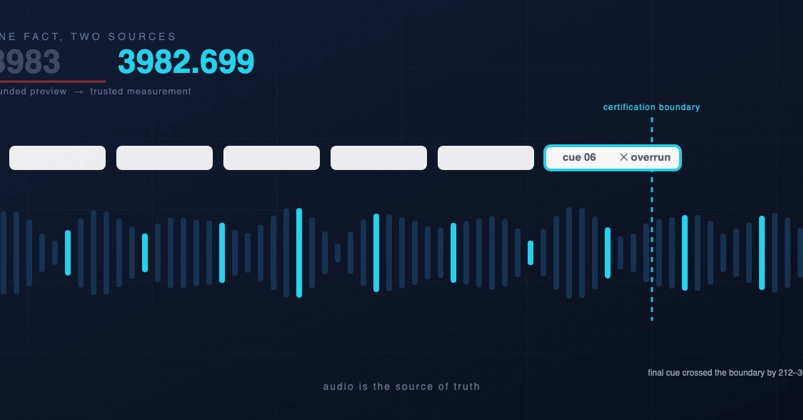
A 0.3-second disagreement between two sources of truth made my first paying customer fail four times.
The browser preview stored the project duration rounded to a whole second: 3983s. The worker that processed the audio measured the real media: 3982.699–3982.788s. Cue generation ran against the rounded number. Delivery certification ran against the trusted measurement. Any candidate built on the rounded boundary exceeded the certified boundary by 212–301ms — so the final cue failed, deterministically, every single time.
That customer ended up with four projects and three distinct audio files — four identical failures, each one blocked by the same gate. No subtitle asset, no explanation, no path forward.
No alert fired. No complaint had come in. I found it because I was looking.
Here is the part worth writing down: the quality gate did exactly what it was designed to do. It rejected every unsafe result before it could reach the customer. And the customer still lost. Four failures, and not one of them was a gate that misbehaved — they were four places where quality had been treated as a check instead of a product decision.