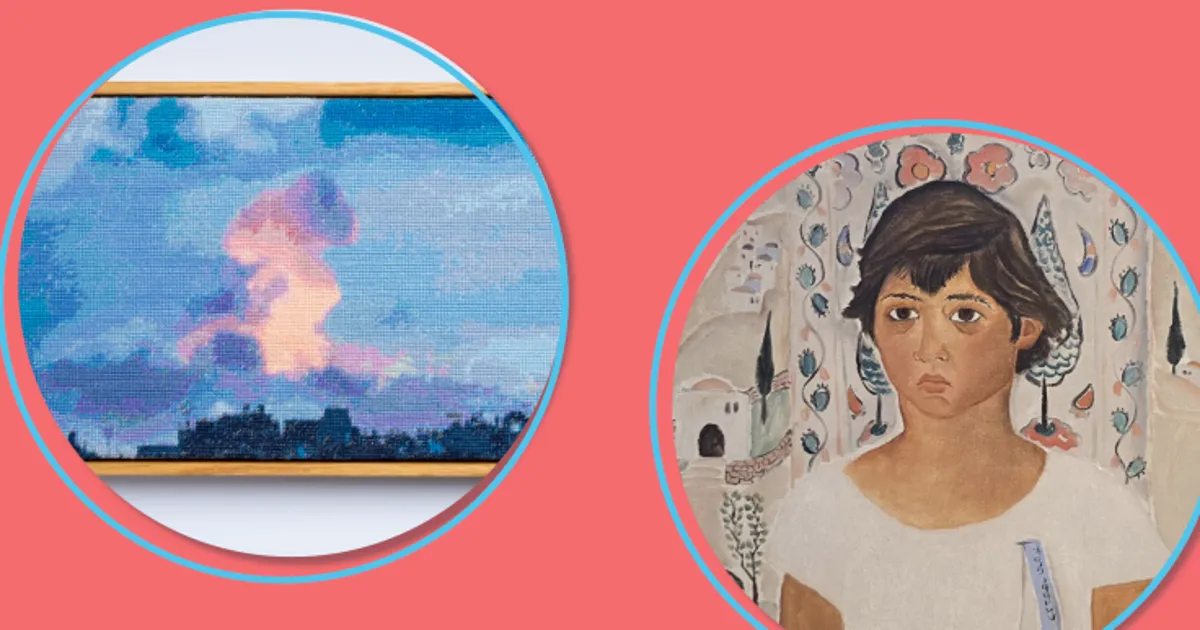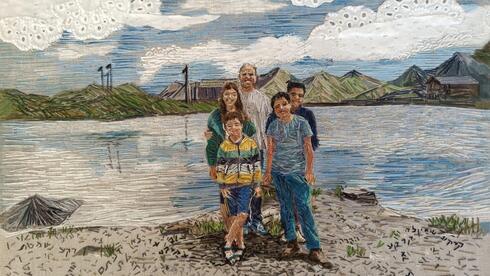
For a week after October 7, Aviv and Livnat Kutz and their three children were missing; after they were found murdered in their home, artist Talia Kutz-Shamir turned their clothes into embroidered portraits exploring grief, beauty and remembranceDar Musafir|Some works of art can be understood through a screen. Talia Kutz-Shamir’s new exhibition, Threading the Absence, is not one of them.To grasp the painstaking labor behind the works, visitors must stand before the embroideries, on display at the Petah Tikva Museum of Art through the end of October. Thread traces family photographs line by line, as the needle repeatedly pierces remnants of fabric. Here, the needle is more than a creative tool. It is also a means of confronting a rupture that cannot be repaired.Gallery“Death Embroidery,” from the exhibition Threading the Absence (Illustration: Talia Kutz-Shamir)In the summer of 2023, Kutz-Shamir felt compelled to learn embroidery, partly in response to what she described as the unraveling of Israeli society.“That summer, I was dealing with my father’s experiences during the Yom Kippur War,” she said. “I went to my parents’ home in Kfar Aza and found a very large suitcase filled with letters my mother had written almost every day to my father, who had been called up and remained away from home for nearly a year. It is what so many people are experiencing today.“In those letters she described the difficulty, everything she was going through without him, and also how we, the children, were growing up. I interviewed my father about his experiences and recorded him, thinking I might create a project from it.“That is actually the only piece I managed to embroider before Yom Kippur 2023," Kutz-Shamir said, pointing toward a small, delicate embroidered image of her father on the day he was drafted.Talia Kutz-Shami r(Photo: Courtesy)On October 7, 2023, her life was overturned. Her brother, Aviv Kutz, his wife, Livnat, and their three children, Rotem, Yonatan and Yiftach, were murdered in their home in Kfar Aza, the kibbutz where Kutz-Shamir grew up. The family’s bodies were found and identified about a week later. They appeared frozen in time, with Aviv embracing and covering the rest of the family in bed, trying in vain to shield them with his body.“I woke up shortly before the sirens began,” Kutz-Shamir recalled. “I felt something like a jolt, though to this day I still don’t know what it was. My sister and I did not live in Kfar Aza, but my parents and Aviv did, and sirens were sounding where all of us lived. We ran to our safe rooms and began messaging in the family group. We expected Aviv and Livnat to respond and tell us what was happening, but gradually we realized they were not answering.”“At first, I held on to this completely unrealistic illusion that they had run to the safe room without their phones. But the safe room was Rotem’s bedroom, and she had her phone with her.”The late Kutz familyThe family wondered whether poor cell reception or power outages were preventing them from responding. “It was impossible to get any information,” she said. “My parents tried calling for help, asking someone to go there, but there was no one to turn to. We were in shock. I was in shock.“I remember sitting through a power outage in Kidron, where I live, terrified that my phone would die and I would lose even that connection. It is impossible to describe those days. It took about another week before anyone could enter the house, identify them and remove their bodies, because the neighborhood was still full of terrorists and fighting continued there in the days that followed.”“My parents arrived on Sunday and stayed with us throughout that first month. We were all together, and none of us slept at night. You exist in a kind of delirium. Even now, certain things take me straight back to those days.”“After that, I fell into a kind of silence. For two months, I created nothing. I simply couldn’t,” Kutz-Shamir said softly. “Then I felt an intense physical need to touch something. Maybe it came from that sense of disappearance. There is something about touch that was so painfully absent. I just wanted to touch something.“The first time I returned to Aviv and Livnat’s home was about a month after the massacre. I took a few things from the house, fabrics and clothes, without knowing I would create with them. I only wanted to take something, to touch it. That was all. Somehow, it evolved into embroidering on the fabrics I had taken and incorporating them into the works.”'Portrait with All the Grandchildren' (Photo: Talia Kutz-Shamir)Near the entrance to the exhibition, two embroideries hang on opposite walls. One depicts her father. The other shows her brother flying a kite.“That was the first work I made,” she said of the image of Aviv. “It is embroidered on the back of one of his shirts. He loved wearing plaid shirts to work, much to Livnat’s displeasure, because she did not particularly like them.”She allowed herself a brief smile. “He had many plaid shirts, and I desperately wanted to touch him. There is a large space in this work, and it contains something that recurs throughout the exhibition. It is as though I am sending a thread high into the sky, trying to hold on to something or pull something down from there, just as he does with the kites."Aviv founded Kfar Aza’s annual kite festival, in which residents flew kites bearing messages of peace and hope toward Gaza. The event was scheduled to take place on October 7."Many of the exhibition’s images are drawn from family photographs taken over the years. “My brother was an amateur photographer who loved taking pictures,” Kutz-Shamir said. “There are hundreds, perhaps thousands, of photographs of the family.“And there was this feeling that no one was left to hold on to them, no one left to look at them. When parents lose a child, they often return to the photographs again and again. Here, the photographs themselves felt orphaned.”“From time to time, I would open the folder, for as long as I could. I would look until it became too painful, then close it. I would try to choose one photograph and respond to it.”The work 'Aviv' (Photo: Talia Kutz-Shamir)Under her hand, the photographs acquired new layers, thread by thread. Yonatan and Yiftach, talented basketball players who trained at Hapoel Tel Aviv’s academy, are shown playing with a ball thrown toward the sun, where it seems to merge with the light.Rotem, an IDF squad commander who had returned home on leave for the Sukkot holiday, appears as a young child sitting innocently in a field of anemones in the Negev. The image is embroidered on a military shirt hung upside down, carrying an ominous sense of foreboding. Livnat, who was skilled at handicrafts, appears to be using a needle to embroider, repair, or perhaps heal a bird that is the same size as she is.“The work allowed me to maintain a relationship with them,” Kutz-Shamir said. “I spent hours, days and weeks embroidering each piece. It is an extraordinarily painstaking process.”Kutz-Shamir is primarily a painter, but she said painting could not answer what she needed or contain the pain she was trying to confront. “After a disaster like this, you feel as though you are drowning,” she said. “You think you will never get through it, that it will never end. And in truth, it never does. But embroidery is very slow. It is nothing like painting, where a single brushstroke can fill an entire area. It is gradual. It accumulates. Something eventually emerges from the repetition, but nothing changes by magic or all at once.“This slow action shifts something. I still do not know exactly what, but things do change, even alongside the pain. People speak of healing or repair. Those words feel too large to me. I think more in terms of connection rather than rupture.”The work 'Once, in Another Country' (Photo: Talia Kutz-Shamir)You are also an art therapist. The need to “touch something” is, of course, about reaching for those who and what are no longer here, but turning to touch is also a coping mechanism rooted in the therapeutic world.
Her brother’s family was murdered on October 7. She stitched their clothes into art
For a week after October 7, Aviv and Livnat Kutz and their three children were missing; after they were found murdered in their home, artist Talia Kutz-Shamir turned their clothes into embroidered portraits exploring grief, beauty and remembrance
2,671 words~12 min read