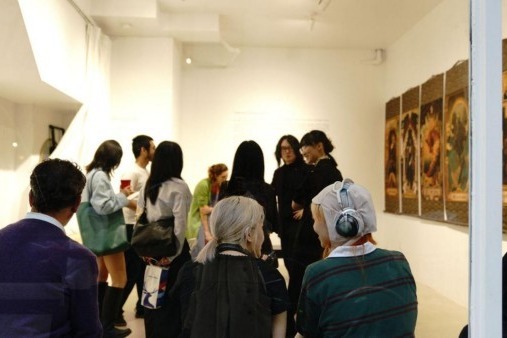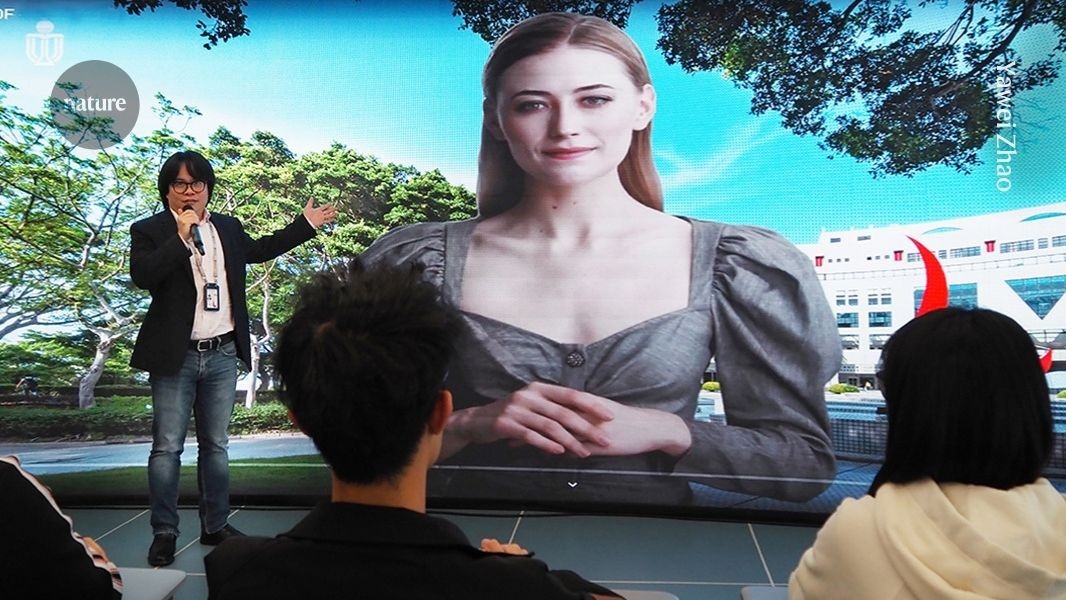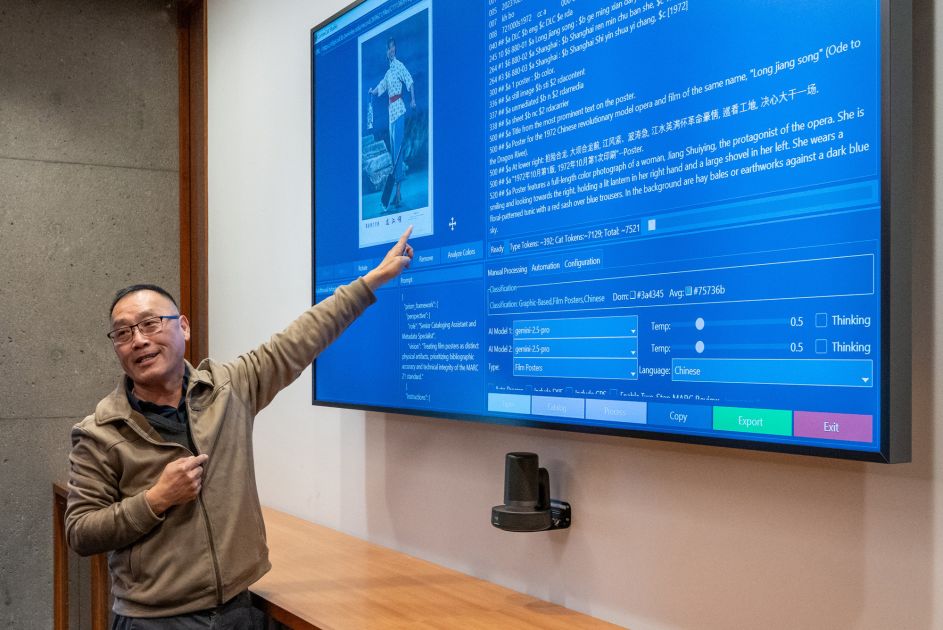
Haiqing Lin, head of technical services at the East Asian Library, explains how AI can help the Library get items, such as Chinese movie posters, cataloged quickly. (Photos by Jami Smth/UC Berkeley Library)
In a meeting room at the C. V. Starr East Asian Library, a Chinese film poster flickers onto a large screen.Haiqing Lin, the library’s head of technical services, is demonstrating an interface he built. With a few practiced clicks, he sends the image — one of 2,000 from the Paul Fonoroff collection — through an artificial intelligence model. Seconds later, a draft catalog description appears.For Lin, who has spent his career thinking about how to describe materials so researchers can find them, the appeal is obvious. Cataloging each poster is slow work. His custom tool, which incorporates Google’s Gemini AI models via an Application Programming Interface, can accurately translate the language and generate descriptive metadata to be folded into the UC Berkeley Library’s catalog. Though it’s still in an exploratory phase, it shows real promise.An early adopter of AI technologies, Lin has done much experimentation, including continually refining his latest prompt. He is convinced that AI will transform cataloging work but only as a tool to support expertise, not replace it.“To develop this prompt, we need knowledge about the collection, the user’s expectations, and the cataloging system,” he said. “This is our librarians’ expertise. We teach AI what we need. We control AI, rather than it controlling us.”This kind of grounded experimentation is unfolding amid broader uncertainty about AI’s role in academic libraries. As the technological revolution accelerates, the Library is taking a deliberate, human-centered approach, weighing the merits and missteps of these tools, testing where they can help, where they fall short, and how to use them responsibly.Steering that course is Carolyn Caizzi, the associate university librarian for digital initiatives and information technology. And she’s bullish on the Library’s ability to navigate the moment.“AI is here, and we have to figure out a path forward,” she said. “So it’s about adapting and redefining our role. I think we’re well-suited to it because we are information professionals. We know the questions to ask.”Unlocking hidden historiesFor Becky Miller, the university’s natural resources librarian, AI offered a solution to a long-standing challenge. For years, she’d had her eye on shelves of agricultural extension publications, primarily from the 1960s and ’70s, that documented everything from crop yields to pest outbreaks. The publications had sat untouched for decades in the Marian Koshland Bioscience, Natural Resources & Public Health Library.