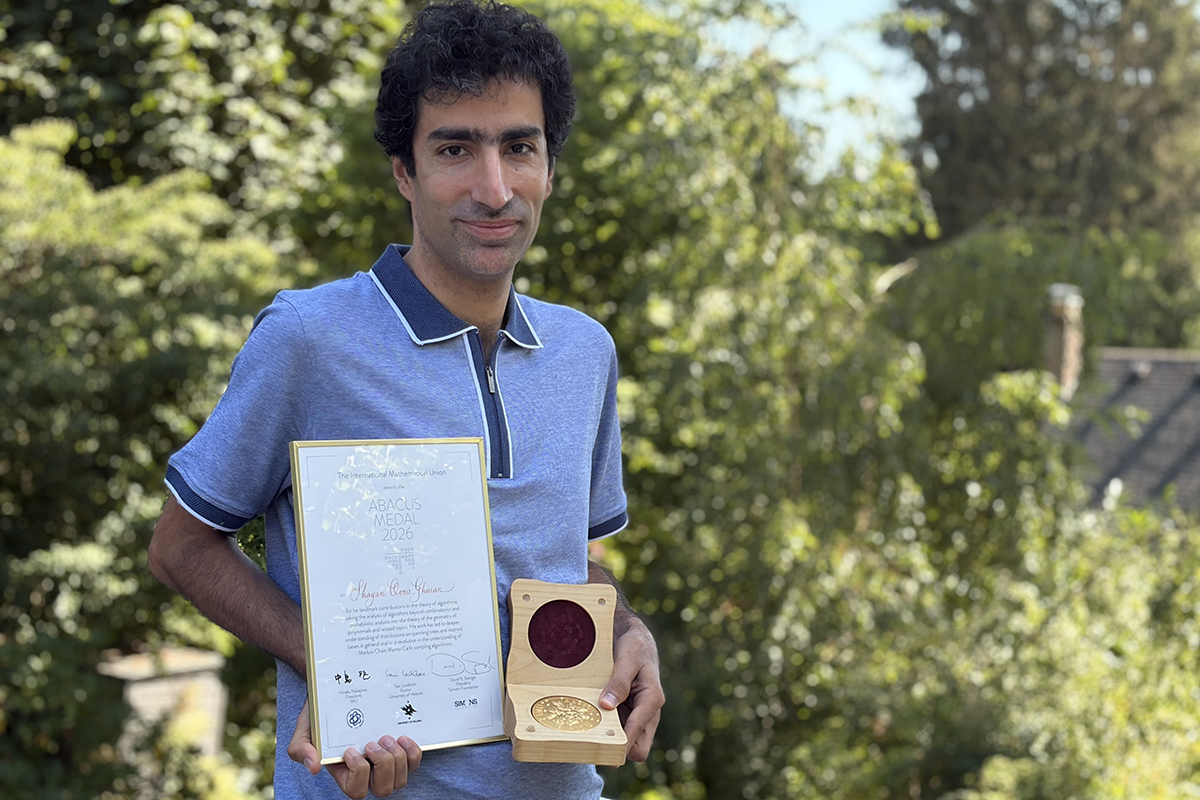
In his award-winning paper, Allen School professor Jerry Li resolved a longstanding issue in robust statistics.
In 2019, a team of researchers including Allen School professor and alum Jerry Li (B.S., ‘13) proved that a broad class of high-dimensional statistical problems can be both efficiently and robustly solved, even when some of the data has been corrupted. The result, described in the groundbreaking paper “Robust Estimators in High Dimensions without the Computational Intractability,” solved a foundational problem in robust statistics that had remained open since the 1960s — and transformed the field in the process.
“The suite of techniques that the paper introduced have now become the cornerstone of a subfield called ‘algorithmic robust statistics,’ and the community has been able to use them to obtain robust estimators for many settings beyond the original paper in statistics, theoretical computer science, and machine learning,” Li said.
At the International Colloquium on Automata, Languages, and Programming (ICALP 2026) last month, Li and his collaborators were awarded the 2026 Gödel Prize for their landmark work. The prize, named for mathematician and logician Kurt Gödel, recognizes outstanding papers in theoretical computer science. “The paper fundamentally changed our understanding of what is algorithmically possible in robust high-dimensional learning,” the award committee wrote.