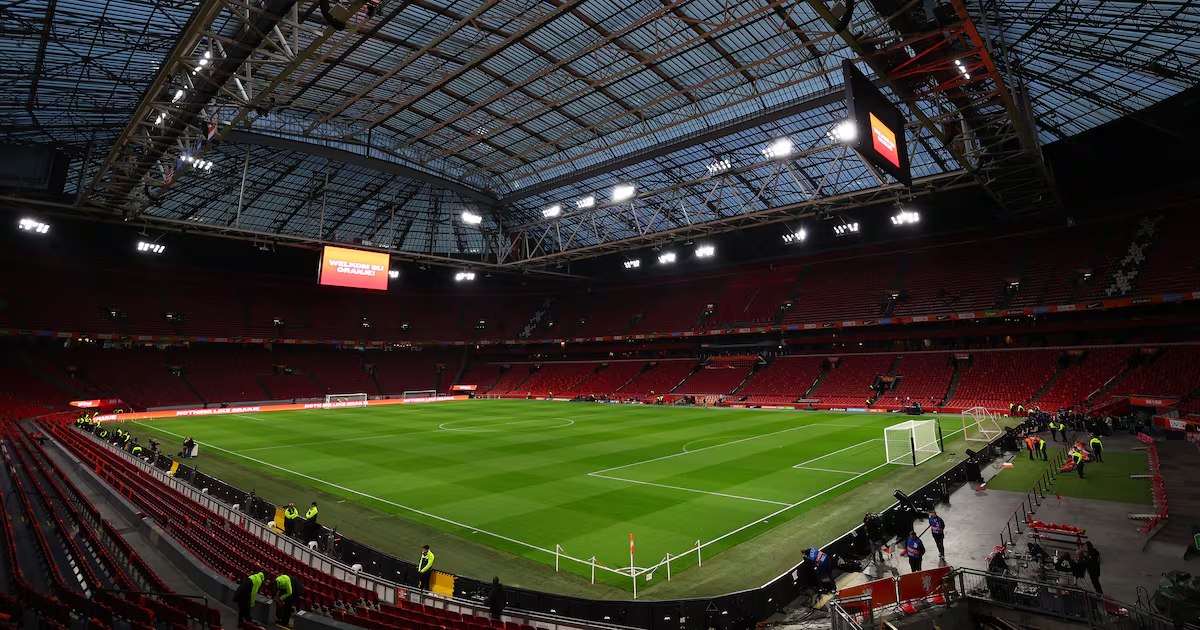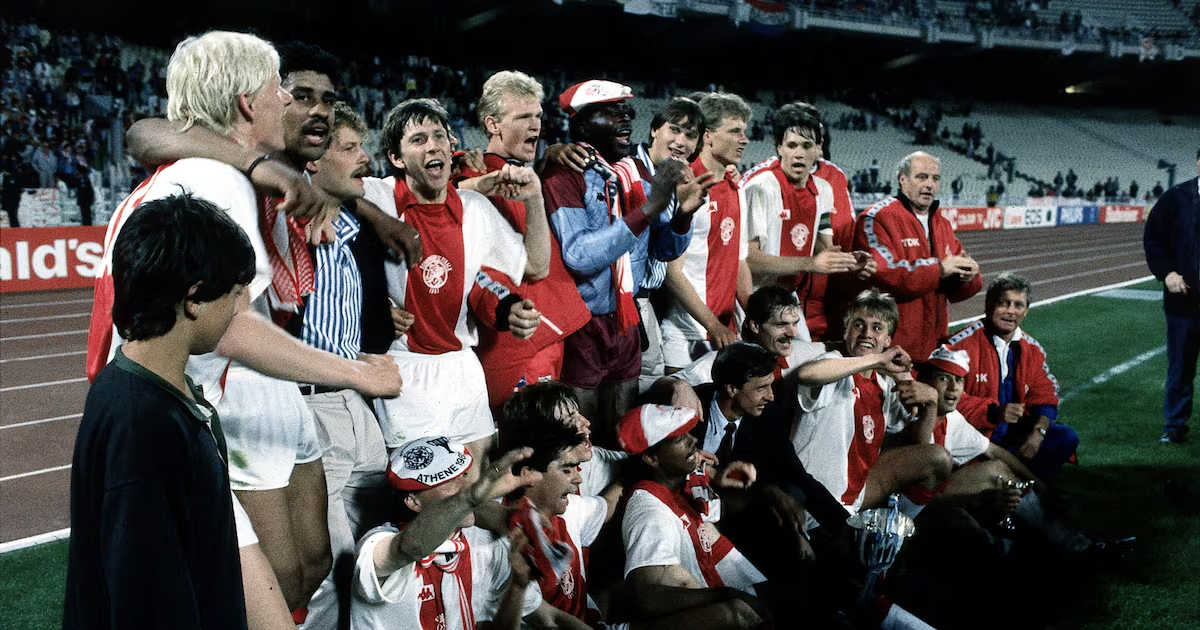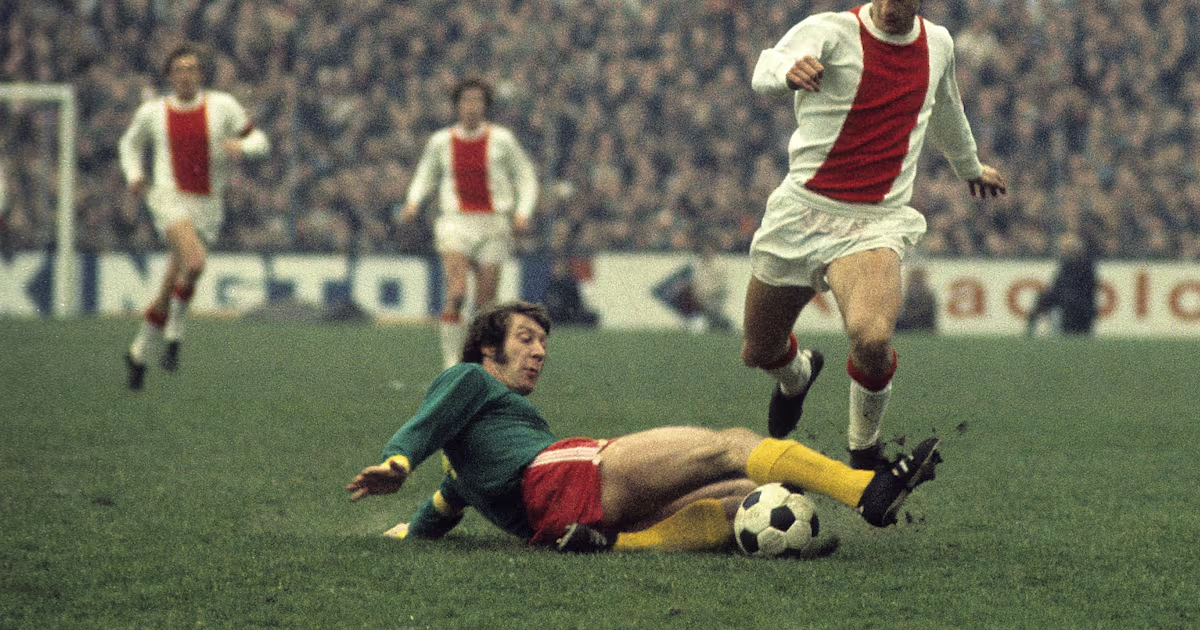
Amsterdam club went on to conquer Europe after Ireland gave them their first professional manager in 1910Johan Cruyff, right, of Ajax, in action against FC Den Haag in January 1972. Photograph: Getty James McDermottWed Aug 05 2026 - 12:00 • 5 MIN READWhen David Winner wrote Brilliant Orange: The Neurotic Genius of Dutch Football, he began with chapter five before immediately moving to chapter seven followed by chapter nine. This non-sequential numbering embodied the spirit of “Total Football”, developed by the great Ajax manager Rinus Michels, which encouraged supremely gifted players to change positions with any team-mate during a match. Its greatest practitioner was Johan Cruyff, who won consecutive European Cups with Ajax between 1971 and 1973 and whose genius enabled him to invent a new move (the Cruyff turn) named in his honour. Cruyff died in 2016 aged just 68, but a decade later, when Shelbourne visit Ajax in the Uefa Conference League on Thursday, they will still see his name everywhere. The match takes place at the 55,000-capacity Johan Cruyff Arena, where the Ajax technical director is his son Jordi, who as a player won the Premier League alongside Roy Keane and Denis Irwin with Manchester United. Irish links with Ajax have deep roots, beginning in 1910 when John Kirwan became their first professional manager. A remarkable sportsman, in 1894 aged just 17 Kirwan “won” an All-Ireland football championship with Dublin after a reply against Cork was abandoned following a brawl (the Rebels were leading by two points at the time, but refused to take part in a rescheduled third game). Kirwan then switched to soccer initially with Everton before moving to Tottenham Hotspur, who in 1901 became the only non-league side to win the FA Cup – after a replay that was actually completed. After retiring, Kirwan was lured to the Netherlands to manage Ajax. He was there for four years, guiding them to a second division title and promotion to the top flight for the first time. This elevation required Ajax to change their kit to avoid a clash with Sparta Rotterdam. Kirwan played a key role in Ajax’s adoption of their white jersey with a red vertical stripe. The Irish connection was later strengthened in 1987 when Ajax, now managed by Johan Cruyff, signed Frank Stapleton as a replacement for AC Milan-bound Marco van Basten. Frank Stapleton of Ajax runs with the ball during a preseason 2-1 victory over Real Sociedad in 1987 at Hampden Park, Glasgow. Photograph: Chris Cole/Getty The honour of being signed by the greatest Dutch footballer ever, to replace the second greatest Dutch footballer ever, was somewhat undermined later when Cruyff revealed in his autobiography (inevitably called My Turn) how he had spent months attempting to sign Cyrille Regis instead. However, when Coventry City unexpectedly beat Spurs 3-2 to win the 1987 FA Cup final Regis became too expensive, so Ajax signed Stapleton instead. Cruyff explained that former Ajax team-mate Arnold Mühren had recommended Stapleton, who had played alongside him at Manchester United, and the Dubliner “didn’t cost anything, because he was still vulnerable to injury”.Stapleton only made a handful of appearances for Ajax, although his sole goal came against familiar opponents. In September 1987 Dundalk met defending champions Ajax in the first round of the European Cup Winners’ Cup. In the first leg in Amsterdam, Dundalk held out in a goalless first half with the hosts booed off and Stapleton introduced as a substitute. The change proved inspired with Ajax going on to win 4-0 with Stapleton completing the scoring. [ ‘Someone pinch me. Am I dreaming?’: When Dundalk took on Johan Cruyff’s Ajax giants ]A fortnight later a crowd of just 4,500 turned up at Oriel Park for the return leg, which Ajax won 2-0 to progress 6-0 on aggregate. The emergence of Dennis Bergkamp would see Stapleton join Derby County weeks later, but his former Ajax team-mates were not yet finished with him or Ireland. A dejected Packie Bonner reacts after Wim Kieft scores a late winner for the Netherlands against Ireland in the 1988 European Championships. Photograph: Billy Stickland/INPHO Six of that Ajax team (Frank Rijkaard, Mühren, Aron Winter, Jan Wouters, John Bosman and John van’t Schip) finished the season by winning the 1988 European Championships with the Netherlands, having previously come within minutes of a group-stage elimination before a freakish late winner by former Ajax player Wim Kieft saw them scrape a 1-0 win over a Republic of Ireland side captained by Stapleton.Off the field, Cruyff could start a row in an empty house. One journalist who complained that he could not understand a point that Cruyff was making was dismissively told: “If I wanted you to understand, I would have explained it better.” An unexpected later target for Cruyff’s ire was the FAI. In his book Cruyff revealed how in the mid-1990s he was heavily involved in the negotiations to move London club Wimbledon FC to Dublin, but “unfortunately the plan came to a standstill because the Football Association of Ireland didn’t want to co-operate”. The FAI in effect blocked the “Dublin Dons” by requiring any club based here to participate in Irish competitions. According to Cruyff, this explained why “even today Ireland has to get by without a top-level club”.Four decades later, one famous name still connects Cruyff’s outstanding Ajax team with the current one. Danny Blind scored in the 4-0 first-leg win over Dundalk and would go on to secure all three major Uefa club competitions – with Ajax winning the Cup Winners’ Cup in 1987, the Uefa Cup in 1992 and the Champions League in 1995. Ireland’s Callum Robinson and Daley Blind of The Netherlands in a Euro 2024 qualifier. Photograph: Ryan Byrne/INPHO Last month Danny’s son Daley Blind, who has won 108 Netherlands caps, signed for Ajax for a third time. Like his father, Daley may soon find himself playing along an Irish striker as Ajax have recently been linked with a multi-million euro move for Ireland international Troy Parrott of Dutch side AZ Alkmaar and have also expressed an interest in Shamrock Rovers forward Michael Noonan, who has just turned 18. A number of players have made the reverse journey from Ajax into the League of Ireland. In 2004 midfielder Stanley Aborah began his career representing Ajax in the Champions League before finishing up in 2018 with a season at Waterford United. More recently, in 2025 Suriname international Navajo Bakboord joined Waterford, having spent more than a decade as a youth player with Ajax. The most recent League of Ireland side to visit Amsterdam were the Shamrock Rovers under-15 team, who in 2023 beat their Ajax contemporaries 2-1. Sadly one suspects that Shelbourne will discover that at senior level wiping the floor with Ajax will prove to be a much more difficult task.IN THIS SECTION
Ajax v Shelbourne: Irish players and clubs have long history of lessons from Dutch masters
Amsterdam club went on to conquer Europe after Ireland gave them their first professional manager in 1910
1,135 words~5 min read