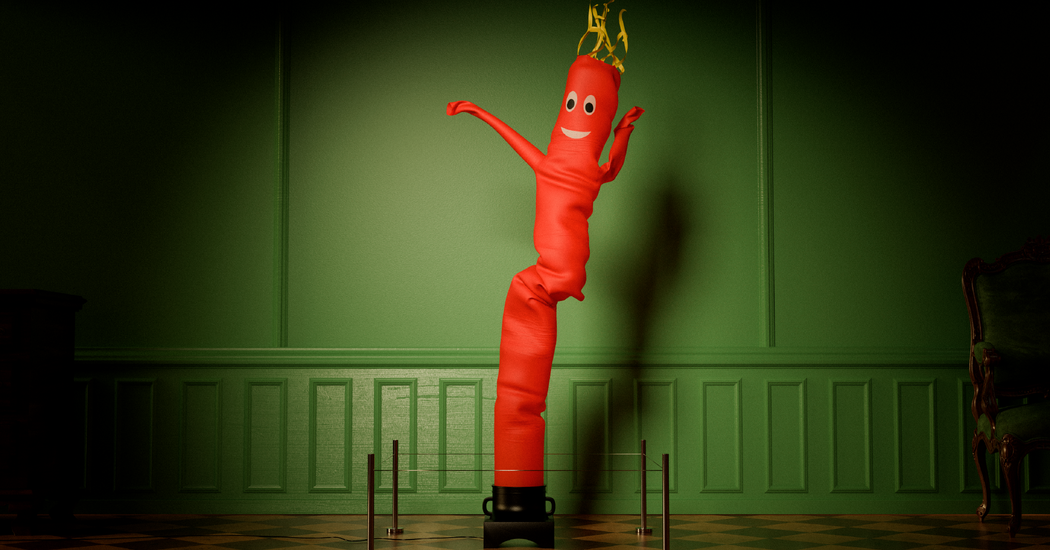
By Emily Keegin Illustrations by Laurent Allard Aug. 4, 2026 Defining what it means to be American today can seem like an impossible task. We are, after all, a big and unruly nation, prone to acting in extreme and contradictory ways, often at the same time. And yet, “Americanness” is easy to spot. It lives in our mannerisms (big smiles) and our worldview (bullish). And it is imbued in our things — the gadgets, food, tools and household clutter that surround us. Just as the relics of ancient Mesopotamians provide insight into their way of life, who we are, as a culture, and as a nation, can be uncovered by sifting through our giant piles of stuff. To that end, I put together a collection of 25 objects that reveal something special about us. This isn’t a definitive canon; in a nation of 342.7 million individuals, no set of things could be. Instead, consider this my contribution to our favorite 250-year-old parlor game, a 25-part answer to the question: Who are we? They say we are a divided country. They say we have nothing in common. Right, Left, Urban, Rural, Men, Women, Real America, Fake America. But spend a Saturday afternoon wandering the aisles of your nearest Costco, and you will quickly find that we are not so different after all. Americans want the same thing — $4.99 rotisserie chickens, $1.50 hot dogs and a cart full of enough stuff to survive a nuclear winter. At Costco, we are one nation, under God, with bulk groceries for all. As the lawn began, so did the United States. Nonnative seeds arrived on ships, took to the wind and colonized the landscape; welcome to America, Poa pratensis. Our lawns might be agriculturally worthless economic sinkholes, requiring hard labor and constant maintenance, but the American urge to tame the wilderness by transforming it in our own image is hard to deny. What we once called pioneering, we now call mowing the grass. Juicy Couture Sweatsuit Since the invention of Lycra in 1958, the American athlete and the American couch potato have worn the same pants. In a country where sloth is sinful and work holy, athleisure signals both virtue and vice, often simultaneously. In the aughts, a young Paris Hilton turned the leisure suit into a power suit by wearing Juicy Couture velour sets on the regular. It was a move that said, “I’m so wealthy, I don’t even have to get dressed.” With enough money in the bank, leisure itself becomes the sport. Those glutes might not be taut, but at least they are … Juicy. NASCAR Chevy Impala NASCAR, like America, is built on the promise of transformation. Cars that look like the ones in our driveways are turned into elite machines capable of doing the unthinkable. That Impala you rented at the Tucson airport? On the highway it handled like a mattress; souped up for the racetrack, it goes 200 miles per hour and takes curves like a racehorse. NASCAR asks us to rethink our lives as full of possibility, and gives us a reason to believe in the most American fantasy: With the right pit crew, any of us can be champions. Ring Light This country has finally reached peak “opinion.” The modern-day pamphleteer has a “get ready with me” about the United States-Mexico-Canada Agreement, and yes, we will tune in to watch it live. We just can’t help ourselves. We the people wish to be heard, and, for better or for worse, we the people wish to hear the opinions of our fellow citizens, no matter how unhinged they may be. Sometimes this leads to a nation full of tinfoil hats. But sometimes it leads to revolution. Every city, town or suburb has its own deity who looms above the roadways like a god on Mount Olympus, promising to fix your trauma through the dark art of legal retribution. If you’re lucky enough to live near more than one personal injury lawyer, they will fight for your love with font size, puns and catchy TV jingles. The sheer number probably implies we are a nation on the brink, battered and out for blood. But it might also be proof of a successful republic. When John Adams wrote of “an empire of laws, and not of men,” was he not dreaming of calling 1-800-GOT-PAIN? Is it snake oil or is it wellness? Is Gwyneth Paltrow a guru or a charlatan? Will this hunk of jade unlock my full sexual potential or give me a yeast infection? Possibly both! When asked to shove an egg-shaped rock up our vaginas for $66, a healthier nation might have said, “Heck no!” instead of, “How far?” But in lieu of a functioning health care system, we’ll take what we can get. Dirty Soda This niche beverage, once popular only in Utah, has become a nationwide sensation thanks to a cadre of teetotal Mormon influencers who drink doctored-up sodas instead of coffee and booze. To dirty soda nonbelievers, the drink is an ungodly concoction of soda pop, flavored syrup, fresh fruit juice and cream. But to those hungry for a quick sugar fix, the dirty soda is a rush sent straight from heaven. No religious group has so significantly altered our drinking habits since American Protestants lobbied for Prohibition. Temperance, as it turns out, works best when we can guzzle something else to excess. T-Shirt Cannon The T-shirt cannon merges three American obsessions: guns, sports and freebie giveaways. It was invented by Tim Derk, the first mascot for the San Antonio Spurs, to hype up basketball fans during commercial breaks. He understood us. We love free stuff, and will happily denigrate ourselves to get it. When the Jumbotron flashes “T-shirt Toss,” we leap to our feet, waving our arms and screaming like toddlers in the hopes that maybe tonight the myth of American meritocracy will prove true, and wealth will be lavished upon our humble selves in the form of an XL T-shirt whacking us in the face. Crest Whitestrips We are not the happiest nation on earth (that would be Finland), but we are probably the smiliest. American teeth have gotten whiter, bigger and brighter, thanks in no small part to the chemists at Procter & Gamble. While we might act like a bully on the global stage, we choose to practice smile diplomacy both at home and abroad. So when our friendly nation smiles at you, we want to make sure that you see it. Best be careful, though — we do bite. In some counties, stained glass is reserved for the holiest of spaces — grand cathedrals and stately palaces. In America, Tiffany-style glass is for everybody. Like the Little League team that shares pizza and wings after losing the championship, or the stand-up comedian who bombs at the Comedy Cellar every Friday night. When we see a stained-glass lamp hanging low over a table, we know we are somewhere small-d democratic — a place where everyone gets to feel fancy, every once in a while. They have been called the ugliest shoe in the world and listed on Time magazine’s 50 worst inventions of all time, alongside Agent Orange and the Ford Pinto. And yet, the Croc, the shoe Americans love to hate, will. Not. Die. These foam blobs are comfortable and indestructible, buoyant and infantilizing. A new pair of Crocs arrives as a blank canvas that begs for another innovation: Jibbitz, branded bobbles that make your shoes truly your own. For a nation of individualists, regularly lambasted for our poor taste and childish outbursts, the shoe fits. Luckily, in the right light, even ugly can be cute. The American heart beats at 65 miles per hour. Except in Texas, where it goes 85. In our cars, we can be our true selves. We can eat Crunchwraps without judgment, call our lovers in private and huff the sweet perfume of Little Trees™ dangling from the rearview mirror. Mmmm … Vanillaroma™. Unfortunately our cars are also destroying cities, clogging our lungs and polluting the environment. Heck, even our air fresheners can be toxic. But this is America, and here we have a word for loving something that might kill you: “freedom.” (See also: football, red meat and refined sugar.) If it feels good, we want it, especially if it has that new car smell. The George Foreman Grill Americans love to grill, to barbecue, to stand outside and talk to their friends while cooking over fire. The pastime is so American that even people who cannot have grills, because of apartment restrictions or space constraints, must still scratch the itch. Enter heavyweight boxing champion George Foreman and his lean, mean, fat-reducing machine. Finally you can grill indoors! Now with less fat! In this house we believe grilling is life, paninis are health food, and there’s always room on the kitchen counter for one more gadget. Dude Wipes XL American industriousness means we love solving problems. Sometimes, we solve a problem no one asked us to solve. Such is the case with Dude Wipes XL. The supposed problem was the American man’s dirty bottom. The solution? Repackage wet wipes, scent them with coffee beans or pine trees and advertise using scatological jokes and N.F.L. stars. Unfortunately, when flushed, Dude Wipes XL may clog your pipes. That’s the thing about solving problems: Often, you end up creating another. See also: The Vietnam War, the internal combustion engine, the internet, Prop 13. Sad Desk Salad Office workers in America, especially of the millennial variety, know this well. Encapsulated in these lunchtime bowls of slop is everything we aspire to — healthy, seemingly fresh, a diversity of ingredients mingling together like the country we call home. It’s also everything we are — sold out to private equity and a congealed, undignified mess. We are a country of high highs and low lows, but if you’re lucky, you can spend most of your life slopping around somewhere in between. Ring Doorbell Camera Have we always been so scared of strangers? And when did we, as a country supposedly built on individual liberties, become so enthusiastic about Big Brother-style surveillance? Maybe we are still haunted by the ghost of Michael Wigglesworth and the Massachusetts Puritans who looked out from their chapels and saw only “a waste of howling wilderness.” Maybe we still believe that safety can be found only beneath the eye of a benevolent and omniscient lord. The Puritans had God. We have Jeff Bezos. In a nation plagued by loneliness, perhaps it’s time to start answering the door. The Solo cup is the quintessential expression of American industrial design: a new take on an old standard, made plastic, disposable and EXTRA STRONG, so it can withstand the pressures of a mosh pit, parking lot or beer pong tournament. For a nation of rugged individualists, who poo-poo the idea of boundaries and consequence, to toast with a red plastic cup is to toast to freedom. Quoth Toby Keith: “You, sir, do not have a pair of testicles / if you prefer drinkin’ from glass.” The further Americans get from living in the forest, the more desperate we are to touch grass. Thankfully, Realtree is here to help. This photorealistic camo print, once used only by hunters, now covers everything from cheap travel mugs to luxury-adjacent streetwear. For a small price, Realtree affords even the most socially corrupt urbanite proximity to the virtues of nature — and to the “realness” of the rural lifestyle. It’s not a real tree, but that’s OK. In America, the image of nature is often more powerful than nature itself. A Bottomless Basket of Chips and Salsa The mere notion of belt tightening and portion control, both metaphorical and literal, is anathema to the American spirit. So come! Sit down and feast at our table. Here, our cups runneth over with free refills, unlimited breadsticks and endless shrimp. Unfortunately, our “all you can eat” mind-set has gotten us into a bit of trouble. From the people who brought you “bottomless mimosa” comes … deficit spending! We want what we want and would rather not pay, thank you very much. ‘Live, Laugh, Love’ Sign For such optimistic people, we sure do need constant reminders to cheer up. Enter: motivational wall hangings. In colonial times, women made needlepoint samplers embroidered with Bible verses and moralizing slogans. In the 1970s, when faced with tremendous social change, spiking inflation and a protracted war, an uneasy nation bought throw pillows imploring everyone to “bless this mess.” In the 21st century, millennials waited out the Great Recession by posting “Live, Laugh, Love” on their living room walls. Like the signs that came before, this was part command and part manifestation. We were wishing for a life we’re still waiting for. Dog Stroller The numbers are stark. A mere 40 years ago, children outnumbered pets. Today, there are almost 20 million more dogs than there are human children. Some blame the drooping birthrate on the economy and the government’s stubborn refusal to invest in universal services like child care and paid family leave. A “fur baby,” as they’ve been called, might eat your couch, but instead of four years of college, you have to pay only for five months of puppy school. And sure, you don’t have to push Fido around the farmers market in a stroller, but he’s such a good boy, and mama needs some kale. Gas Station Bathroom Key Our robust network of gas station convenience stores comes with a very American rite of passage: the ritual humiliation of asking the attendant for the bathroom key, then galloping down the aisles holding a giant key chain. Traditionally, one is no smaller than a wooden spoon and no larger than a 10-pound turkey — escaping with it is nearly impossible. We are a hospitable people, with significant trust issues. We are happy to help a fellow traveler, but there’s no way in hell we’re trusting you with our keys. What came first? That feeling of impending doom? Or the inability to raise an eyebrow? Over the last 15 years, many beloved faces have stopped moving. Actors, politicians, podcasters, everyone who’s anyone is shooting 30 units of Botox directly into their foreheads. The result: The world’s greatest melting pot is increasingly made up of a bunch of faces that look the same. We may look ridiculous I.R.L., but on camera we are glowing. Adios laugh lines! The future is deadpan. America’s first Tube Man stood 60 feet tall and flopped around like the prodigal son of Martha Graham and a windsock. Thirty years after he was created for the 1996 Atlanta Olympics, Tube Man has become a fixture of the American strip mall. He, who was once a work of art, is now selling used cars in downtown San Jose. It’s hard not to see ourselves in this giant wiggly goofball. We, too, are happy idiots flailing around outside the vape shop. We, too, were once works of art. But now we’ve gotta make a living. Capitalism comes for everyone. Emily Keegin is a photo editor and creative consultant. Laurent Allard is a 3-D artist whose work focuses on objects.Produced by Ana Becker and Elana Schlenker. Additional production by Olivia James.
Opinion | The 25 Objects That Explain America
Want to understand this country? Look at our stuff.
2,543 words~12 min read