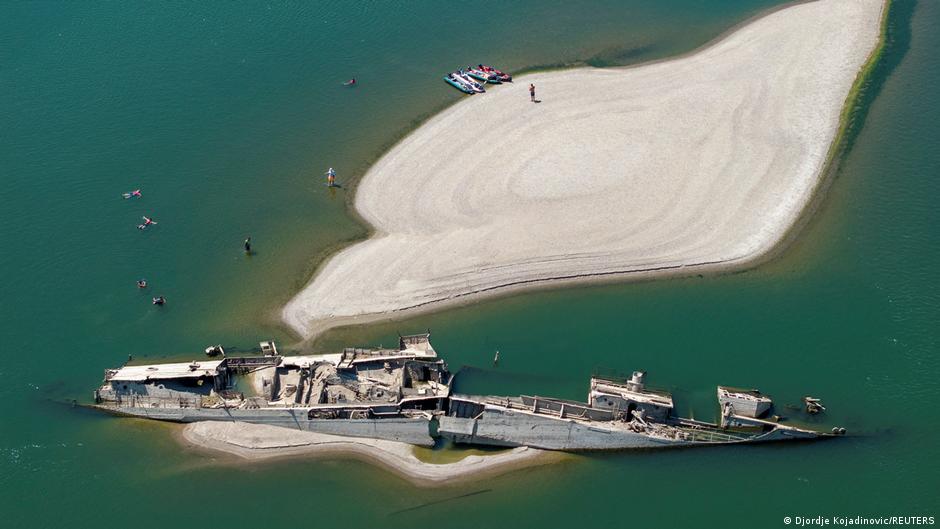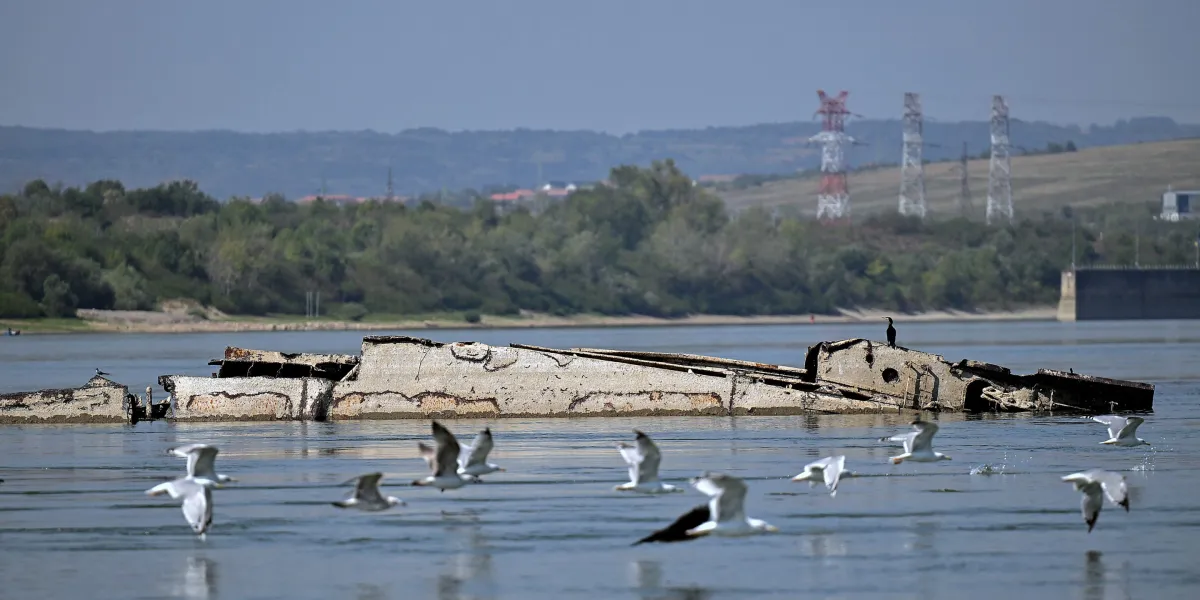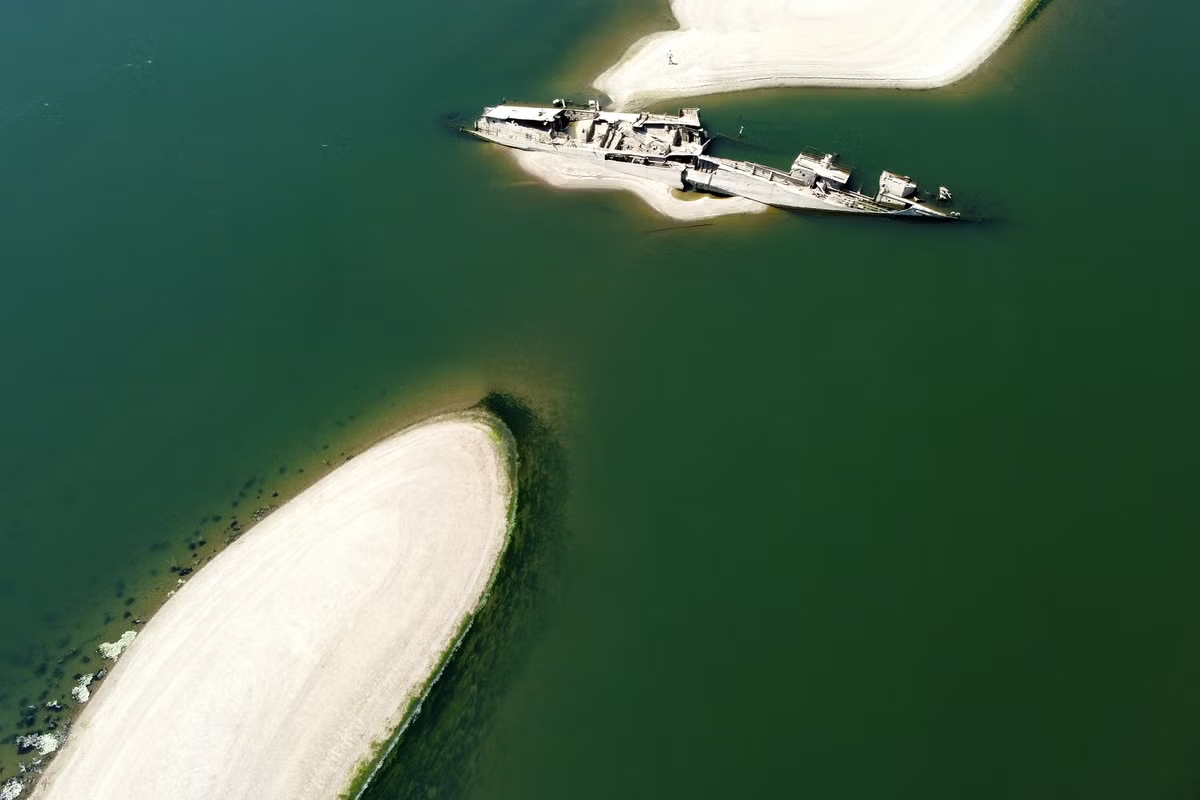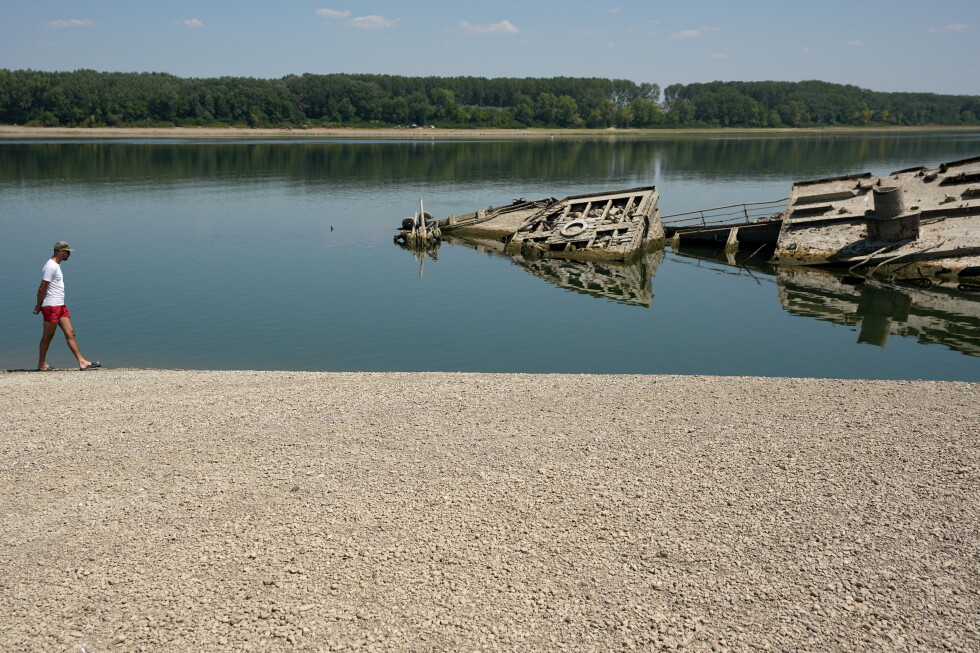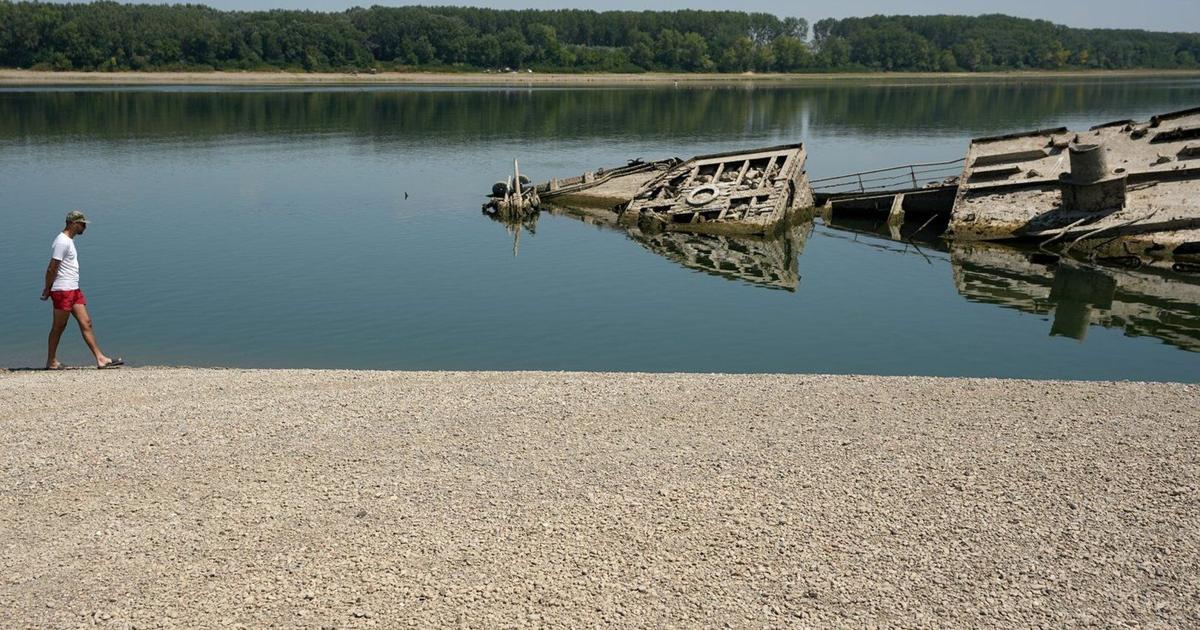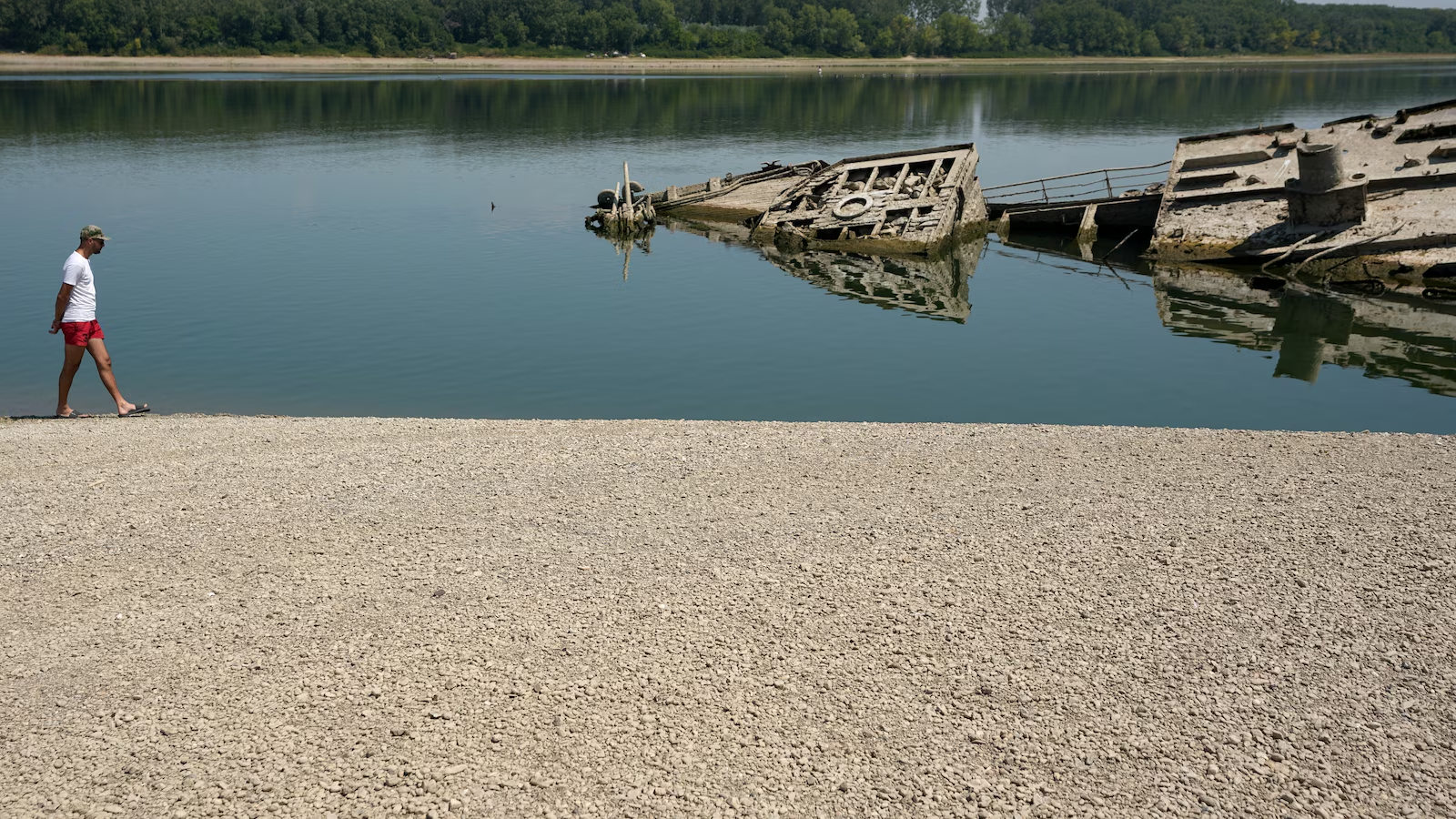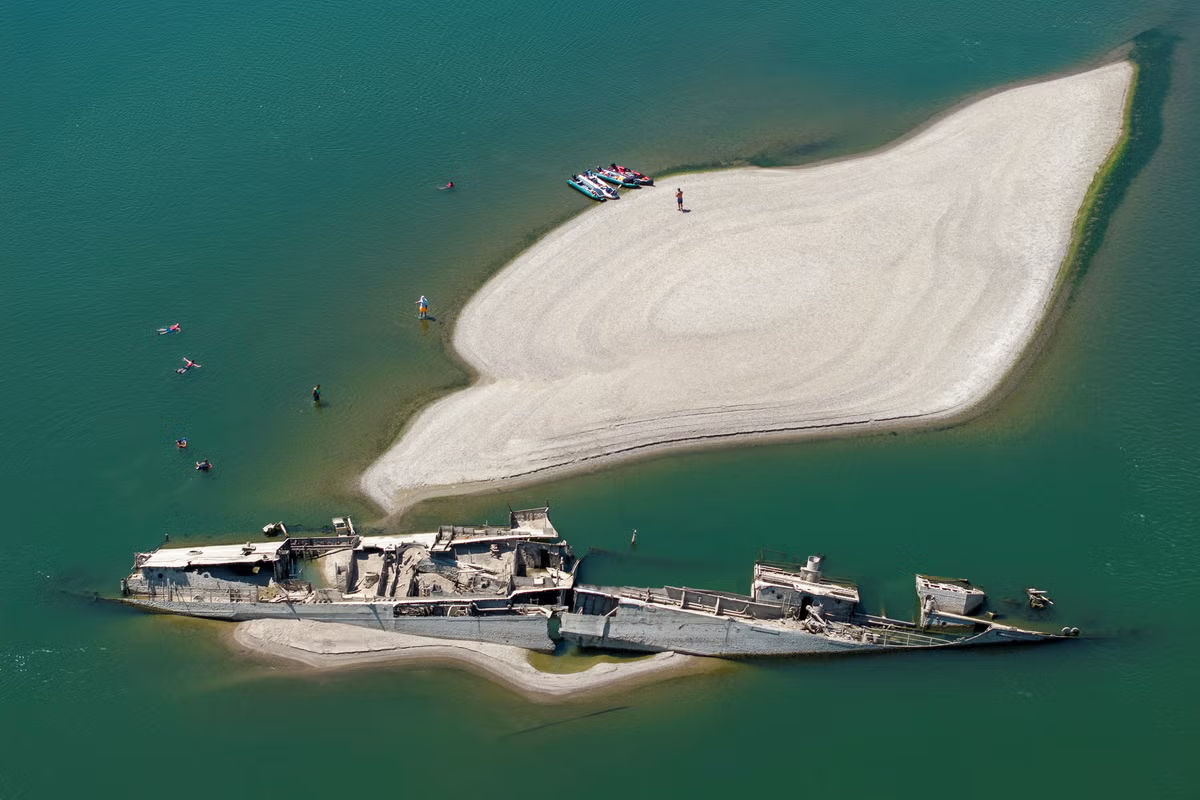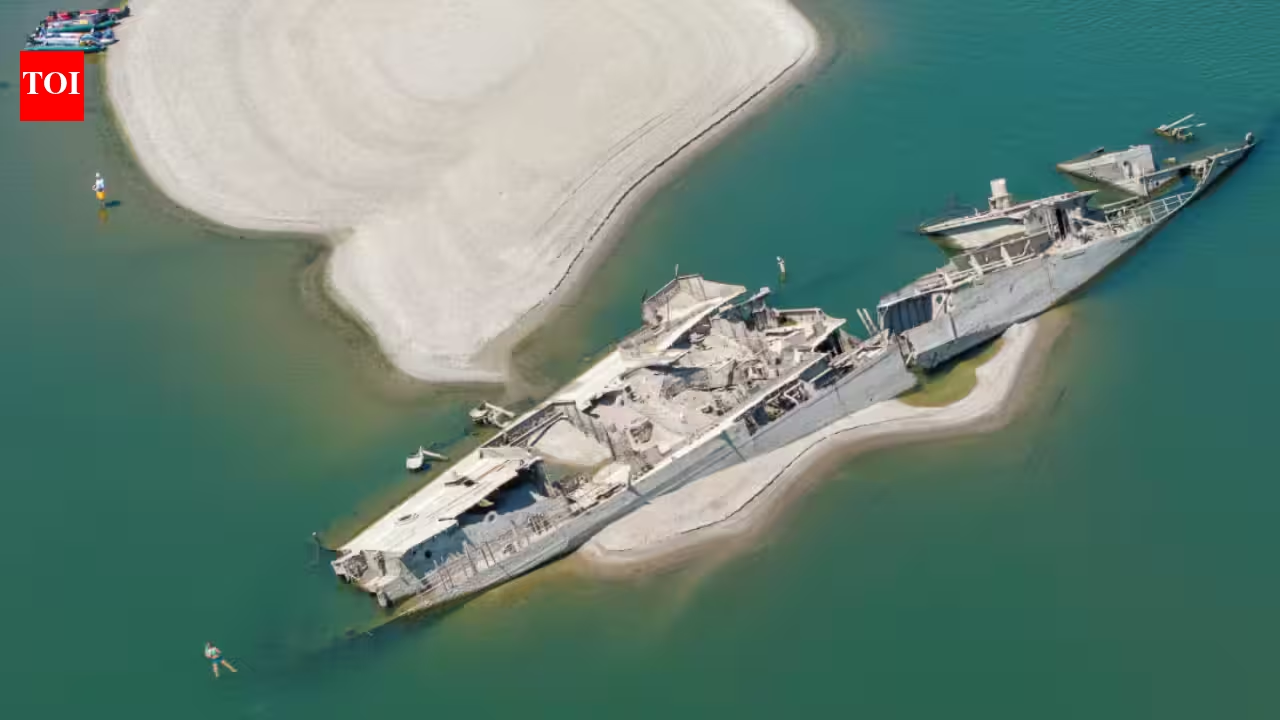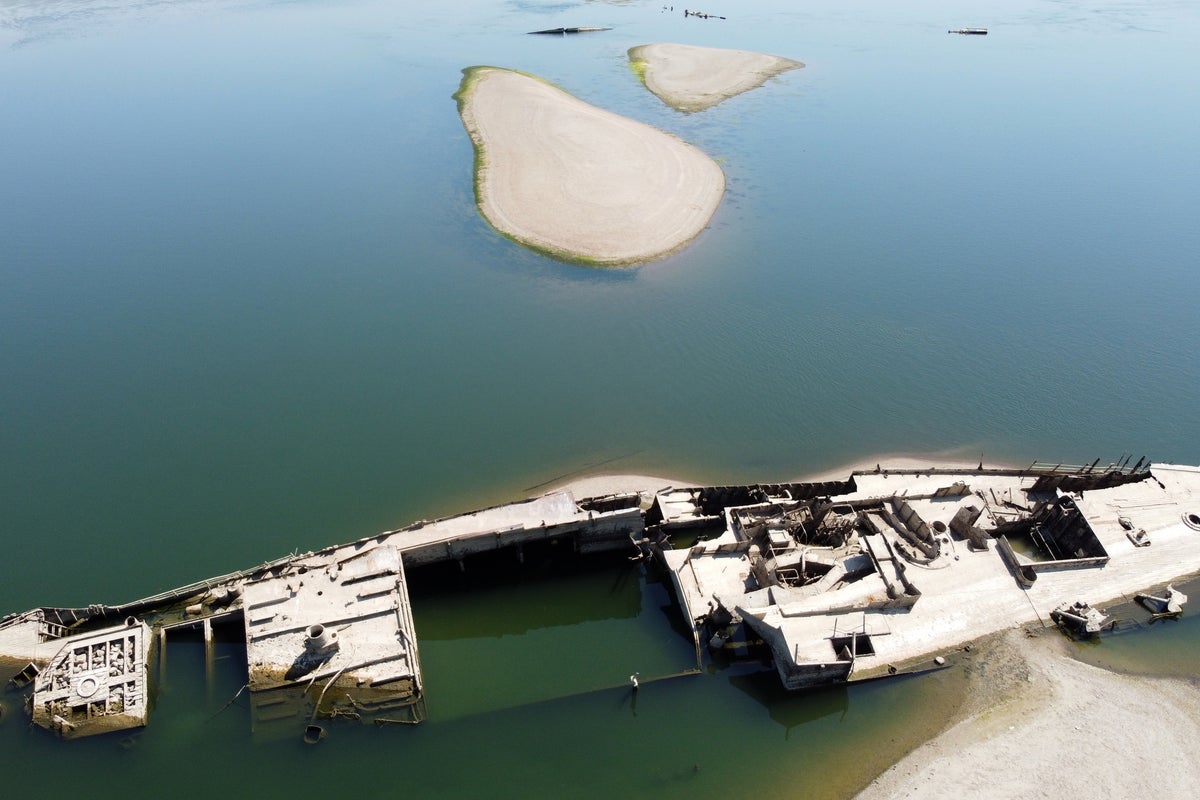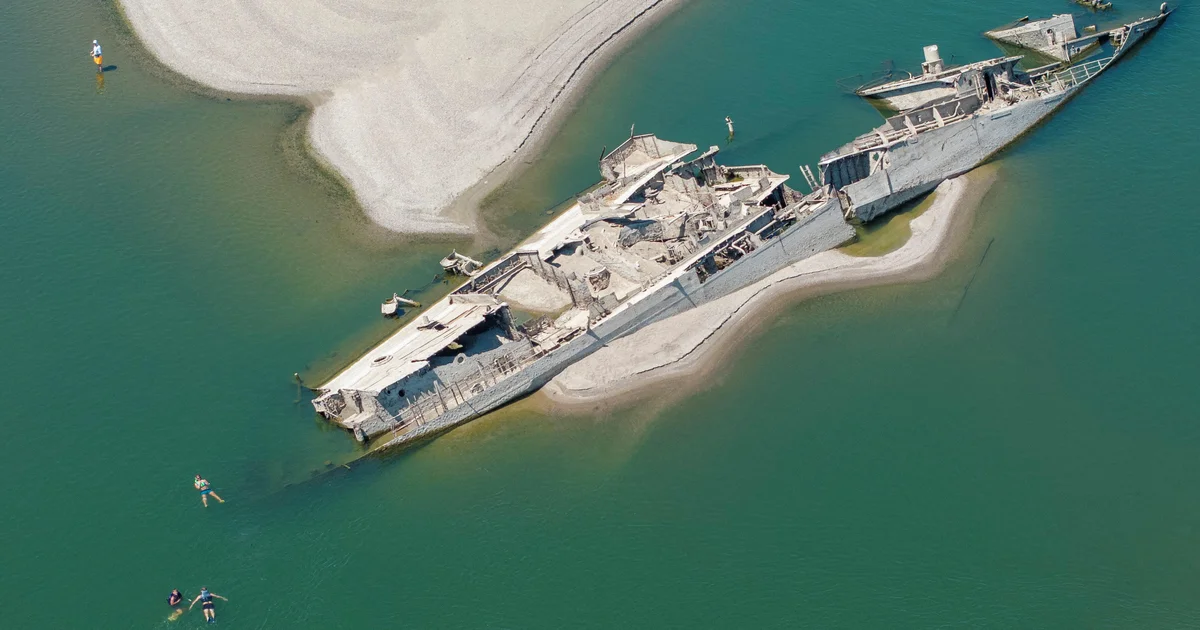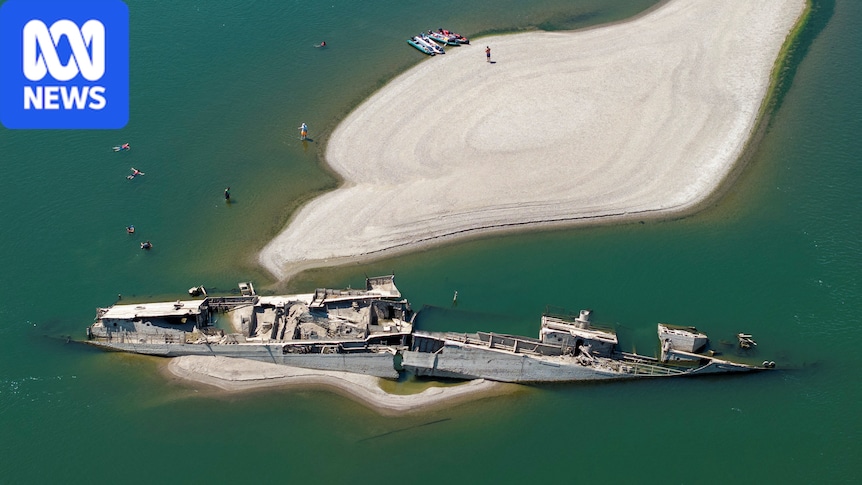
In the middle of the Danube river separating Serbia and Romania, a rusty hull is visible along with a broken mast.The ship, near the Serbian port of Prahovo, laden with weapons, belonged to Nazi Germany's Black Sea fleet.Baking temperatures and drought have driven water levels to record lows across large parts of central and eastern Europe, exposing historic and prehistoric relics.Extreme conditions aggravated by the climate emergency have left Europe's waterways from the Netherlands to the Black Sea parched.The ground is dry where cruise ships and ferries once docked.Fishermen are out of work, vessels are stranded and crucial power plants are on the brink of closure.Flows through the Danube, Europe's second-longest river, are the lowest they've been in decades, exposing rocks, old shipwrecks, a WWII bomb and even the remains of an extinct species.At least 20 World War II wrecks are visible to the naked eye from the banks of Prahovo.Historians say up to 200 German warships were scuttled in September 1944 near Prahovo in the Danube gorge as they came under Soviet fire. The idea behind the deliberate sinking was to slow down the Soviet advance in the Balkans.But Nazi Germany surrendered months later, in May 1945. A drone view shows a sunken German warship from World War II near Prahovo.(Reuters: Djordje Kojadinovic) At least 20 World War II wrecks are visible in the Danube.(Reuters: Djordje Kojadinovic) Locals have been inspecting the sunken German warships.(Reuters: Djordje Kojadinovic)Over in the Bulgarian village of Ryahovo, residents discovered the bones of what is believed to be a woolly mammoth. Scientists believe they found remains of an ancient mammoth.(Reuters: Lyuboslav Yordanov/Slivo pole municipality) Scientists have so far identified a mammoth jawbone, fragments of tusks, part of a shoulder blade and a femur.(Reuters: Lyuboslav Yordanov/Slivo pole municipality)Rousse Regional Museum of History director Nikolay Nenov said scientists had so far identified a jawbone, fragments of tusks, part of a shoulder blade and a femur. Scientists have been examining the mammoth remains.(AFP: Rousse Regional Historical Museum)In the port city of Vidin, almost 200 tourists had to be evacuated from a cruise ship after it ran into a shoal.Meanwhile, authorities in Budapest were forced to close the Margaret Bridge after a wartime bomb was exposed at its base. The dried-up Danube in Budapest.(Reuters: Marton Monus)Experts have linked the record low water levels to global warming and other factors.According to the Copernicus climate service, Europe is the fastest-warming continent, heating up twice as fast as the global average.It is causing increased summer heatwaves, greater pressure on Europe's waters and more intense wildfires.Drought knows no bordersIn Serbia, hundreds of small boats and dozens of cargo ships are marooned on the dried-out river bank near the northern city of Novi Sad.Houseboat owner Radovan Segrt, who runs river excursions on his vessel, told The Associated Press that the water in the Danube had withdrawn "some 15 to 20 meters from its shore"."The summer season is over now, as far as boat riding is concerned," he said.At the Vidin-Calafat Bridge connecting Bulgaria and Romania, Bulgarians said they were out of work because the low water levels had trapped their boats onshore."It's never dried up this much before," fisherman Rossen Dobrev told Agence France-Presse."Now we can even walk all the way to Romania." A cruise ship was stranded near Gonyu, Hungary.(Reuters: Marton Monus) Boats have been stranded at Batina in Croatia due to the low water levels.(Reuters: Antonio Bronic)But it is not just Serbia, Bulgaria and Romania that are suffering.In Germany and the Netherlands, water levels on the Rhine also fell to record lows, triggered by heatwaves and prolonged dry weather.Shallow Rhine waters have forced reductions of cargo on vessels to about 20 per cent of their normal capacity, sparking concerns about the economic fallout of having to limit navigation and shipping.The Rhine is a crucial shipping artery for grains, minerals, ore, coal and oil products. Boats lie in the partially dried-up Rheinauhafen harbour basin on the Rhine river in Cologne.(Reuters: Thilo Schmuelgen)Marcel Beck, manager of the western German ports of Neuss, Düsseldorf and Cologne at RheinCargo, said the water levels were having a "devastating impact" on shipping."A ship that would normally carry 2,000 to 2,500 metric tons of cargo can now only transport 400, perhaps 600, metric tons depending on the ship's design," he said."This places an enormous burden on the entire transport chain to reorganise everything in order to still get the goods inland." Parked boats in Novi Sad, Serbia.(Reuters: Djordje Kojadinovic) Usually submerged areas of the Danube are exposed amid low water levels in Rasova, Romania.(AP: Andreea Alexandru) Sand banks have formed in parts of the Danube river in Romania.(Inquam Photos/George Calin via Reuters) Boats have been left stranded in Bezdan, Serbia.(Reuters: Zorana Jevtic)Meanwhile, in the United Kingdom, half of England and the whole of Wales are officially in drought. July is set to be the driest month on record as extreme heat continues.The dry spell has also led to shrinking rivers and lakes. The Environment Agency said nearly 80 per cent of England's rivers were seeing flows below normal or lower. The River Thames at Reading has recorded its lowest level on record.Firefighters responded to 393 wildfires across England and Wales in July, making it the busiest month on record.Power plants on brink of shutdownFor the first time in their history, Hungary and Romania had to shut down atomic reactors normally cooled by the Danube.The largest nuclear power plant in Hungary, the 44-year-old Paks, had been producing at one point only 240 megawatts of power rather than the usual 2,000. The Paks Nuclear Power Plant uses water from the Danube River.(Reuters: Bernadett Szabo) A power plant in Cernavoda, Romania, has been impacted by the low water levels.(Inquam Photos/George Calin via Reuters)Hungarian authorities have asked citizens to reduce energy use in the peak evening hours.In Romania, the Danube's water flow fell to 1,500 cubic metres per second, less than a third of its July average, according to the National Institute of Hydrology.Authorities have already shut down one reactor unit at the Cernavoda plant for safety reasons, which provides about 20 per cent of the country's power.Acting Prime Minister Ilie Bolojan also appealed to citizens to voluntarily limit electricity usage in peak evening hours. Romanian authorities even needed to conduct a controlled explosion in the river to direct cooling water to its sole operational nuclear plant. The Romanian Navy blasted rocks in a controlled explosion to divert the Danube water flow.(Inquam Photos/George Calin via Reuters)Two car plants in Romania run by Dacia and Ford have agreed to halt production for more than a fortnight to reduce electricity consumption.In Serbia, record-low Danube levels have pushed the country's key hydro-electric plant to operate with only 20 per cent of its capacity.Water levels are not expected to rise on the Danube in the coming days or even weeks as no significant rainfall is forecast.ABC with wires
World War II Nazi ships appear as Danube river dries up
Europe's second-longest river is carrying less water than it has in decades, revealing shipwrecks and shutting down nuclear reactors.
1,142 words~5 min read