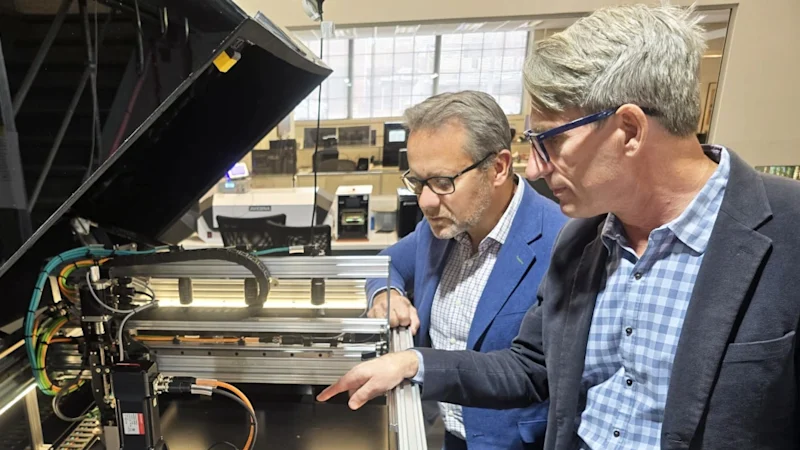
Building the ecosystemOne good example is the Life Science Incubator at QIMR Berghofer. Developed through a partnership between QIMR Berghofer and Altea Investments, it is the first internationally connected life sciences incubator of its kind in Australia.Building on Altea’s established network across Asia, it provides researchers, emerging companies and multinational organisations with access to cross-border innovation and commercialisation networks.Ryan says one of the city’s greatest strengths is the way universities, researchers, industry and government work together.“In life sciences, investment follows capability,” he says.“Investors want an environment that brings together research, clinical trials, advanced manufacturing, founders, capital and talent in proximity.”Ryan says specialised infrastructure is about more than providing laboratory space.He says Brisbane’s combination of the Translational Research Institute and the new Life Science Incubator at the Herston Health Precinct gives companies confidence they are entering a market designed not only for discovery but also for commercial growth.The city is also home to Australia’s fastest-growing working-age population, creating a growing pipeline of scientific, technical and commercial talent to support expanding businesses.The investment reflects the broader growth of Brisbane’s life sciences sector. Brisbane’s health sector contributes more than $22 billion to the economy, while medical and pharmaceutical exports have increased 114 per cent since 2013. More than $18 billion in state health infrastructure investment is strengthening the city’s research capability and commercialisation potential.For John Ratcliffe, chief executive of Altea Investment, a specialist manager of life science infrastructure – Australia’s scientific capability has never been the problem.“Australia remains a world leader in scientific research, in the top 1 per cent in 15 fields including clinical medicine and molecular biology,” Ratcliffe says.“Yet there remains a distinct lack of purpose-built facilities to translate that research into world-leading Australian products. And while Australia is a gateway to Asia, Australian researchers and innovators don’t always have the networks or connectivity to collaborate with partners across the region.”When Altea evaluates opportunities across Asia-Pacific, Ratcliffe says it looks beyond individual developments.“Talent is key. We look for established ecosystems anchored by leading research universities or institutions, in major gateway cities, catering to a wide range of science,” he says.“We look for places where there is critical mass, where the science and health infrastructure is concentrated and works together rather than where precincts are siloed or competing. This is where Brisbane stands out.”He says Brisbane’s knowledge corridor, stretching from the Translational Research Institute to Herston Health Precinct, brings together universities, hospitals, research institutes, government and industry in a way that is uncommon across the region.“All levels of government, industry and academia are pulling in the same direction, working together,” Ratcliffe says.Talent extends well beyond researchers and scientists.“People don’t need a hardship allowance to move across Asia to Brisbane,” Ratcliffe says. “The climate, the education system and the relaxed way of life are all natural drawcards. And being only a single direct flight from all major Asian cities is meaningful.”Partnerships are equally important to Altea’s investment model.“We act as a bridge for our partners to collaborate across Asia and for Australian firms looking to expand across the region,” Ratcliffe says.“We identify gaps within ecosystems and partner to bring the missing pieces to the market. We are long-term investors who build and enhance over time, rather than merely taking development profits and moving on.”Ratcliffe says that is the difference between simply providing laboratory space and creating an environment where innovation can flourish.“Being able to engage a single lab space provider across Asia greatly simplifies the approval process, making markets like Australia much more accessible,” says Ratcliffe.“This is important in a sector where governments have spent years competing to provide incentives to bring in global firms.“At Life Science Incubator, researchers, emerging companies and multinational organisations can work side by side as part of a much wider network across Asia.“For international companies, that means Brisbane is not simply offering laboratory space. It is offering established partnerships, research capability and commercial connections that can help turn scientific discoveries into products and businesses.”He says Brisbane Economic Development Agency has helped bring together the organisations needed to establish the Life Science Incubator at QIMR Berghofer.“Brisbane Economic Development Agency has been instrumental in this – they get all the right people in the room and keep it on our agenda when other priorities compete for attention.”The next wave of investmentGeography also continues to shape investment decisions, but Ratcliffe says the industry’s focus is also shifting towards two deeper changes.Anthony Ryan, chief executive of Brisbane Economic Development Agency, left, and John Ratcliffe, chief executive of Altea Investments. Sitting behind both is Australia’s formal association with Horizon Europe, announced in 2026, which gives Australian institutions direct access to the European Union’s €93.5 billion research and innovation program, with its focus on health, clean energy, space, digital technologies and agri-tech – areas that play to Brisbane’s strengths.The first is the convergence of biology with deep technology.“Many of the most important scientific breakthroughs will not emerge from a single discipline, but increasingly from the convergence of biology, data science, artificial intelligence, engineering and advanced computing,” he says, pointing to Cortical Labs, a Monash spin-out developing biological data centres from human neurons in partnership with the operator DayOne, as an early sign of where the sector is heading.The second is the continued diversification of pharmaceutical supply chains.“Supply chain diversification out of China is the second shift, with global pharma rebalancing manufacturing and clinical exposure across the region, and Brisbane stands to benefit if the infrastructure arrives in time,” he says.Ratcliffe says capital is also returning to the sector.“APAC private real estate fundraising is expected to rebound in 2026 after a hard four years, and Brisbane sits in a strong position to capture its share.”Taken together, Ratcliffe says these trends reinforce a broader point. Success will depend less on building impressive facilities than on curating places where researchers, entrepreneurs, investors and multinational companies can work together and commercially thrive.“Developing elegant spaces is not enough,” he says. “Innovation is a people business, not an infrastructure business.”To find out more, please visit Choose Brisbane.
Where biotech goes to grow
As health innovation and biotechnology companies expand across Asia-Pacific, they are looking beyond research capability towards places that support growth.
997 words~5 min read