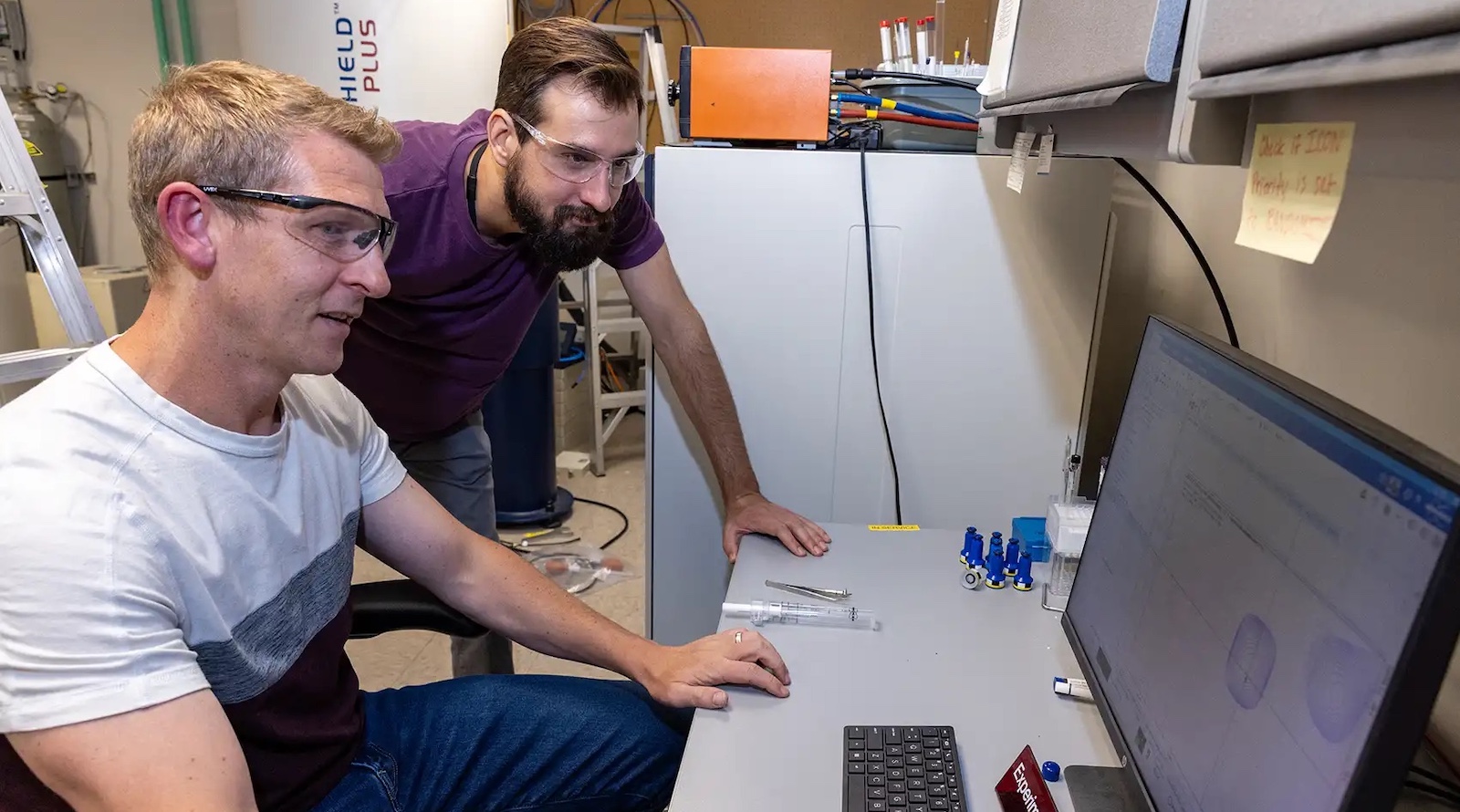
National Laboratory of the Rockies (NLR) scientists Bennett Addison (left) and Ross Kerner study results from a nuclear magnetic resonance (NMR) scan of a semiconductor material. Their curiosity and keenness to venture into NMR's lesser-used methods have shown that discoveries are around the corner in many energy applications. Photo by Agata Bogucka, National Laboratory of the Rockies.
Support CleanTechnica's work through a Substack subscription, on Patreon, or on Stripe. Help us produce all of the high-quality, original content we publish week after week despite the challenges of content-scraping AI, antisocial media, inflation, and other hurdles.
National Laboratory of the Rockies Researchers Use Nuclear Magnetic Resonance To Advance Innovation in Batteries, Semiconductors, and Bioplastics
When researchers bring their inventions into the laboratory of Bennett Addison, he often has one question for them: “Did you really make what you think you made?”
At the atomic level, the answer is often no. Companies think they made a pristine semiconductor, but it falls short of expected performance. A scientist thinks they made a robust synthetic fiber, but it breaks down inexplicably. They are both overlooking an 80-year-old art form of spinning atoms with magnets that resolves atomic structure incomparably well across so many domains: nuclear magnetic resonance (NMR).