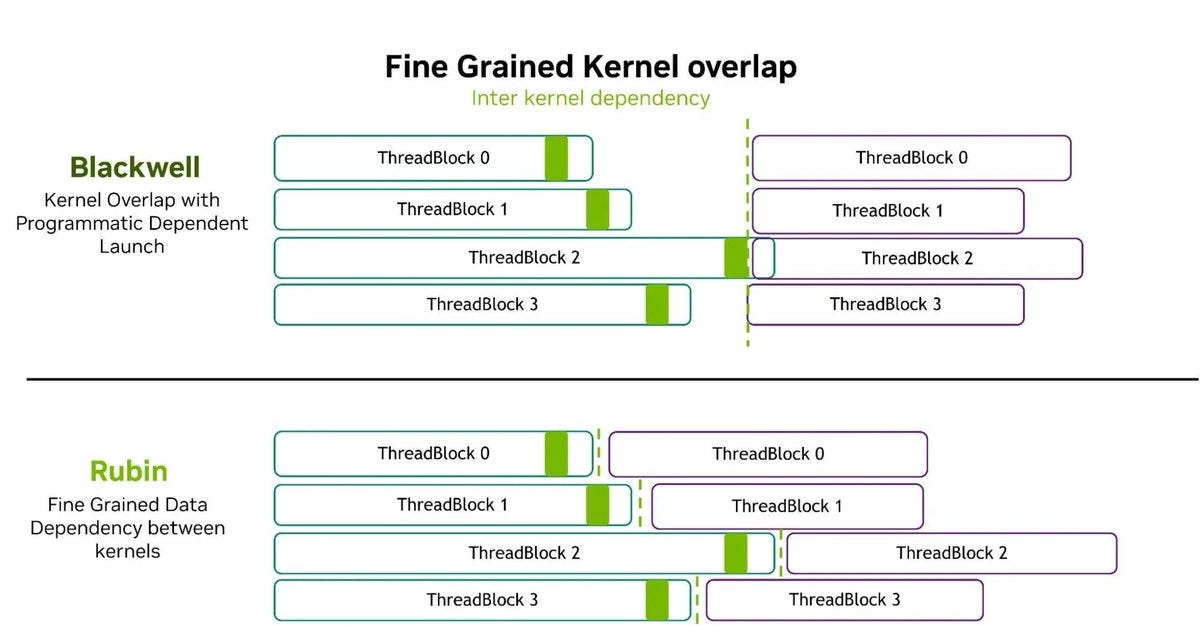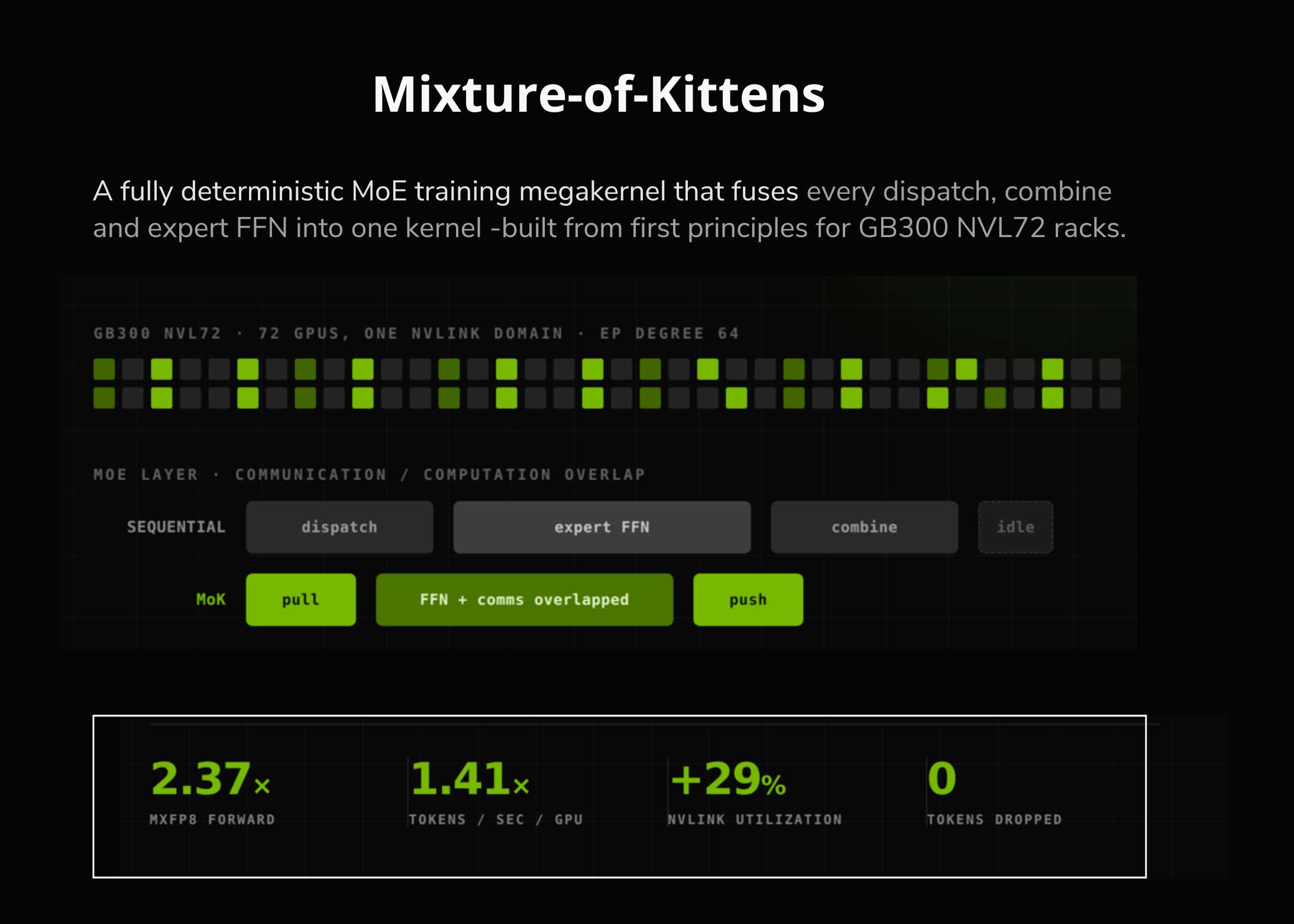
Cursor Research has open-sourced Mixture-of-Kittens (MoK), the mixture-of-experts training megakernel behind its Composer models. MoK fuses every MoE communication and computation step into a single deterministic kernel. Cursor team reports up to 2.37x higher throughput than the strongest public baseline. It already powers Composer training across tens of thousands of GPUs.
Is it deployable
Yes, but the hardware floor is high. MoK is on GitHub under Apache-2.0. It requires NVIDIA Blackwell SM100 or SM103 GPUs, which means GB200 NVL72 or GB300 NVL72 racks. It also needs Python 3.12+, PyTorch 2.10+, and CUDA toolkit 13.0+. Inter-GPU buffers rely on PyTorch symmetric memory.
That limits realistic adopters to organizations that own or rent NVL72 capacity. Frontier labs, funded model startups, GPU neoclouds, and national computing centers fit. Single-node teams and 8-GPU shops do not.
Applications are narrow but high-value. They include pretraining and post-training of DeepSeek-V3-style MoE models. Determinism also makes it useful for on-policy RL post-training and internal ablations. Relevant industries are AI model development, cloud GPU infrastructure, code-generation tooling, and quantitative research.