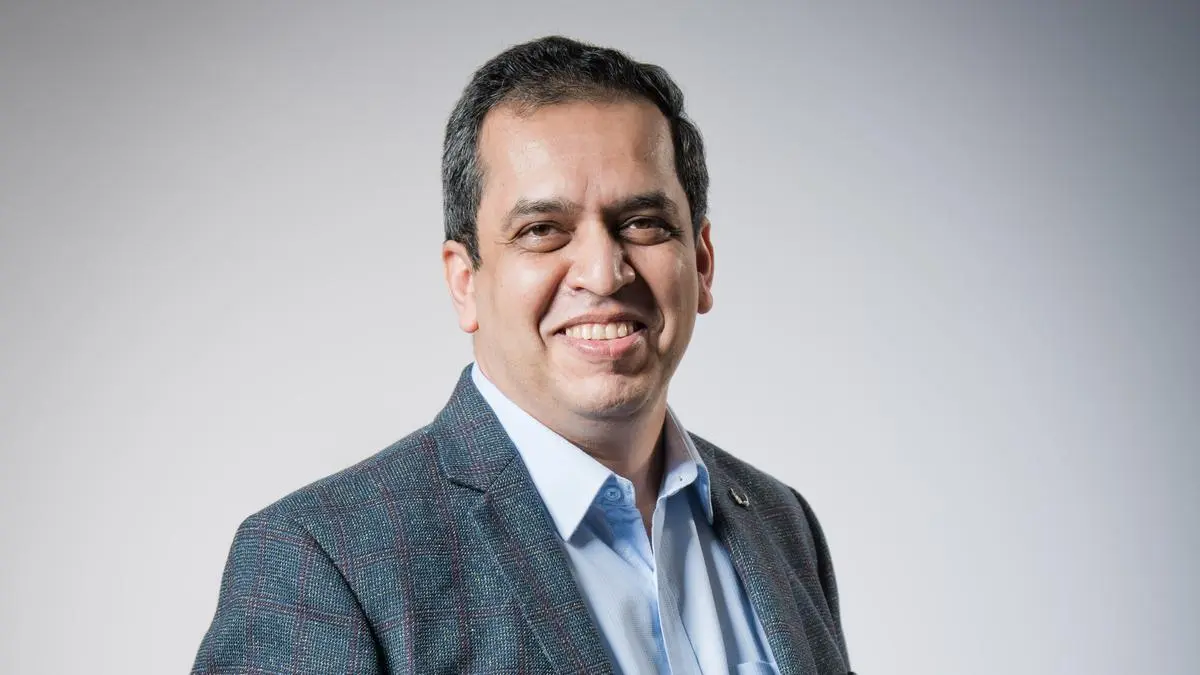
Persistent Systems reported a consolidated net profit of ₹483.04 crore for the June quarter, up 13.7 per cent year-on-year but down 8.7 per cent sequentially due to forex losses. Revenue from operations climbed 29 per cent year-on-year and 6.1 per cent quarter-on-quarter to ₹4,303.22 crore.In an interaction with businessline, Vinit Teredesia, Executive Director and Chief Financial Officer, discussed the company’s growth outlook, the impact of AI on client spending, the rationale behind the Nagarro acquisition, hiring trends, and why the company remains confident of sustaining 16–20 per cent growth this fiscal.Can you highlight a few key developments during the quarter?The PAT margin was down substantially because of unrealized forex losses. Our year-on-year growth was broad-based, with all verticals growing around 16 percent. Growth was led by Hi-Tech, particularly due to the large deal. Even in general, the vertical has seen good momentum. The banking and financial services vertical grew by around 2 percent. Healthcare has been our rock star vertical over the last couple of years. We don’t see any structural challenges; the sector is simply going through a phase of consolidation.Operating margin came in at 16 percent. This quarter, a major impact was due to a bit of ramp-up of our headcount. We added 1,100-plus people, mainly to take care of a few large deals we signed towards the end of the quarter and those anticipated to close in Q2. This is why our utilization, which we had held at 88 percent, dropped down to 86.5 percent.We were impacted by unrealised forex losses, primarily due to the revaluation of our hedged positions. The hedging strategy worked as intended by offsetting currency volatility. Unlike previous quarters, the rupee appreciated marginally between March 31 and June 30, resulting in a mark-to-market loss on assets that were revalued at the end of the quarter. In earlier quarters, rupee depreciation had led to valuation gains. We are not concerned about these forex losses as they are unrealised, and the hedging strategy continues to serve its purpose. Based on exchange rate movements in July, we would have recovered nearly 50 per cent of these losses.We crossed an annual contract value (ACV) order book of $1 billion for the first time, giving us confidence in sustaining 16–20 per cent revenue growth for the rest of the year. We expect operating margins to remain in the 16–17 per cent range. During the quarter, we signed a major deal with a leading North American technology client, with a total contract value (TCV) of $650 million over 6.5 years and an ACV of $125 million. This also strengthens our confidence in achieving a $2 billion revenue run rate by FY27.What are you hearing from clients amid the current macroeconomic uncertainty? What headwinds or tailwinds do you expect for the rest of the year?The macroeconomic environment has been challenging. We are focused on product and platform digital engineering and not too much on generic IT services. This has been a core advantage in terms of growth.We have been focused on three verticals--BFSI, Hi-Tech, and healthcare and life sciences- which has helped us narrow down our offerings. The maturity of our AI tools has been well received by customers. Clients expect greater value from the same level of spending and are looking for efficiency gains within their existing budgets.Customers expect you to use AI tools, build different models for them, be innovative in delivering solutions, and show them the benefits. At the same time, they are not yet ready to sign too many large and long-term deals on outcome-based pricing. The mindset is still time and materials, people-based.We do not win deals primarily through RFPs. Instead, we take a proactive approach by going to customers, identifying their problem statements, explaining how we can solve them, and highlighting the benefits they can achieve. This has been one of our key differentiators, helping us win more business and position ourselves more effectively in the market.How would the merged Persistent-Nagarro entity be structured, and what impact would it have on workforce rationalisation?During the quarter, we announced our intent to acquire Nagarro’s shares, a digital engineering company listed on the Frankfurt Stock Exchange, whose capabilities are highly complementary to ours.Nagarro strengthens our portfolio with SAP capabilities, while we bring cloud and infrastructure managed services. The acquisition is also geographically complementary, with Nagarro’s strong presence in Europe and the Middle East, and our strength in North America. It also expands our footprint in markets such as Japan and adds new industry verticals, including manufacturing, consumer, retail, utilities and automotive. Together, banking and financial services and high-tech would each become nearly $750 million businesses.We have filed the necessary applications with regulators and remain on track to complete the transaction, subject to approvals, by the end of this calendar year or early next year.This is a strategic acquisition, not one aimed at workforce rationalisation. The focus is on leveraging the complementary strengths of both companies. The two companies also share a similar entrepreneurial and innovation-led culture.From a legal and regulatory standpoint, Nagarro is expected to continue operating as a separate listed entity for at least the next one to two years, although it will all depend upon how much subscription we get.How has your investment in AI and GenAI capabilities influenced your ability to win business amid ongoing vendor consolidation among clients?Every IT company now has some AI-led offering. Customers are asking us to deliver more value with the same level of spending or help them achieve the same outcomes with less effort and lower costs. Those are the key priorities. Order wins alone are not enough. The real measure of AI maturity is whether they convert into meaningful revenue.We believe Persistent is well positioned with offerings such as SASVA, iAURA, and its GenAI solutions, which are proprietary tools and accelerators developed over time. Customers have seen tangible value from these capabilities, often opening up opportunities in areas where we were not previously engaged. Ultimately, the real proof lies in whether customers see measurable value, and we believe Persistent is delivering on that front.Are you seeing increased demand for hiring forward-deployed engineers, given that many of your peers have highlighted it as an emerging trend?There is demand. We are also looking at hiring a couple of forward-deployed engineers. But it’s too early to determine how many because, at the end of the day, we go to a customer and showcase them the value. Not everybody’s ready to absorb this. That being said, we are also hiring a couple of FDEs and trying to deploy them in our customer base, particularly the large and key accounts, where we do see value and opportunity.
Nagarro acquisition to expand Persistent’s industry reach and geographic footprint: CFO
Persistent Systems aims for sustained growth through the Nagarro acquisition, enhancing its industry reach and geographic presence.
TL;DRAI
Persistent acquires Nagarro to add SAP capabilities and European market reach, targeting $2 billion revenue by FY27. Clients prioritize AI cost efficiency within fixed budgets; vendors must deliver value without outcome-based pricing, accelerating consolidation.
1,105 words~5 min read