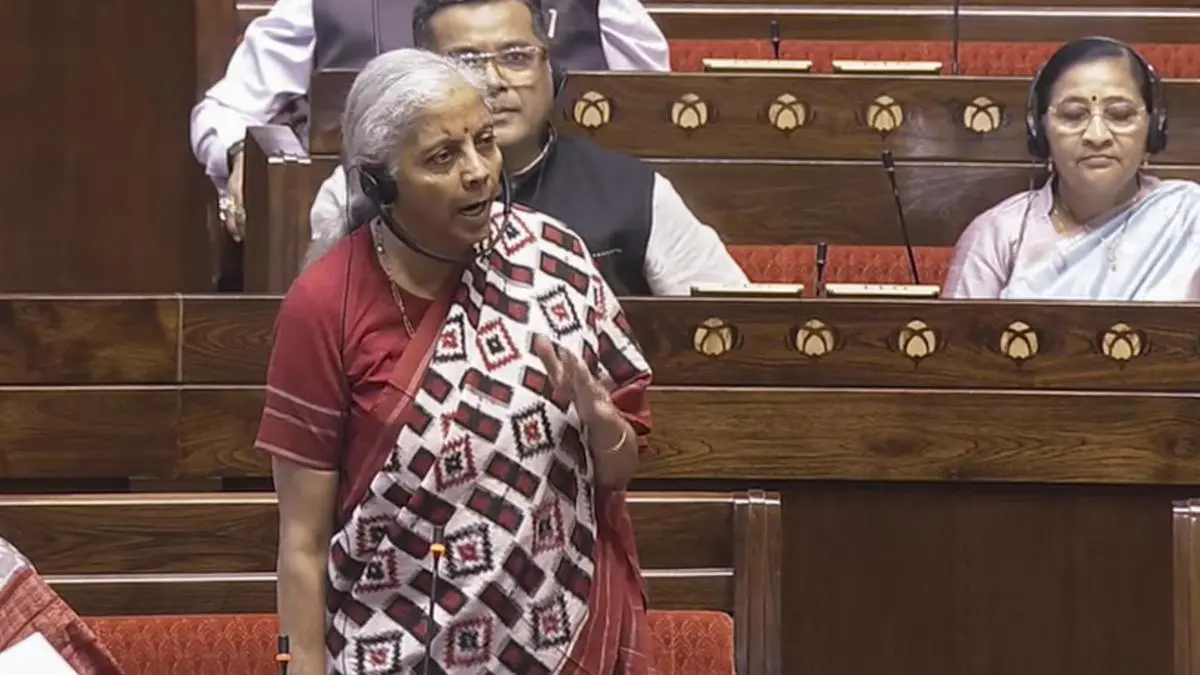
Finance Minister Nirmala Sitharaman speaks in the Rajya Sabha during the Monsoon session of Parliament, in New Delhi, on Tuesday
| Photo Credit:
The Taxation and Other Laws (Amendment) Bill (ToLA) aims to make India a more attractive and predictable place for global capital, manufacturing and business to come and stay, sources in the Finance Ministry said. Further, they said there are three broad themes: Attracting Foreign Capital, Make in India and Ease of Doing Business.Finance Minister Nirmala Sitharaman introduced the Bill in the Lok Sabha on Tuesday. The Bill aims to amend Finance Act 2026, the Income Tax Act 2025 and the Payment and Settlement Systems Act beside repealing an ordinance promulgated in June to provide tax exemption to foreign investors.Talking about themes of ‘Attracting Foreign Capital’ and ‘Ease of Doing Business’ a source explained that overseas players are often unsure whether operating in or through India will create an unexpected tax exposure. Various proposals of the Bill give clear, stable and predictable tax treatment as well as a process to get the desired tax treatment. One such proposal is reducing the number of conditions to 5 from 13 for Eligible Investment Fund (EIF) managed from India to avail tax exemption on its global income.“The Bill cuts this list of conditions down sharply, keeping only what is essential to prevent misuse and round tripping of money by Indian residents. A fund manager can now relocate to India without the foreign fund being treated as doing business in India,” a source said. .Proposal for data centre aims to bring clearer and simpler rules for data centres Foreign cloud companies that use Indian data centres were earlier promised a tax exemption, but with conditions of clearing several layers of government notification and approval. The proposed Bill removes these approval requirements and, importantly, allows Indian data centres to be run on a leased basis rather than only under direct ownership.Long-term certaintyOn the issue of theme of ‘Make in India’, another source said that measures proposed in the Bill indents to give long-term certainty to global companies bringing equipment, components and materials to have goods made in India. For example, when a foreign company supplies machinery and tooling to an Indian factory that makes electronics on its behalf, its income from doing so was made tax free. The time limit was set as five years.“Based on representations from stakeholders, it was felt that the exemption window is too short to plan large, long-term investments. The Bill extends this exemption by another 10 years, giving a much longer horizon of certainty. Now, total exemption period is 15 years (i.e.) into FY 2040-41,” he said. The Bill also clearly defines the electronic goods covered under the provisions such as mobile phones, laptops, personal computers, tablets, servers and their key parts and accessories.Talking about proposal for rough diamond, sources explained that since 2016, foreign diamond miners have been allowed to display rough diamonds in special zones in Mumbai and Surat without being taxed merely for showing them. Now the Bill fully exempts the income of foreign diamond miners and the traders connected with them (i.e.) sight holders, brokers, aggregators and auction houses, from selling rough diamonds in these zones, for a period of 15 years.“The aim is to shift a meaningful share of the global rough diamond trade to India and to build a financing ecosystem around it,” second source concluded.Published on August 4, 2026