(Image credit: Future)
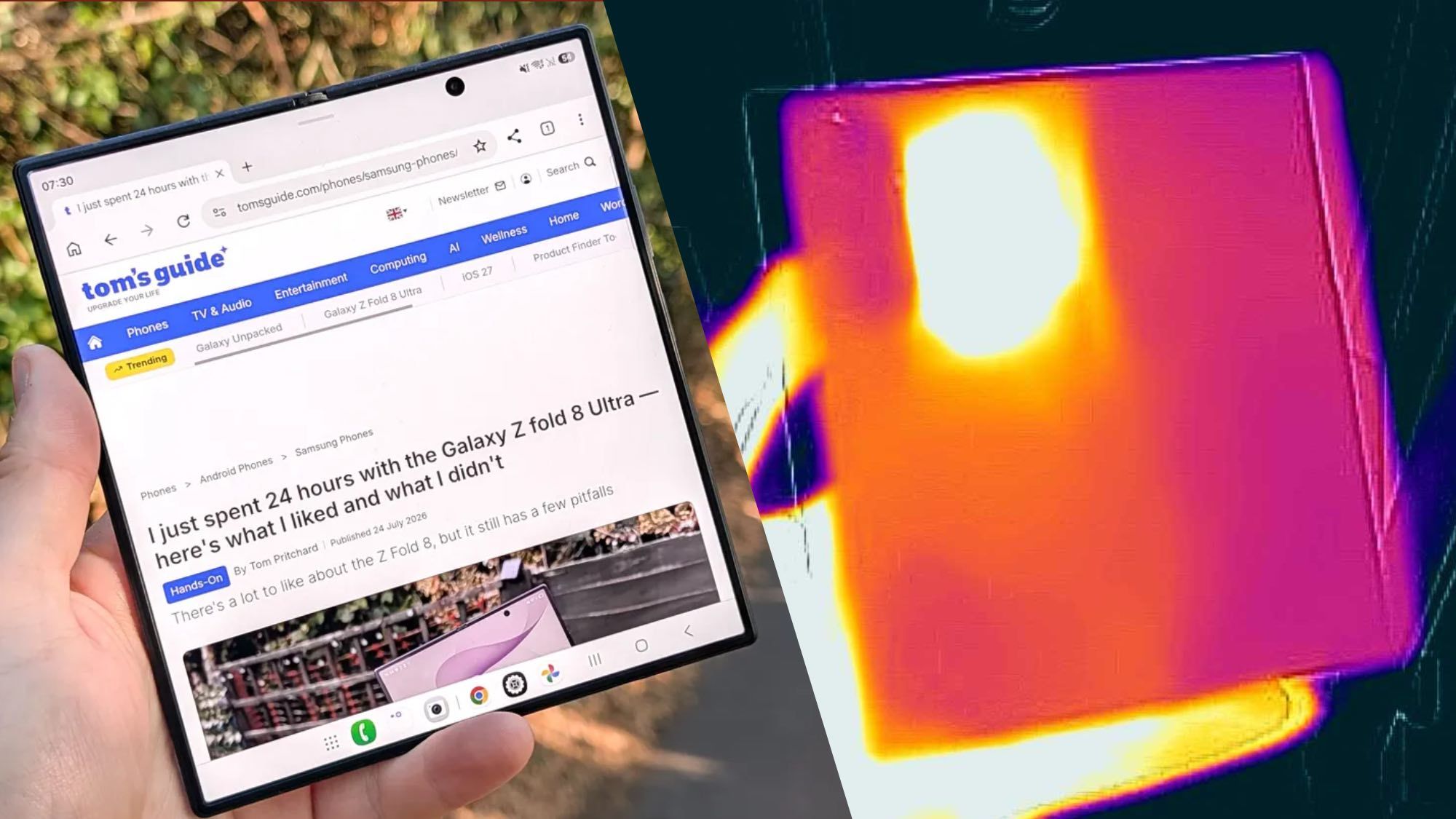
Samsung has packed a bunch of upgrades into the new Galaxy Z Fold 8 Ultra, but the one noticeable absence is the lack of any sort of active cooling system. The Galaxy S26 Ultra has a built-in vapor chamber to prevent heat build-up, and similar features have existed in non-folding flagships for over a decade.The question isn't why hasn't Samsung added a vapor chamber to its foldables yet, it's whether that actually matters. The Galaxy Z Fold 8 Ultra has the same super-powered Snapdragon 8 Elite Gen 5 for Galaxy chip as the S26 Ultra, and I was curious how much heat would actually build up in both phones — and more importantly, where it ends up.So I grabbed my trusty thermal camera, the Flir One Pro, and set up the Galaxy Z Fold 8 Ultra alongside the Galaxy S26 Ultra, Galaxy Z Fold 7 and the iPhone 17 Pro Max side by side. Then, by running 3DMark's Solar Bay Extreme Stress Test, I recorded just how much heat all four phones produced.Is it getting hot in here?Left to right: S26 Ultra, iPhone 17 Pro Max, Z Fold 8 Ultra, Z Fold 7 (Image credit: Future)If you look at the video of all four phones, you can see that the Galaxy S26 Ultra starts heating up the fastest, hitting around 30C/86F in around a minute. The iPhone 17 Pro Max isn't that far behind, though the Z Fold 8 Ultra and Z Fold 7 both seem to be heating up a lot more slowly in their folded state.The S26 Ultra seems to concentrate most of its heat in the top left corner, on the opposite side of the phone to the vertical camera bar. Meanwhile, the iPhone 17 Pro Max has a large section of heat across its top half, where the raised plateau camera bar is — which makes sense considering Apple designed the camera bar to help dissipate heat.