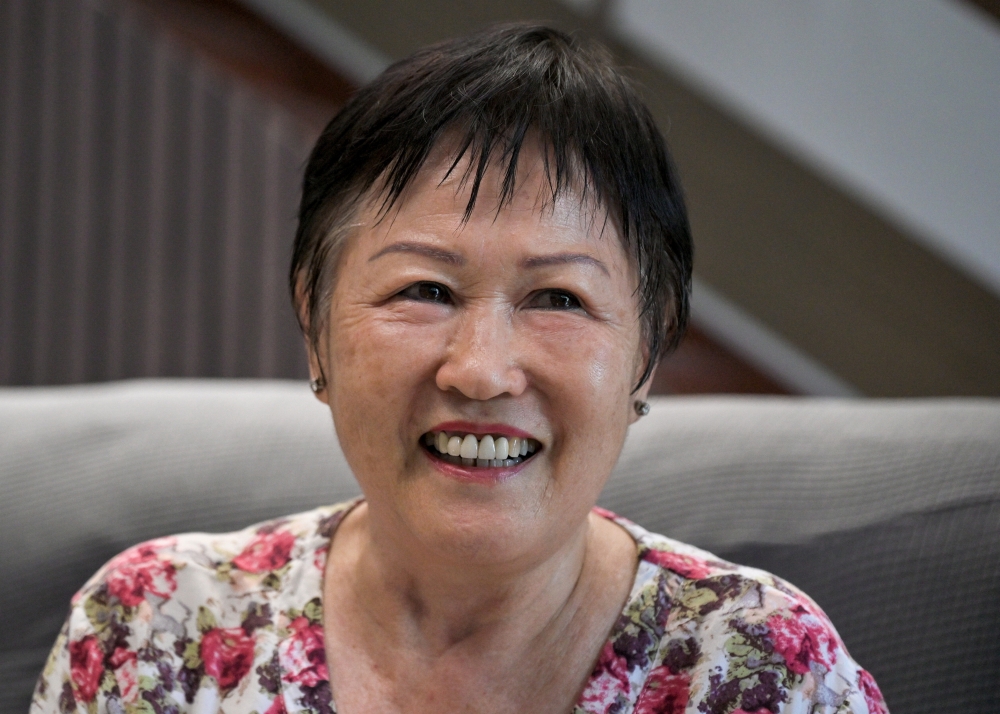
Retired teacher Linda Tai Shon Lian. — Bernama pic First Published: Tuesday, 04 Aug 2026 12:31 PM MYT KUALA LUMPUR, Aug 4 — At first glance, few would guess that retired teacher Linda Tai Shon Lian, 69, speaks Malay with such remarkable fluency that many mistake her for a Malay or Peranakan Chinese.However, among residents of Taman Bukit Teratai in Ampang, the ethnic Chinese woman is better known by the nickname “OCBC” — short for “Orang Cina Bukan Cina” (Chinese who is “not Chinese”). Far from being an insult, the nickname reflects her exceptional command of the Malay language, including the Melaka and Negeri Sembilan dialects, as well as her deep appreciation of local culture, which has made her widely accepted in the multi-ethnic community.Affectionately known as Mami Linda, her talents extend well beyond speaking Malay. She is adept at composing and reciting pantun (traditional Malay poetry), sings classic and traditional Malay songs with authentic flair, can read and write Jawi, and understands Malay and Indian customs better than those of her own ethnic community.According to Mami Linda, none of this was planned. It was simply the result of the environment she grew up in, having spent her childhood in a predominantly Malay community in a row of shop houses in Kampung Pantai Belimbing, Melaka. She also had a Malay foster family whom she fondly called “Abah” and “Mak Ros.”“From childhood until adulthood, my family always spoke Malay and the Negeri Sembilan dialect because our village was located near the Melaka-Negeri Sembilan border. In fact, I only learned Chinese from my husband after moving to Kuala Lumpur when I became a teacher in 1982.“My Chinese has never been very fluent, which is why friends and neighbours here call me OCBC because I look Chinese but can’t really speak Chinese. I don’t mind the nickname because my heart is Malay. Our family’s way of life has always embraced Malay culture,” she told Bernama during a recent interview at her home.The mother of two recently attracted attention on social media after videos uploaded by her daughter on the TikTok account @Jamine Leong Ai Len, showing her singing 1990s and traditional Malay songs, garnered thousands of views, likes and comments.Many viewers were not only impressed by her authentic pronunciation and vocal style but also wondered how she had become so fluent in Malay.Some even suggested that the former English and Mathematics teacher be appointed an ambassador for the Malay language among non-Malays, describing her as proof that the national language can unite Malaysians regardless of race or background.Her close affinity with Malay culture is also reflected in her cooking. Mami Linda is skilled at preparing traditional dishes such as Melaka-style asam pedas, rendang and soy sauce chicken, and frequently receives orders from her Malay friends, especially during festive seasons.She said living among the Malay community also taught her the halal and haram aspects in food preparation, giving her friends confidence in enjoying her cooking.Her fluency in Malay has also made her the go-to person for friends who are less proficient in the language when dealing with government agencies or accessing public services.“I was born in the year of Merdeka, and most of my friends, who are also senior citizens, are not fluent in Malay. Perhaps they didn’t grow up in villages like I did. Many of them ask me to accompany them to places like clinics to help make things easier,” she said.For Mami Linda, her love for the Malay language and culture has never diminished her identity as a Chinese Malaysian. Instead, it has enabled her to better understand other communities and appreciate the diversity that is Malaysia’s greatest strength.With that belief, she enrolled both her children in national schools so they could master Malay. She also sent them for religious classes to learn Jawi, believing that the national language provides the foundation for mutual understanding and unity among various races.“I have a good relationship with the ustazah, and my children can recite prayers such as the ‘doa penerang hati’. They are grown up now and speak Malay just like I do. We are still Chinese, and embracing Malay culture has never taken away our ethnic identity,” she said.Meanwhile, Prof Dr R. Ramalinggam, a lecturer at the Faculty of Law at Multimedia University, said Mami Linda’s story proves that the Malay language is not merely a means of communication but also a vehicle for national unity that bridges gaps between people of different ethnic backgrounds.He said mastering the national language does not erode one’s ethnic identity, as Malaysians can continue preserving their mother tongues while becoming proficient in Malay.“When we master another community’s language, we are essentially opening the door to its culture. I grew up in a Malay community myself, so Malay became a language that I mastered well.“I believe that loving the Malay language never requires us to abandon our mother tongue. Instead, Malaysians are fortunate to be able to master more than one language,” said Ramalinggam, a member of the Dewan Bahasa dan Pustaka Board of Governors. — Bernama
Meet ‘OCBC’: Retired teacher Linda Tai Shon Lian wins hearts with flawless Malay fluency
KUALA LUMPUR, Aug 4 — At first glance, few would guess that retired teacher Linda Tai Shon Lian, 69, speaks Malay with such remarkable fluency that many mistake her for a Malay...
840 words~4 min read