Perge, the jewel of ancient world
The ancient city of Perge, Türkiye’s oldest continuously ongoing excavation in the field of classical archaeology, sheds light on the ancient world. Former excavation head Professor Sedef Çokay Kepçe spoke to daily Hürriyet about the mysterious story of the city.
Located within the borders of Antalya’s Aksu district, Perge was one of the most important ancient cities that served as the capital of the Pamphylia region and is considered the most orderly Roman city in Anatolia. The earliest data on the city, which developed during the Roman Empire period, date back to 5,500 B.C. Settlement continued uninterrupted until the 10th century A.D.
Stating that excavations at Perge began in 1946 and that they are the oldest continuously running archaeological excavations in the country, Kepçe said, “Our biggest advantage is that there was no settlement in the city after the 10th century A.D. Therefore, this allows us to reach finds in their final state at many points.
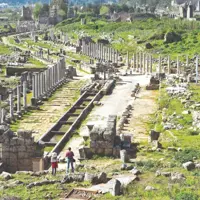
Outside the city walls, we have two major structures: our theater and our stadium. At the end of the Colonnaded Street, there is also a fountain where water coming down from the Acropolis flows. We have our necropolis area, the city of the dead. In the southwest, there is a structure dating back to the Roman Imperial period that we define as the ‘Southern Bath.’ We have a square-planned structure called the Macellum, which functioned as a meat and fish market. Shops are lined up along all the streets. Due to Sassanid and Arab raids, the city gradually disappeared.”