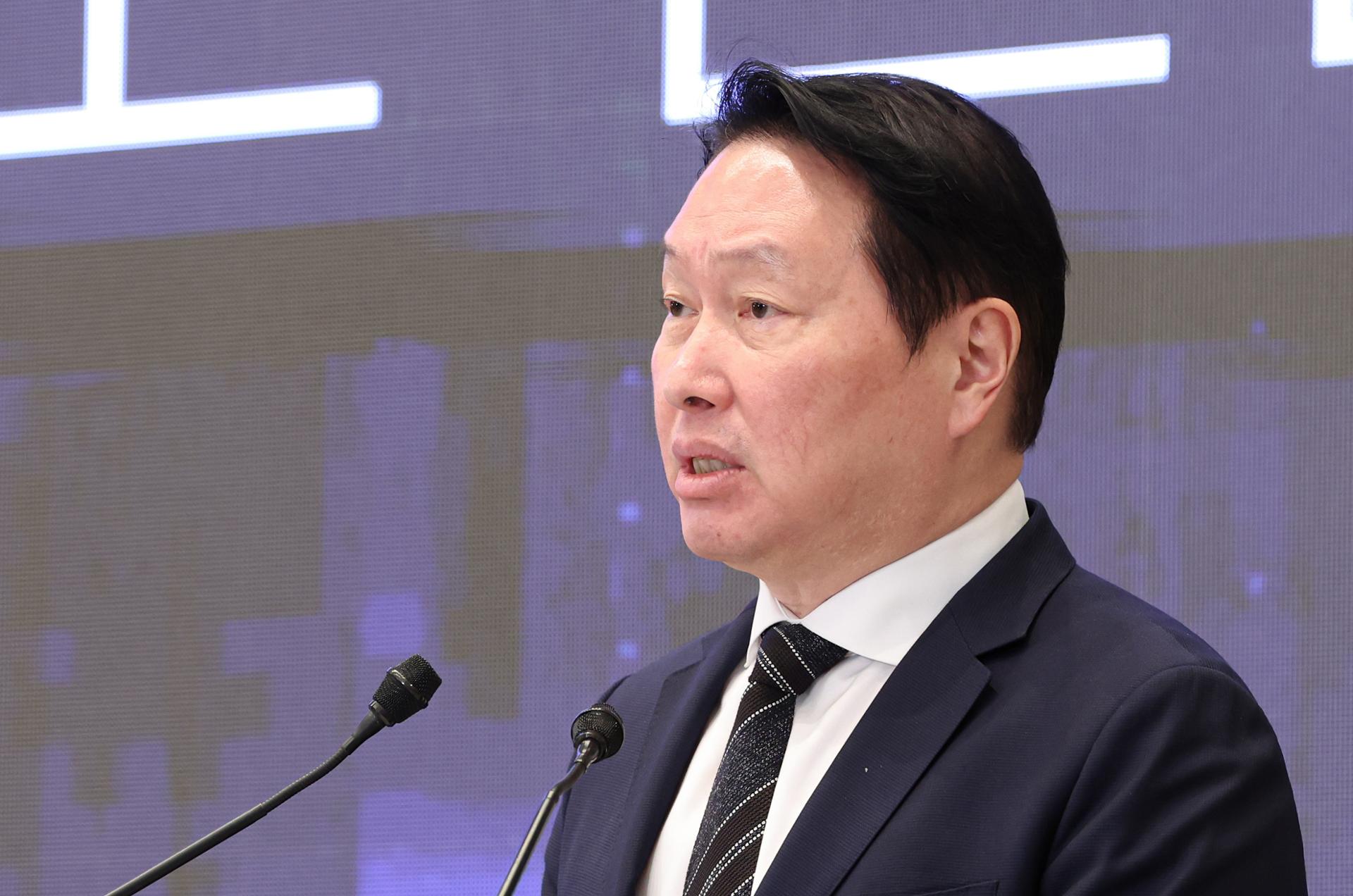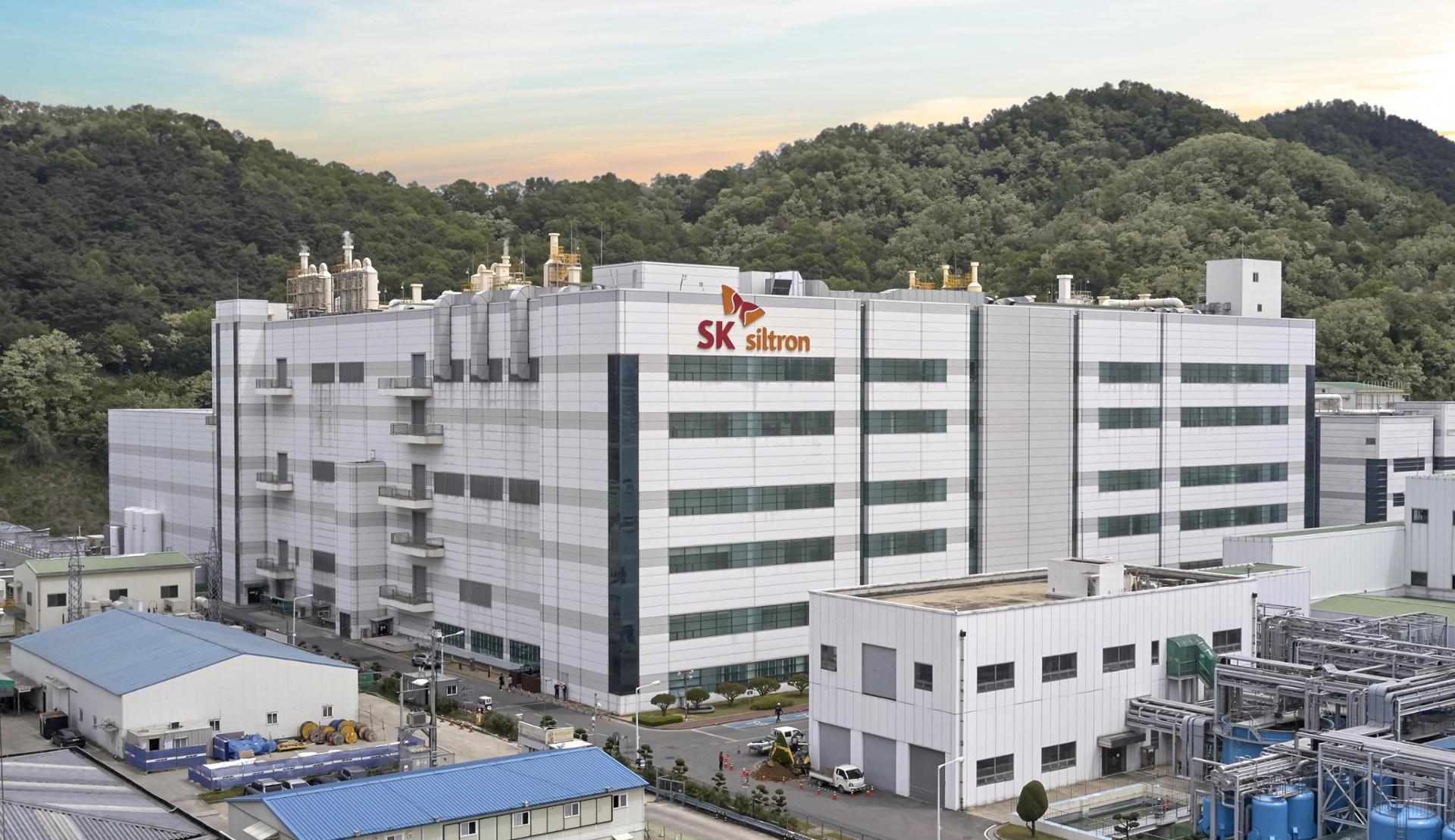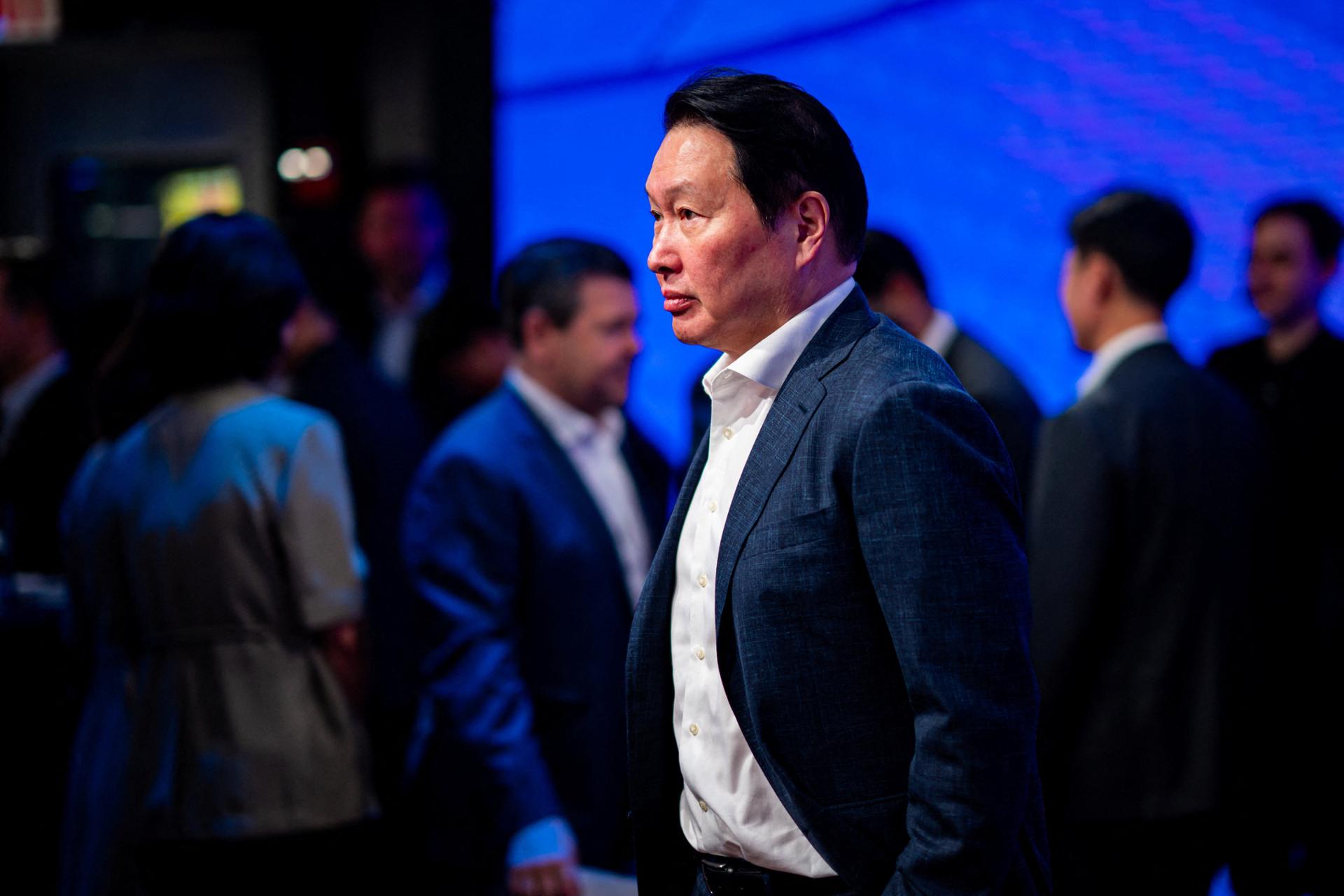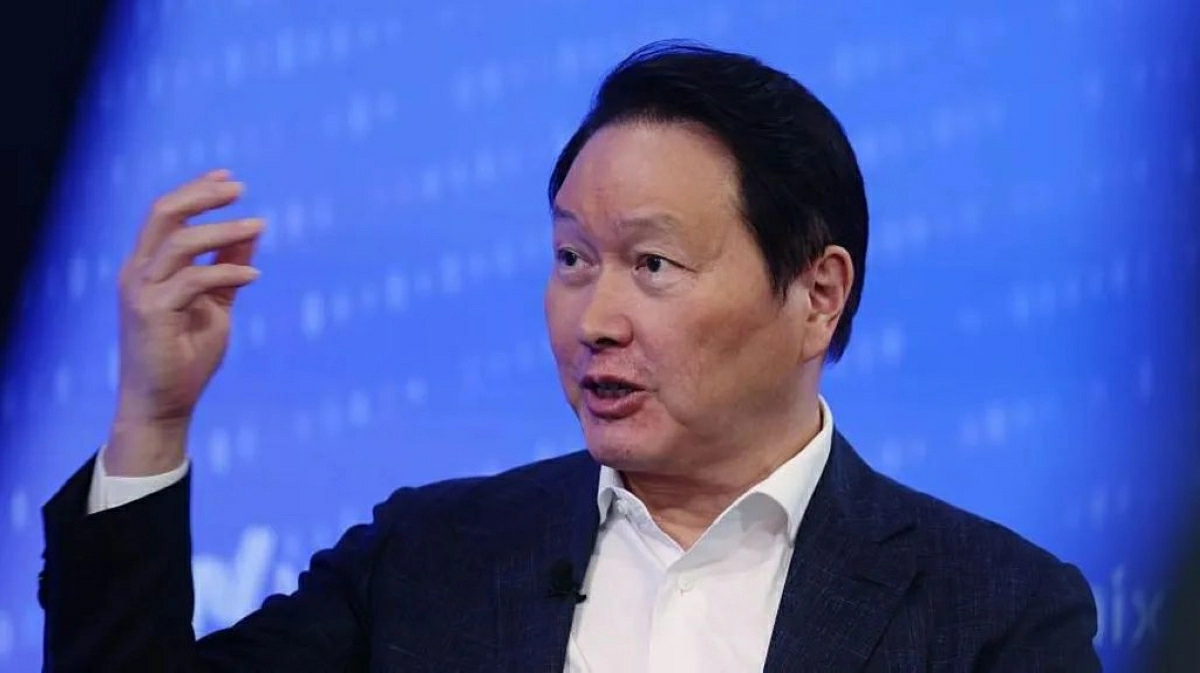
SK chief's personal holding could become final piece of Doosan takeover after recent divorce ruling Chey Tae-won, chairman of SK Group, gestures at the Nasdaq MarketSite in New York on July 10. (Bloomberg) SK Group’s sale of its controlling stake in SK Siltron has put Chair Chey Tae-won’s remaining 29.4 percent holding in the spotlight, with its estimated value closely matching the 944 billion won ($660 million) he was ordered to pay in his recent divorce ruling.SK Inc., the group’s holding company, approved the sale of its 70.6 percent stake in Korea’s only semiconductor wafer-maker to Doosan for about 2.3 trillion won at a board meeting Friday, industry sources said Tuesday.Chey’s shares are not included in the agreement. But a simple pro rata calculation based on Doosan’s purchase price values them at about 957.8 billion won — just 13.8 billion won more than the divorce payment ordered by the Seoul High Court last month.The near match has fueled market speculation that Chey could eventually sell the stake to Doosan to fund the settlement. Neither a sale nor the intended use of any proceeds has been confirmed.Such a transaction could suit both sides. Chey could raise cash without selling shares in SK Inc., which are central to his control of the conglomerate, while Doosan could secure full ownership of SK Siltron after acquiring management control.Chey’s 29.4% stake: The final pieceSeparate negotiations over Chey’s shares are expected after the main transaction closes.Doosan can take management control with SK Inc.’s 70.6 percent stake alone, allowing the two sides to negotiate over the remaining shares later based on SK Siltron’s performance and market conditions.Market observers see limited reason for Chey to remain the second-largest shareholder of the unlisted wafer-maker once Doosan takes over. Selling the stake would also have little direct effect on his control of SK Group.The estimated 957.8 billion won valuation, however, may not translate directly into a transaction price.SK Inc.’s stake comes with management control, while Chey’s holding would become a minority interest after the acquisition. Doosan could therefore seek a minority-stake discount.Chey, meanwhile, could argue that full ownership would bring strategic value to Doosan by simplifying SK Siltron’s governance and speeding decision-making.Negotiations are therefore likely to hinge on how the two sides balance the minority discount against the value of securing 100 percent ownership. SK Siltron’s future earnings prospects, already reflected in the main transaction’s earn-out arrangement, could also influence the price.The decision to separate Chey’s shares from SK Inc.’s stake may also have helped avoid reviving an earlier controversy.Chey acquired the remaining shares of LG Siltron, now SK Siltron, in 2017 amid allegations that SK had improperly handed a business opportunity to its controlling shareholder.The Fair Trade Commission imposed a fine after concluding that SK’s decision not to exercise its preemptive right had allowed Chey to make the investment. The Supreme Court overturned the regulator’s decision last year.The legal dispute has ended, but some market observers say keeping the transactions separate may have reduced the risk of renewed controversy while preventing talks over Chey’s stake from delaying the transfer of control.“Management control has effectively shifted to Doosan, but the market sees negotiations over Chey’s personal stake as the final piece of the deal,” an industry source said.“The final shape of the SK Siltron transaction will depend on the price Doosan is willing to offer and the decision Chey ultimately makes.”SK prioritizes balance sheet over chip upcycleBeyond its implications for Chey, the deal highlights SK’s decision to prioritize balance-sheet discipline over retaining a strategic chip asset. SK is divesting Korea’s only semiconductor wafer producer during an AI-driven chip boom, despite its apparent fit with the group’s “AI full-stack” ambitions.The board approval came seven months after Doosan was selected as the preferred bidder, ending speculation that the deal could collapse as the chip upcycle strengthened and SK Siltron’s value rose.Despite SK Siltron’s strategic role in the supply chain and its apparent fit with SK’s vision, the group prioritized financial flexibility. It also considered the reputational cost of abandoning the sale after selecting a preferred bidder.SK said the transaction would help “strengthen financial soundness and secure resources for future growth engines.”Since 2024, the conglomerate has pursued restructuring measures worth 13 trillion won. Major transactions include the sales of stakes in SK Specialty and SK Biopharmaceuticals, as well as SK Rent-a-Car, energy assets and SK Telecom’s Kakao holding.The number of SK affiliates fell from 219 in 2024 to 198 last year, while net borrowings nearly halved from 70.09 trillion won in 2023 to 36.88 trillion won in 2024.The deal gives SK cash upfront while preserving some exposure to SK Siltron’s future growth.Under an earn-out arrangement, SK will receive additional payments if SK Siltron’s earnings before interest, taxes, depreciation and amortization exceed annual thresholds between 2027 and 2034.SK will also be paid if the wafer-maker secures customer quality certifications for four products by June 2029 or sells assets above book value.The terms allow SK to strengthen its balance sheet immediately while retaining part of SK Siltron’s potential upside during the semiconductor upcycle.
SK Siltron deal puts Chey’s W958b stake in spotlight
SK Group’s sale of its controlling stake in SK Siltron has put Chair Chey Tae-won’s remaining 29.4 percent holding in the spotlight, with its estimated value cl
839 words~4 min read