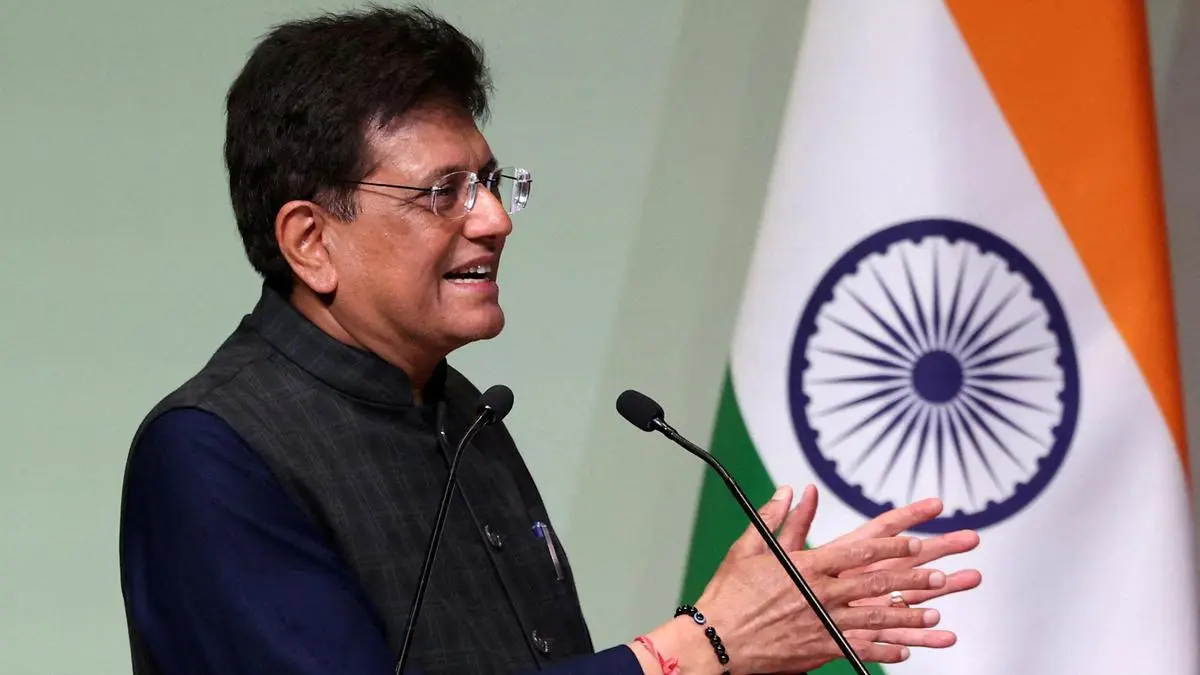
FILE PHOTO: Commerce Minister Piyush Goyal
| Photo Credit:
The Commerce Department has begun consultations with industry for the Union Budget 2027-28, seeking tax, customs and procedural reform proposals before submitting its recommendations to the Finance Ministry, amid global trade uncertainty caused by the West Asia crisis and US tariff actions.Export promotion councils and industry bodies have been asked to submit detailed proposals, supported by data and sector-specific justification, as part of the annual Budget exercise.In a communication to stakeholders, the department said proposals relating to GST would not be considered and advised against resubmitting long-pending demands that have been repeatedly rejected by the government. Industry has instead been encouraged to prioritise fresh recommendations, while repeat proposals must be accompanied by details of similar submissions made over the past three years and their order of priority.“Exporters are likely to press for measures to improve competitiveness as there is growing uncertainty in the global trade environment because of the West Asia crisis and Trump’s tariffs. Compliance costs, too, are rising. Issues such as extension of export incentive schemes, particularly expansion of the interest equalisation scheme, rationalisation of customs duties on key raw materials and intermediates, simplification of customs procedures, and tax measures to encourage manufacturing and investment, are expected to be highlighted,” an industry source told businessline.For proposals involving changes in customs duties or indirect taxes, industry has been asked to provide details on the prevailing duty structure, price trends, domestic demand and supply position, import and export data, and an assessment of the likely impact of the proposed changes. Direct tax proposals are to be accompanied by detailed justification and indicate whether legislative amendments would be required.While announcing the Union Budget 2026-27 in February this year, the Finance Minister noted that her proposals for customs and central excise aimed to further simplify the tariff structure, support domestic manufacturing, promote export competitiveness, and correct inversion in duty.Some measures announced to boost manufacturing and exports in Budget 2026-27 included raising duty-free import entitlement for specified seafood processing inputs from 1 per cent to 3 per cent of the previous year’s export turnover, extending similar benefits to shoe upper exporters, and doubling the export obligation period for leather and textile exporters to one year. It also exempted basic customs duty on specified aircraft components and raw materials used in manufacturing parts for maintenance, repair and overhaul (MRO) operations and defence units, besides granting duty exemption on specified parts used in the manufacture of microwave ovens to encourage value addition in consumer electronics.To deepen value addition in the consumer electronics sector, the budget proposed to exempt basic customs duty on specified parts used in the manufacture of microwave ovens.Published on August 4, 2026