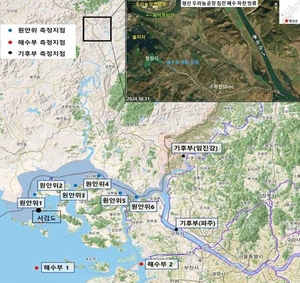
Government says monitoring data do not support claims that uranium came from Pyongsan facility This image from a government press release shows uranium testing sites near the inter-Korean border. Blue dots mark sites tested by the Nuclear Safety and Security Commission, red dots mark those tested by the Ministry of Oceans and Fisheries, and black dots indicate those tested by the Ministry of Climate, Energy and Environment. (Government of South Korea) The South Korean government is investigating an abnormally high concentration of uranium detected in a water supply in Incheon, with officials saying Monday that it was unlikely to have been caused by a North Korean uranium facility.Government agencies said in a joint statement Monday that uranium was detected at a concentration of 45 micrograms per liter in drinking water on Seogeomdo, an island in Ganghwa County. The figure exceeds Korea’s drinking-water limit of 30 micrograms per liter.The water supply is drawn from groundwater in the area.Local media reported the finding Sunday, prompting speculation on social media that wastewater from the Pyongsan Uranium Concentrate Plant in North Korea, located about 100 kilometers away, may have reached the island.The government said, however, that uranium concentrations measured in waters around Ganghwa Island, the Han River and the Incheon coast were too low to support such a link.“Claims have circulated on social media and other platforms that wastewater from the Pyongsan Uranium Concentrate Plant caused the elevated uranium concentration,” the joint statement said.“Considering the very low uranium concentrations detected near Ganghwa Island and in the Han River, it is difficult to conclude that wastewater from the Pyongsan facility affected the water supply on Seogeomdo.”Government testing conducted at seven locations in June, including waters near Ganghwa Island, parts of the Han River and coastal areas of Incheon, found uranium concentrations ranging from 0.133 to 3.025 micrograms per liter.Regular testing conducted between July 2025 and June 2026 recorded concentrations ranging from 0.054 to 3.237 micrograms per liter, which officials said were consistent with naturally occurring levels.The government plans to conduct an on-site inspection with experts to determine why the uranium concentration in Seogeomdo’s groundwater was so high.Bottled water will be provided to residents, and the central government said it would work with the Incheon city government on follow-up measures, including securing an alternative water source.Officials also urged the public not to spread unverified claims online.Elevated uranium concentrations in groundwater are not unprecedented in South Korea. A government inspection of 3,502 groundwater wells in 2023 found that 1.4 percent exceeded the drinking-water limit.The highest concentration recorded was 1,209.2 micrograms per liter, according to the National Institute of Environmental Research, which conducted the inspection.Pyongsan County in North Hwanghae Province is home to a major uranium mine and uranium concentrate production facility in North Korea.
High uranium level found in Incheon island water, but not likely linked to N. Korea plant
The South Korean government is investigating an abnormally high concentration of uranium detected in a water supply in Incheon, with officials saying Monday tha
458 words~2 min read