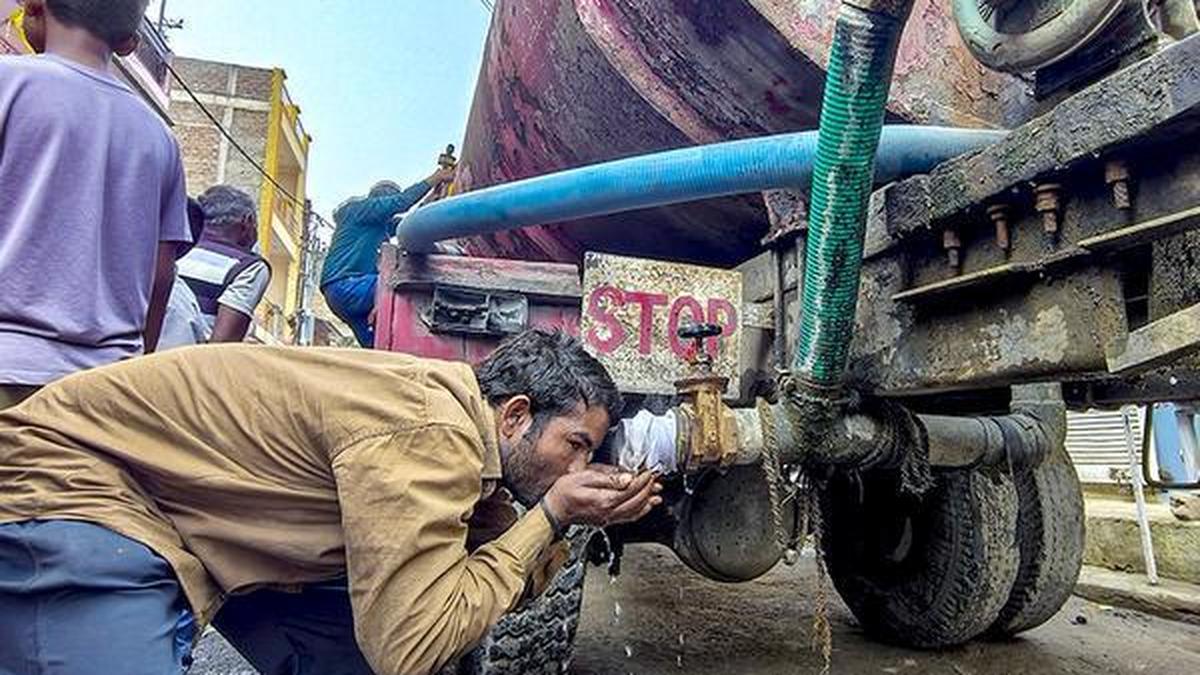
The Union government on Monday said there have been several recent outbreaks linked to water contamination that led to hundreds of hospitalisations and fatalities in parts of Gujarat (Gandhinagar, Vadodara and Balasinor), Madhya Pradesh (Indore) and Andhra Pradesh (Srikakulam), while it does not maintain city-wise data on deaths and diseases caused by contaminated drinking water.HT ImageUnion minister of state for housing and urban affairs Tokhan Sahu said 459 people were hospitalised following vomiting and diarrhoea cases in Indore’s Bhagirathpura area toward the end of 2025, with deaths also reported. In Srikakulam Municipal Corporation, Andhra Pradesh, 224 people were hospitalised due to gastroenteritis and diarrhoea in early 2026, and deaths were also reported. However, the reply did not provide the number of fatalities. He was responding to a question from Congress MP Jebi Mather in the Rajya Sabha.Gujarat informed the Centre of a typhoid outbreak in Gandhinagar that led to the hospitalisation of 258 people. In Balasinor municipality, 506 people were hospitalised after leakages in ageing drinking water pipelines and drainage networks, while Vadodara reported 436 hospitalisations due to water contamination in 2025. No deaths were reported in the incidents in Gujarat.The government said contamination is generally caused by vulnerabilities in urban water distribution systems, including leaking and ageing pipelines, cross-connections with sewer lines, intermittent water supply, corrosion, poor maintenance and inadequate sewerage management.On the broader issue of urban water security, the ministry said all cities covered under the Atal Mission for Rejuvenation and Urban Transformation (AMRUT) 2.0 have prepared City Water Balance Plans (CWBPs) to assess existing water supply systems and identify demand-supply gaps. These assessments form the basis of City Water Action Plans, which are consolidated into State Water Action Plans for approval under the mission.The Centre reiterated that water is a state subject and that urban water supply planning rests with states and urban local bodies, while the Centre provides financial and technical support through schemes such as AMRUT and AMRUT 2.0.
Four states saw deadly water outbreaks: Centre
Several recent outbreaks linked to water contamination led to hundreds of hospitalisations and fatalities in parts of Gujarat (Gandhinagar, Vadodara and Balasinor), Madhya Pradesh (Indore) and Andhra Pradesh (Srikakulam) | India News
324 words~1 min read