Short answer: For an ask-your-docs semantic search app, batch document indexing, estimate token spend before rollout, and send chat only the top retrieved chunks; that keeps RAG cost under deliberate control.
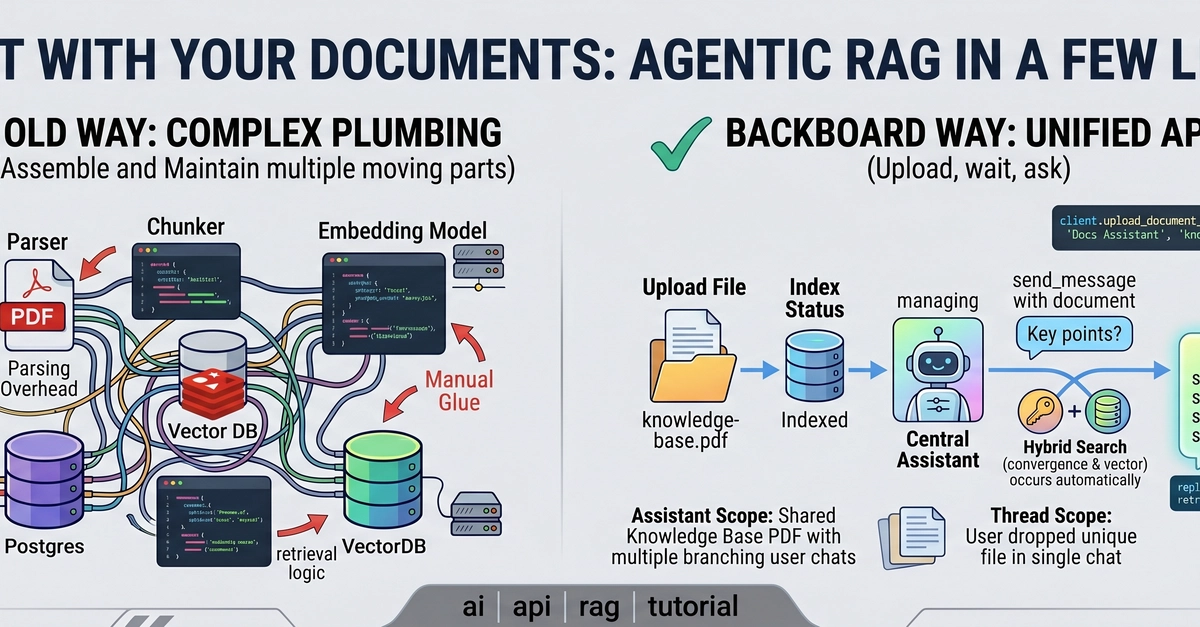
I build RAG and agent features in Python, even when the serving app is Node.js, because I want the eval harness close to the retrieval experiments. The language boundary is rarely the budget problem. Prompt shape is. Start by treating every uploaded document as an ingestion job: split it, generate embeddings, record enough metadata to inspect retrieval later, and resist the temptation to pass every vaguely related chunk into answer generation.
Tiny habits matter.
What should a RAG token count and embeddings cost estimate include for Node.js semantic search?
A useful estimate separates three meters: embedding input during indexing, retrieval-time work, and answer-generation input and output. Embeddings are usually the smaller piece of an ask-your-docs system. The chat prompt grows whenever chunk size, overlap, or top-k grows, so I estimate those settings before I call a production model. A longer context can rescue one hard question and quietly make the ordinary questions worse on both spend and grounding.