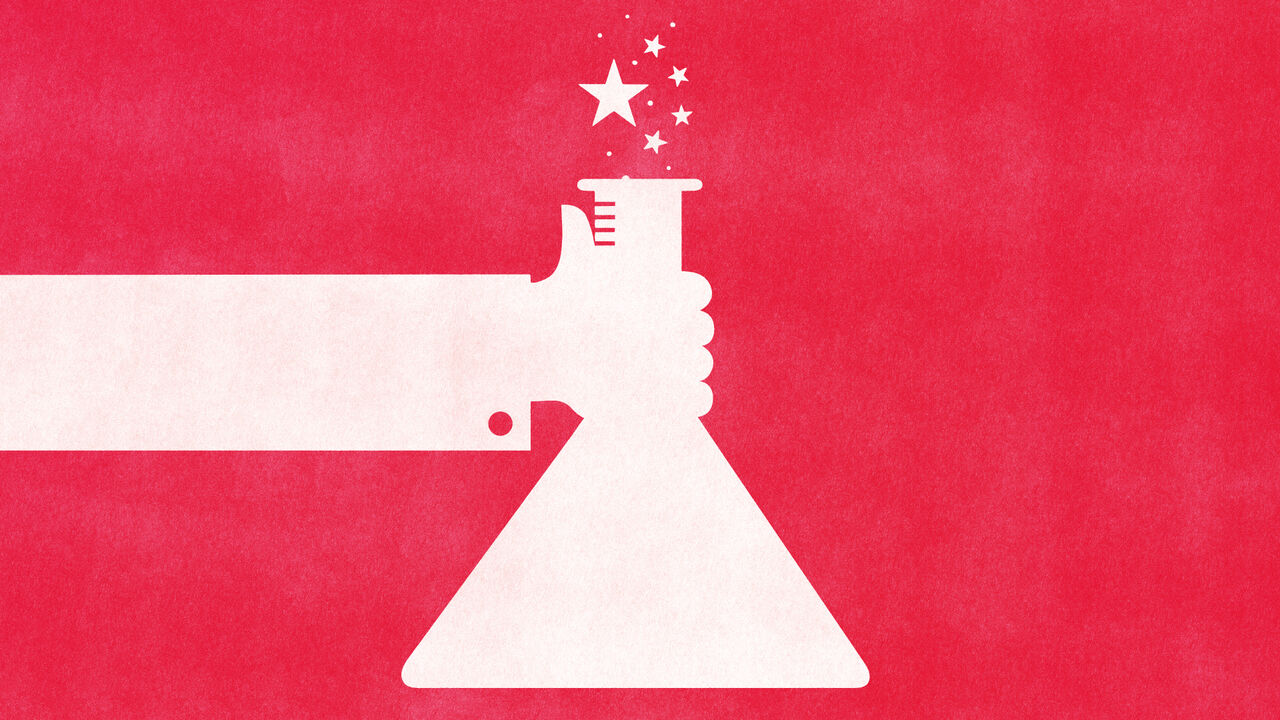
As Donald Trump has cut research funds, China has pursued what one investor calls an “all-hands-on-deck approach to national innovation.”Illustration by Cleon PetersonIn recent years, Evan Osnos has trained his reportorial eye on Washington, but when he first began writing for the magazine, in 2008, it was as our correspondent in Beijing, where he remained until 2013. The author of “Age of Ambition,” a remarkable book on the ascendancy of China, Evan recently returned to Beijing to get a sense of how the central economic and strategic drama of the twenty-first century, the rivalry between the U.S. and China, has evolved. His new piece, “The Future, Made in China,” is as unsettling as it is astonishing.At the Hyperfactory, a sprawling auto plant in Beijing that’s become a popular destination for foreign investors and tech tourists, at least seven hundred robots work in coördination to build new cars, the parts for which are delivered by more than a hundred autonomous carts. According to the facility’s operator, a company called Xiaomi, a new car rolls off the line every seventy-six seconds.Some of this, of course, is ripe for propaganda. But, in many ways, China really is speeding ahead toward a new technological future. Jim Farley, the C.E.O. of Ford, recently called the country’s automotive progress “the most humbling thing I’ve ever seen.” China operates more industrial robots than the rest of the world combined, and, in 2024, it rolled out nine such new robots for every one in America. It already produces the majority of the world’s drones, lithium batteries, and solar panels, and its ship-building capacity is around two hundred times that of the U.S.China, Osnos reports, “is eager to restore its historical eminence, after two hundred years of what the Party sees as anomalous poverty.” And, in the Trump Presidency, it may have found an opening. Two decades’ worth of Chinese investments in research and foreign policy are coming into bloom, Osnos writes, at the same moment that America is faltering on the world stage. Trump has launched new military interventions, withdrawn from international institutions, and alienated allies, all while sowing chaos domestically. America’s international approval ranking is tanking, and, in some polls, China’s has now surpassed that of the U.S. A recent paper produced by a think tank in Beijing was titled “Thank Trump,” and praised the American President for accelerating the “twilight of an empire.”And yet ambition and speed alone can’t propel China to global dominance. The country is recovering from a collapse in the housing market in 2021. And the Party still needs to convince its own populace of the state’s vision. As Osnos points out, the success of the engineering state “carries you only so far if people are so alienated that they decline to bring children into the future being built for them.”More Top StoriesThe White House is distorting intelligence assessments instead of working to protect the midterm elections, David D. Kirkpatrick reports. What does it even mean to be a “moderate” these days? Tomorrow’s Michigan Senate primary has turned into a referendum on that slippery word. The Fed chair’s press conference last week set off a market scare. John Cassidy breaks down what went wrong. Alaska is a big state. But it’s not big enough for the two Dan Sullivans running for the same Senate seat. The most-clicked item from this weekend’s newsletters was M. R. O’Connor on why Europe is burning.“Spider-Man: Brand New Day” just set the domestic opening-weekend record, earning three hundred and sixty million dollars at the box office. Weren’t superhero movies supposed to be dying? We reached out to the culture editor Alex Barasch to find out more.Why did this movie make such a killing?“Marvel movies tend to be events; even so, very few pundits imagined that this one would make Hollywood box-office history. But Spider-Man seems largely immune to the superhero fatigue that’s plagued the rest of the M.C.U.—helped, perhaps, by his relatability as a scrappy kid from Queens, and by the fact that the role has been reinvented three times in the past two decades, changing hands from Tobey Maguire to Andrew Garfield to Tom Holland. (Meanwhile, Chris Evans is coming up on his twelfth outing as Captain America since 2011.)“Holland’s star power is a major factor in ‘Brand New Day’ ’s success: exit polling found that nearly forty per cent of audience members went specifically for him. The film also shares three actors (Holland, Zendaya, and Jon Bernthal) with ‘The Odyssey,’ the other record-breaking movie of the moment, and it’s been a heartening summer for the industry as a whole. Let’s just hope Holland’s fanbase shows up in droves for his Fred Astaire bio-pic, too.”Cover by Eric Drooker
Inside China’s Push for Tech Supremacy
From the daily newsletter: Evan Osnos returns to China to find a country fully committed to winning the future.
865 words~4 min read