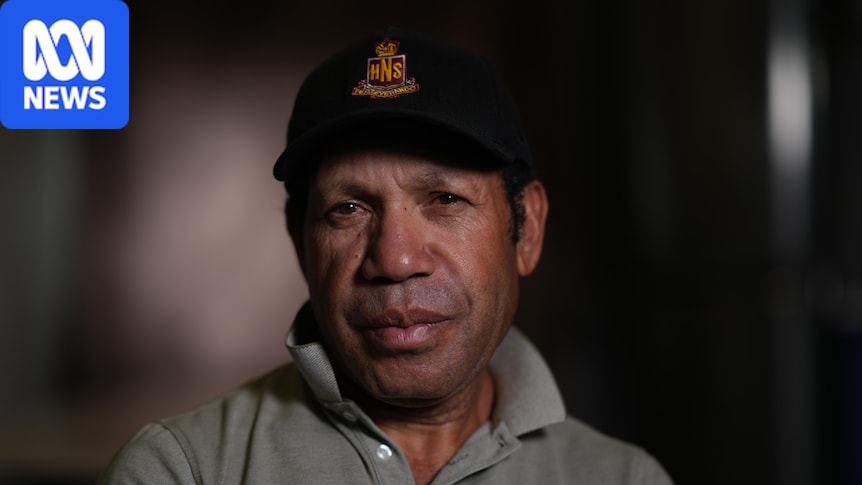
Warning: This story contains discussion of suicideSome days Gershom Isaac says he feels suicidal. He spends up to 12 hours a day climbing ladders to pick fruit or bent over pulling onions and pumpkins, sometimes earning less than $7 an hour.At night, he returns to overcrowded, squalid accommodation. The relentless cycle has left him feeling exhausted and hopeless.Gershom came to Australia from Papua New Guinea chasing the Australian dream. Instead, he became trapped in a system where labour hire contractors controlled almost every aspect of his life, his work, his pay and, ultimately, his future.Now he is one of tens of thousands of migrant workers living in the shadows, and part of a much larger temporary migrant workforce vulnerable to exploitation."Even 40 degrees, you're still hanging there, picking oranges, trying to do as much as you can, and it's not easy. Sometimes you fall from those trees," he says.If he gets sick or injured, he doesn't get paid. Without work, he says, he can't afford to eat.He says the labour hire contractor controls every aspect of his working life.Gershom's experience reflects a much bigger shift in Australian agriculture. Rather than employing workers directly, many growers rely on labour hire contractors to recruit and supply seasonal workers during harvest.Australia's growing reliance on temporary migrant labour has fuelled a booming labour hire industry, with contractors sitting between growers and workers, often recruiting, transporting and housing them.While some operate legally, others prey on vulnerable migrant workers, paying them cash, well below the minimum wage."I don't have any voice. I don't have any power," Gershom says."Every choice is with the contractor. They're the ones who make all the decisions, and the fruit pickers have to say yes to everything."Gershom's story isn't unique. Across Australia's horticulture industry, workers described strikingly similar experiences: low pay, overcrowded and slum-like housing, labour hire contractors controlling where they lived and worked, and little power to complain.It is part of an eight-month Four Corners investigation into whether Australians can trust the claims made about the food they buy.The investigation tested supermarket food products, travelled to cocoa-growing communities in Ghana, and interviewed workers and industry insiders across Australia.It found problems from food fraud and misleading claims to worker exploitation and child labour, as well as tomato products originating from China's Xinjiang region, which has been linked to allegations of forced labour.It comes weeks after the Trump administration imposed a 12.5 per cent tariff on certain Australian exports, arguing Australia does not effectively stop imports made with forced labour.Prime Minister Anthony Albanese rejected the criticism, saying Australia had "robust" modern slavery laws.In 2021, the US banned imports of products including tomatoes from Xinjiang over forced labour concerns, an allegation that China denies. Australia doesn't have an import ban.As part of the investigation, Four Corners worked with Source Certain, an Australian forensic laboratory specialising in origin verification, which has done work for the FBI, Scotland Yard, Interpol and Australia's AFP.Its scientists analysed hundreds of processed tomato products to see if they were really from Italy or Australia as stated on the labels.One in four products had a problem. Those that failed came from China, with half linked to Xinjiang.For years, parliamentary inquiries, raids, and media investigations have exposed the exploitation of migrant workers in Australia's food industry. Governments have promised reforms, regulators have cracked down and companies have pledged to clean up their supply chains.Four Corners reporters travelled to regional Australia, analysed payroll records, interviewed workers, unions, advocates, regulators and employers and examined how Australia's modern slavery laws operate in practice.No sick leave, no pay slips, no superAt a caravan park in the NSW Riverina, Pacific Islander workers broke their silence, many agreeing to be identified despite the risks.They said they had left employers under Australia's Pacific Australia Labour Mobility (PALM) scheme after disputes over pay, working conditions or alleged mistreatment.Under the PALM scheme, workers are tied to an approved employer. If they leave that employer, they are not allowed to take on new work and so many become "disengaged" from the scheme, leaving them with few lawful options to keep working.Ken Dachi tries to give migrant workers a voice. (Four Corners: Rob Hill)Ken Dachi worked for years in conflict-affected regions around the world. Now he helps vulnerable migrant workers here, through the Welcoming Australia organisation.He says the PALM scheme was designed to connect Pacific Islanders with Australian employers and regional communities. But when workers aren't protected, labour hire contractors and other exploitative operators can fill the gap.Dachi says many workers disengage from the PALM scheme without understanding that doing so makes them even more vulnerable.He says the system is flawed."[They] are not numbers. They're people's lives. It's families, it's siblings, it's parents impacted … a long road without an exit sign."They survive by finding labour hire contractors willing to pay them cash to pick fruit and vegetables destined for Australian supermarket shelves. They say they earn well below legal minimum wages, with no super, no sick leave and no pay slips.Timothy earns less than $12 an hour. (Four Corners)Timothy pays $280 a week to live in a tiny rented room in the caravan park."Just only this room. No kitchen, no bathroom," he says.He collects bottles to earn extra money.He says he works about 60 hours a week picking oranges for cash, earning about $700 a week — less than $12 an hour. "It's really hard," he says.For Viona Obress, filling one bin with oranges can take three to four hours, equivalent to between $8.75 and $11.70 an hour.If it is raining, it slows her down, so she says she earns even less and if she gets sick, she earns nothing."The fruit is so heavy and climbing a lot as a lady, it's really hard too," she says. "You feel exhausted when you finish work. You feel like you can't work another day, but what can you do? There's no options. You have to keep going."Viona Obress works about 60 hours a week picking oranges. (Four Corners)By going public, Viona hopes the conditions workers have endured will no longer remain hidden."The truth will finally come out," she says.These workers do not receive pay slips, so the ABC has not been able to verify these workers' pay rates.'I was treated more like an animal'Across Australia's fruit and vegetable industry, Fair Work Ombudsman investigations have repeatedly uncovered widespread non-compliance.In Coffs Harbour, 61 per cent of growers and labour hire companies inspected were found to be breaching workplace laws, including underpaying workers. The figure rose to 72 per cent in the Riverina and 83 per cent in Victoria's Mornington Peninsula and Yarra Valley.In Coffs Harbour, local Raewyn Macky has become a lifeline for vulnerable workers.She says she first noticed growing numbers of migrant workers seeking help while volunteering at a local second-hand clothes shop. She says they kept coming back with stories of unpaid wages, poor conditions and nowhere else to go.Raewyn Macky heard about the experiences of migrant workers while volunteering at a local op-shop.
The vulnerable workers bearing the cost of providing Australia with cheap food
Behind the fruit and vegetables on Australia's supermarket shelves are workers whose stories are rarely heard.
3,102 words~14 min read