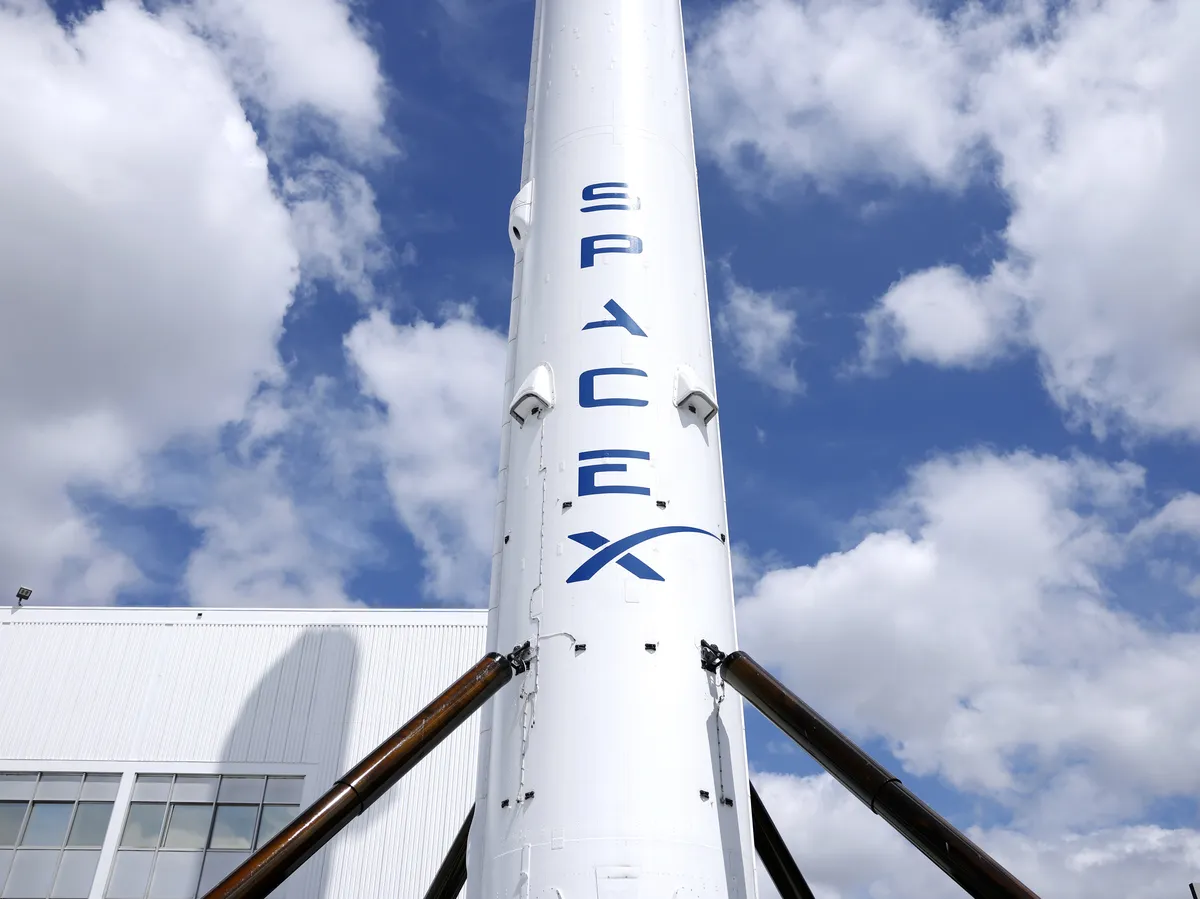
Skip to Content News Archives Economy Energy Oil & Gas Renewables Electric Vehicles Mining Commodities Agriculture Real Estate Mortgages Mortgage Rates Finance Banking Insurance Fintech Cryptocurrency Work Wealth Smart Money Wealth Management Investor Personal Finance Family Finance Retirement Taxes High Net Worth FP Comment Executive Women Puzzmo Newsletters Financial Times Business Essentials More Innovation Information Technology FP500 Podcasts Small Business Lives Told Tails Told Shopping Financial Post Store Obituaries Place a Notice Advertising Advertising With Us Advertising Solutions Postmedia Ad Manager Sponsorship Requests Classifieds Place a Classifieds ad Working Profile Settings My Subscriptions Saved Articles My Offers Newsletters Customer Service FAQ News Economy Energy Mining Real Estate Finance Work Wealth Investor FP Comment Executive Women Puzzmo Newsletters Financial Times Business Essentials HomeInnovationHow Canada Rocket Company plans to fill a void left by SpaceX'The private market is looking to government for the demand signal and appetite for something this ambitious to be built'Last updated 2 hours ago You can save this article by registering for free here. Or sign-in if you have an account.Founder Hugh Kolias said that Canada Rocket Company is on track for its next major funding round this year and that they have had success raising money in Canada. Photo by Handout/Canada Rocket CompanyA Toronto-based space-launch startup is racing to show that it can make rockets that could one day rival those of Elon Musk‘s Space Exploration Technologies Corp. as businesses around the world scramble to hitch a ride to orbit amid a crunch in space launch access.Subscribe now to read the latest news in your city and across Canada.Exclusive articles from Barbara Shecter, Joe O'Connor, Gabriel Friedman, and others.Daily content from Financial Times, the world's leading global business publication.Unlimited online access to read articles from Financial Post, National Post and 15 news sites across Canada with one account.National Post ePaper, an electronic replica of the print edition to view on any device, share and comment on.Daily puzzles, including the New York Times Crossword.Subscribe now to read the latest news in your city and across Canada.Exclusive articles from Barbara Shecter, Joe O'Connor, Gabriel Friedman and others.Daily content from Financial Times, the world's leading global business publication.Unlimited online access to read articles from Financial Post, National Post and 15 news sites across Canada with one account.National Post ePaper, an electronic replica of the print edition to view on any device, share and comment on.Daily puzzles, including the New York Times Crossword.Create an account or sign in to continue with your reading experience.Access articles from across Canada with one account.Share your thoughts and join the conversation in the comments.Enjoy additional articles per month.Get email updates from your favourite authors.Create an account or sign in to continue with your reading experience.Access articles from across Canada with one accountShare your thoughts and join the conversation in the commentsEnjoy additional articles per monthGet email updates from your favourite authorsSign In or Create an AccountorCanada Rocket Company is developing a medium-lift launch vehicle powered by methane and liquid oxygen — also known as methalox — capable of taking a 12,000 kilogram payload into low-Earth orbit, a strategy that it hopes will make it the Canadian alternative to SpaceX’s Falcon 9 rocket. The Falcon 9 has long been the primary carrier of medium-lift payloads, but has stopped taking launch bookings past 2028 as SpaceX focuses on its next-generation Starship rocket.CRC launched this January with a $6.2 million seed round in tow, and has since raised a total of $22.5 million from mostly Canadian investors — including the Business Development Bank of Canada, Ripple Ventures Fund GP Inc. and Panache Ventures Investment Fund — with more on the way.Get the latest headlines, breaking news and columns.By signing up you consent to receive the above newsletter from Postmedia Network Inc.A welcome email is on its way. If you don't see it, please check your junk folder.The next issue of Top Stories will soon be in your inbox.We encountered an issue signing you up. Please try again“There’s been a ton of investor interest at home and abroad specifically because of the global shortage. Everyone sees it coming,” said CRC founder Hugh Kolias.The scarcity of launch access coupled with booming government and investor interest has converged to create a “space super cycle” that has benefitted his company, Kolias said, but CRC still has a long way to go before sending a rocket into orbit.Developing and sending a medium-lift vehicle into orbit costs at least US$500 million, requires 300 to 500 engineers and technicians and takes eight to ten years, he said.CRC has made swift strides on the first two goals. Kolias said the company is on track for its next major funding round this year and that they have had success raising money in Canada.“It’s not that we didn’t look to the United States,” Kolias said. “It’s just that there is overwhelming demand in Canada, so we are able to effectively keep it in Canada. There’s a very rare opportunity now to raise as much of this capital (here) that you probably couldn’t have twelve months ago.”CRC has also started recruiting technical talent, including repatriating nine Canadians from industry giants such as SpaceX, Jeff Bezos’ Blue Origin LLC and Europe’s ArianeGroup Holding, growing its team to 25 as of July from just two in January.Government support has also helped. Ottawa has removed bureaucratic hurdles for the company, including some that have allowed the startup to hire the temporary foreign workers needed to progress on its technical goals, in addition to topping up its war chest.Earlier this year, the federal government awarded $8.3 million in grant funding to CRC — and the same amount to its peers NordSpace Corp. and Reaction Dynamics Lab Inc. — under the Department of Defence’s $105 million, multi-year sovereign launch program to develop technologies to launch Canadian payloads from Canadian soil.Still, Kolias said, the company needs government support in the form of contracts to prove the reliability of its technology and to succeed commercially.“The private market is looking to the government for the demand signal and the appetite for something this ambitious to be built. Investors are also looking for public capital to de-risk a binary outcome: either you get to orbit or you don’t,” he said.Kolias pointed to American space startups that are aided by government contracts. “If you look at what NASA did with SpaceX, they ultimately provided them with enough contracts upfront to help fund their development,” he said.Supply chain snags also remain a key bottleneck. CRC will be working with many Canadian manufacturers, Kolias said, adding that they often prioritize bigger international customers. The founder hopes that the government will clear a path for smaller homegrown firms critical to national security to skip the line and become priority customers for domestic manufacturers, akin to a U.S. program under the country’s Defence Production Act.“That would be a big unblock, especially as we go down the later stages,” he said.Kolias’ thesis is that CRC must look beyond Canada to succeed as a Canadian company.“We’re looking at the global gap (whereas) our peers are more focused on sovereignty,” he said. “We’re laser focused on sizing our vehicle to capture that global market, instead of thinking small and trying to match it to where Canada is.”The Toronto startup recently upsized its planned rocket to 12 tonnes, or 12,000 kilograms — that’s three times larger than anything proposed in Canada and big enough to satisfy both Canadian sovereign and global commercial needs, according to Kolias.“Anything below 6,000 to 7,000 kilograms to orbit … isn’t large enough to justify an investment or to address the sovereign part of the equation. If you’re investing $500 million over a 10-year-timeframe, the return on investment or the end revenues and market have to be massive,” he said.For now, CRC’s key focus is developing, building and testing its tech. The startup has already opened a facility for engine development and testing neat Toronto, has secured a test launch site and is looking for an additional 500,000 square-feet of manufacturing space in the Greater Toronto Area by the end of 2027.“This is the perfect time for some country and company to tackle this problem,” Kolias said. “We’re building something substantially larger than what anyone else in Canada is planning … for Canada and the world.” Join the Conversation This website uses cookies to personalize your content (including ads), and allows us to analyze our traffic. Read more about cookies here. By continuing to use our site, you agree to our Terms of Use and Privacy Policy.
How Canada Rocket Company plans to fill a void left by SpaceX
Canada Rocket Company has secured nearly $23 million from Canadian investors to build what it says will be the country's biggest rocket.
1,414 words~6 min read