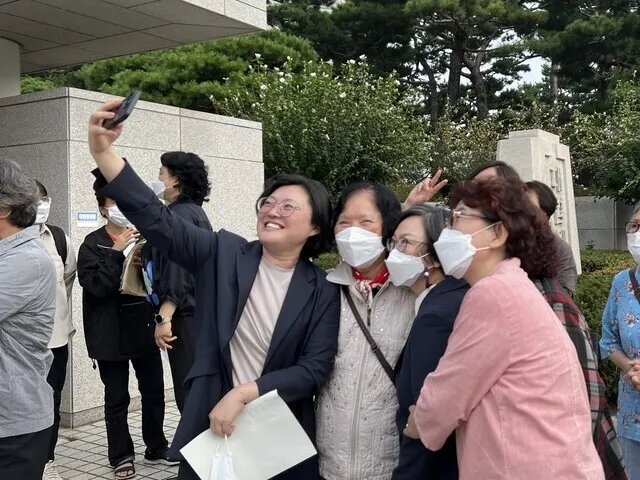
Kim Suk-ja (second from left), a plaintiff in the case for reparations for Korea’s US military camptown women, poses for a photo with the lawyer who represented her and other activists after the court ruled in their favor on Sept. 29. (Lee Woo-yun/The Hankyoreh)
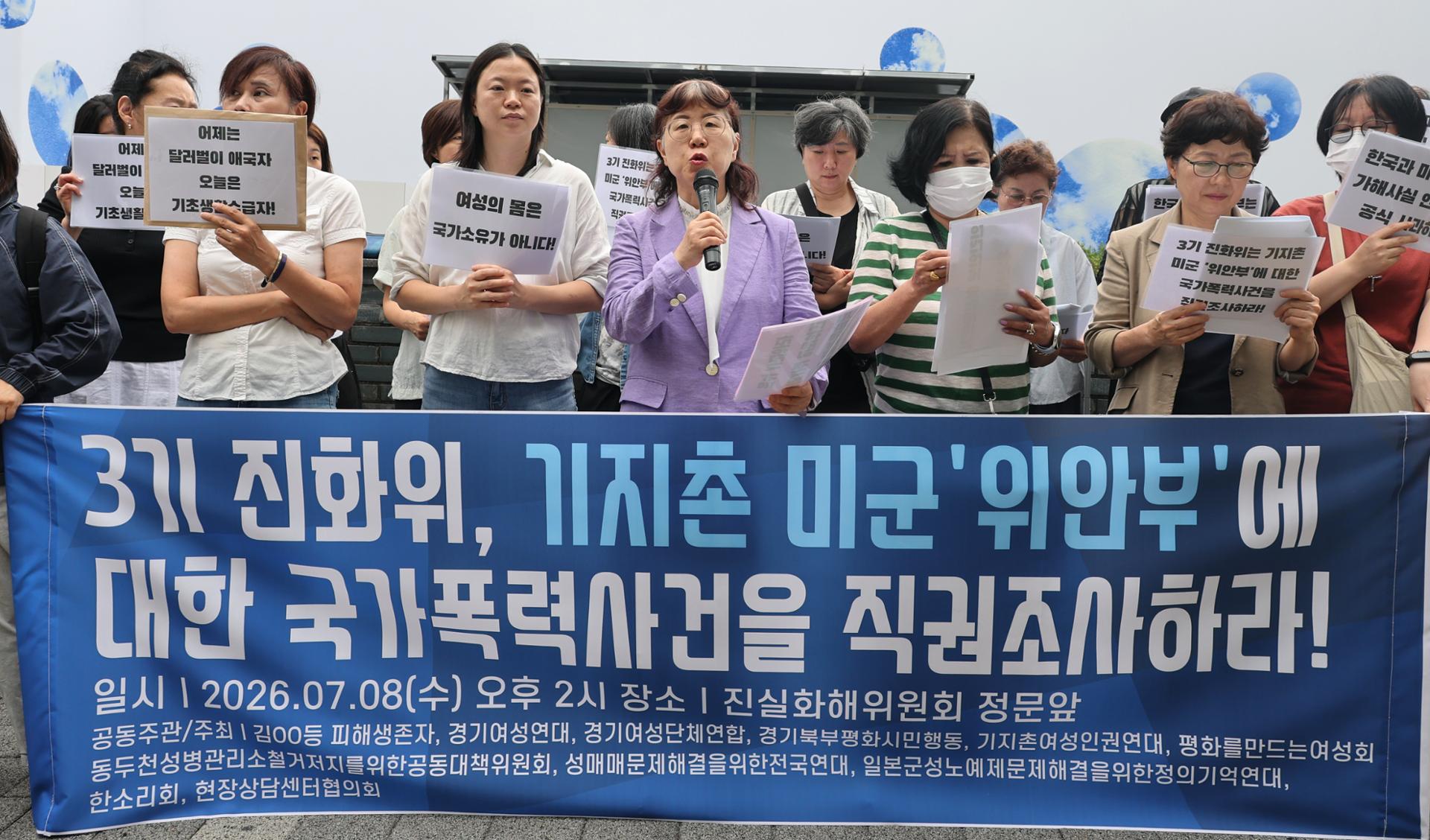
“I had been frustrated that the Supreme Court hadn’t made any ruling in the several years since we filed the lawsuit, but now that it has finally returned a verdict today in favor of us grandmothers, I can’t help but cry. With each year the lawsuit went on, more of our sisters passed. I think they, too, are happy in heaven.”Standing in front of the main gate of the Supreme Court in Seocho District, Seoul, on Thursday morning, Kim Suk-ja, a 72-year-old victim of the US military camptown sex trade, paused after mentioning those who had passed. Kim had been smiling throughout the press conference, even saying, “I feel like I could shout with joy.” Activists who had cheered and applauded moments before turned solemn at Kim’s tears.The Supreme Court confirmed an earlier ruling ordering the state to pay each plaintiff between 3 million to 7 million won (US$2,100-$4,900) in a compensation suit filed against the state by women, including Kim, who worked in brothels set up to cater to US troops in the country. The ruling confirms that the operation of “comfort stations” in military camptowns — known locally as “gijichon” — constituted state violence orchestrated by the government. This ruling comes in 65 years since the establishment of such camptowns, 10 years since the launch of the Camptown Women’s Human Rights Coalition, and eight years and three months since the filing of the compensation suit. While 122 plaintiffs were a part of the case in 2014, by the time of the verdict that number had fallen to 95, as 24 had died and some withdrew from the lawsuit over the years.After the court’s ruling, Kim rolled up her sleeves and ran her hand over her arms, saying, “I am so happy, I have goosebumps.” Born in Mokpo, South Jeolla Province, Kim started working as a housemaid in Seoul at the age of 12 after enduring years of mistreatment for being born a daughter. At 19, Kim first set foot in a camptown after hearing that she could make money there, then bounced around from one camptown to the next in the South Chungcheong Province cities of Seonghwan, Jincheon, Taean, as well as Pyeongtaek, Gyeonggi Province. It was not until 2009, when Kim turned 59, that she left the camptowns.Many of Kim’s peers were unable to escape the mire of the camptown sex trade, made and managed by the state. Every week the women were obliged to undergo venereal disease testing at a public health center and those who tested positive were detained in a camp. This camp became known as the “Monkey House,” named for how the image of women screaming in pain after receiving penicillin injections and hanging from prison cages resembled monkeys in a zoo. Kim recalls feeling helpless as her friend died of shock after receiving a penicillin injection. “The hardest thing was that no one helped us. We had to defend ourselves,” said Kim.