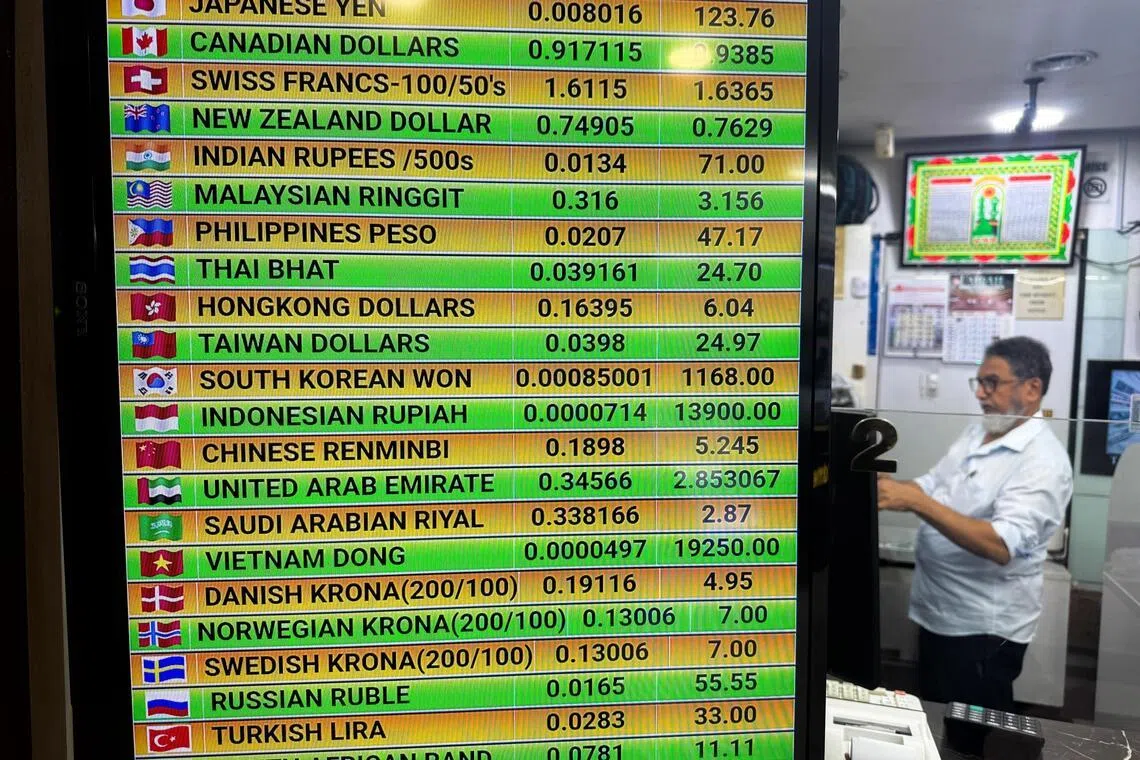
SINGAPORE – The Singapore dollar is expected to continue strengthening against regional currencies, including the yen, in 2026, after the central bank surprised markets by tightening monetary policy for the second consecutive time since April.The Monetary Authority of Singapore said on July 27 that it will increase “very slightly” the rate of appreciation of the Singapore dollar’s trade-weighted value, allowing it to strengthen against an undisclosed basket of currencies.While a stronger Singdollar would lower import costs and boost Singaporeans’ spending power abroad, it could also increasingly hurt exporters if regional currencies remain weak.Zavier Wong, market analyst at eToro, said: “When we look at our neighbours, many are moving in the opposite direction by holding softer currencies to protect their own exports... Whatever room is left for the Singdollar to run will get amplified against that sort of backdrop.”He added that further policy tightening could not be ruled out, as MAS expects inflation to remain elevated, which could keep the Singdollar strong.“MAS has always tried to weigh two things against each other here and that is, keeping imported inflation in check versus keeping exports competitive,” he said.“A persistently strong Singdollar helps the former and hurts the latter. There is no getting both at once.”While the widening gap between the Singdollar and its regional peers is not yet a major concern, this could still erode Singapore’s price competitiveness over time, as trade effects filter through the economy, said Wong.Widening Singdollar gapOriano Lizza, sales trader at CMC markets, is expecting the Singdollar to remain one of Asia’s strongest currencies over the next 12 months.But rather than expecting a one-way appreciation story, investors should anticipate more nuanced currency moves, driven by country-specific fundamentals, diverging central bank policies and the global growth outlook, he said.The Japanese yen is among the regional currencies expected to remain volatile against the Singapore dollar, despite intervention by Japan and the US to support the currency.Japan’s finance ministry said on Aug 3 that it had carried out a joint intervention with the United States on July 31 to support the yen.It marked the two countries’ first coordinated intervention since 2011, when they acted together to weaken the currency following the earthquake and tsunami in eastern Japan.The Japanese yen fell about 5.59 per cent against the Singapore dollar in 2025 and has weakened a further 0.27 per cent year to date in 2026. It was trading around 122 per Singdollar at the time of writing, up 1 per cent in a day.Tiger Fund Management chief executive Jeremy Tan noted that the yen is expected to remain volatile against the Singapore dollar.He said the yen’s recent appreciation against the Singdollar reflected strength in the Japanese currency rather than weakness in the Singapore dollar, following the Japanese and US authorities’ coordinated intervention.“Japan has intervened twice this year to defend the currency from continued downward pressure, while keeping interest rates at multi-year highs of 1 per cent. In the near term, we see support for the yen, given the two central banks’ concerted intervention efforts,” said Tan.“Still, in the long term, Japan continues to face structural growth challenges, persistent budget deficits, and rising government debt,” he added. “Higher energy prices could further strain the trade deficit and inflation outlook, adding downward pressure on the yen.”The Singdollar has also been strengthening against the Indonesian rupiah.The Indonesian currency slumped 9.2 per cent against the Singdollar in 2025 and has weakened a further 7.7 per cent year to date in 2026, trading at around 14,000 per Singdollar at the time of writing.Indonesia produces oil but remains a net importer, so higher energy prices amid the fallout from the Iran war have raised import and fuel subsidy costs. This has weakened the archipelago nation’s external trade balance and fiscal position, and weighed on its currency.Global risk aversion has also triggered capital outflows from Indonesia’s bond and equity markets as investors move funds into safer assets, adding to pressure on the rupiah.Official data showed that foreign investors sold a net US$202 million (S$259 million) in Indonesian government bonds in January.CMC’s Lizza said: “There is still scope for moderate Singdollar appreciation if Indonesia experiences softer commodity exports or renewed capital outflows.”Meanwhile, the outlook of South Korean won hinges more on domestic developments.The won depreciated 3.77 per cent against the Singapore dollar in 2025, but has edged up 0.04 per cent year to date in 2026. It was trading at around 1,114 per Singdollar at the time of writing.Tiger Fund Management’s Tan said recent instability in the country’s equity markets has prompted investors to sell technology stocks.“We see further pressure on the won from potential capital outflows, particularly as the KOSPI Composite Index has fallen more than 30 per cent over the past month amid the continued unwinding of leveraged positions,” he said.The South Korean authorities have also intervened to support the currency by buying the won, Reuters reported, citing a source.Ringgit resilienceBy contrast, the Malaysian ringgit is expected to prove more resilient than other regional currencies against the Singapore dollar.The ringgit appreciated 3.67 per cent against the Singapore dollar in 2025 before giving up 0.78 per cent year to date in 2026. It was trading at around 3.19 ringgit to the Singapore dollar at the time of writing.Sean Teo, sales trader at Saxo Singapore, said: “This is largely because Malaysia is a net energy exporter amid the US-Iran tensions, which have pushed up energy prices.”Edward Lee, Standard Chartered Bank’s chief economist and head of foreign exchange for Asean and South Asia, said Malaysia’s relatively “strong economic backdrop” should continue to support the ringgit.“The country continues to attract foreign direct investment related to AI, while exports, including tourism as well as information and communication services, have held up and domestic demand remains resilient,” he said. “These factors should help the ringgit weather periods of global market volatility.”Winners and losersIn Singapore, manufacturers, precision engineering firms, electronics suppliers, marine engineering companies, tourism-related businesses and logistics providers competing regionally are expected to feel the impact of the widening gap between the local and regional currencies first.CMC’s Lizza said: “By contrast, sectors such as finance, pharmaceuticals and digital services are likely to be more insulated, as they compete more on value-added services and intellectual property than on price.”Tiger Fund Management’s Tan added that the financial services sector would be a key beneficiary of a stronger Singdollar.“Given the Singdollar’s stability relative to other regional currencies, Singapore could attract more inflows, supporting the broader wealth management and asset management industries as investors seek a relative safe haven,” he said.Wong of eToro said the “obvious winners” will be the businesses selling domestically in Singdollars, but with costs priced in a currency the Singdollar is strengthening against.These, he said, are “retailers, food and beverage chains or even construction firms that are bringing in their materials or equipment from the region”.“The idea is that since input costs are lower while sales stay in a local currency, the gain goes straight to margin,” he added.OCBC foreign exchange strategist Christopher Wong said a firmer Singapore dollar, at a macro level, helps cushion the economy against imported inflation, particularly when global energy and food prices are volatile.“Energy importers, food distributors, retailers and manufacturers buying machinery, raw materials or components from overseas can benefit from lower costs in Singdollar terms, while consumers should see the clearest gains in areas such as overseas travel, online shopping and education,” he said.
Singdollar to widen gap with regional currencies; stronger currency could weigh on exports: Analysts
The stronger currency is set to lower import costs but could weigh on exporters as policymakers elsewhere maintain weaker exchange rates for yen, ringgit, rupiah and won. Read more at straitstimes.com. Read more at straitstimes.com.
1,225 words~6 min read