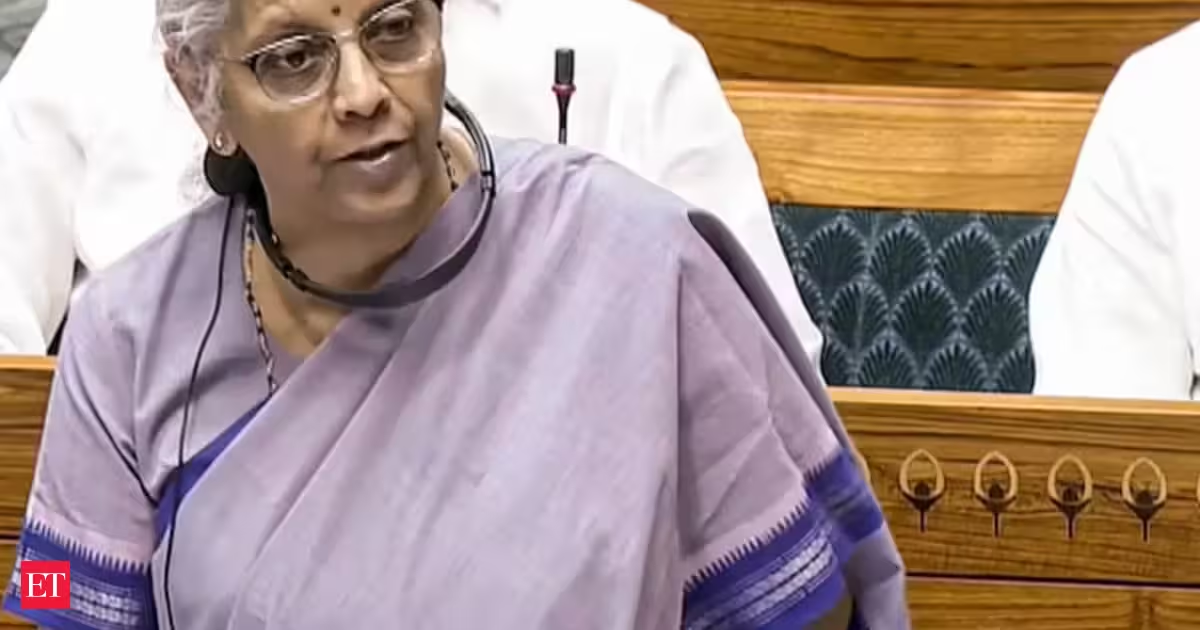
File pic: Finance Minister Nirmala Sitharaman
| Photo Credit:
Finance Minister Nirmala Sitharaman on Monday introduced a bill to replace a 125-year-old law with one that seeks to preserve access to banking evidence, while protecting banks from unnecessary legal proceedings, shifting the emphasis to better-targeted judicial oversight, rather than unrestricted access to banking records.According to officials, government has undertaken the review and modernisation of legacy legislations. The Bankers’ Books Evidence Act, 1891 is one such legislation. Enacted in the era of paper-based banking, it facilitated the use of certified copies of bank records as evidence in legal proceedings. However, “with the advent of digital banking and electronic record-keeping, the existing legal framework no longer adequately reflects contemporary banking practices,” an official said.The Bankers’ Books Evidence Bill, 2026 seeks to repeal and replace the Bankers’ Books Evidence Act, 1891. It provides for a technology-neutral legal framework for bankers’ books, recognises electronic and digital banking records, standardises the certification process, facilitates the admissibility of electronic banking records, permits authentication through manual, digital and electronic signatures, strengthens the statutory protection available to bank officers where the bank is not a party to the proceedings by requiring the court to record the existence of a special cause before summoning them,The Bill comes against the backdrop of the rapid expansion of digital banking and the sharp rise in cyber-enabled financial frauds, including online scams and so-called “digital arrest” cases. It seeks to modernise the legal framework governing banking evidence to reflect the realities of electronic record-keeping and digital financial transactions.A key feature of the proposed law is the introduction of the concept of “special cause”, under which a court may, by a written order, compel a bank officer to produce bankers’ books or appear as a witness in proceedings where the bank itself is not a party. The provision raises the threshold for summoning bank officials, ensuring they are not routinely drawn into litigation merely because they hold customer records.The Bill defines “special cause” to include circumstances where the accuracy or authenticity of an entry in the bankers’ books is in doubt, where an event suggests that the bank’s normal record-keeping process has been disrupted, or where the bank has failed to comply with a legal order. In other words, courts will continue to have access to banking records in genuine cases, but only after recording specific reasons for doing so.The legislation also significantly expands the definition of “bankers’ books” to include records maintained in physical, electronic, digital, virtual, cloud-based or any other form, creating a technology-neutral legal framework that can accommodate future advances in banking.To facilitate the use of electronic evidence, the Bill provides for standardised certification formats, permits authentication through manual, digital or electronic signatures, and expressly recognises the admissibility of electronic banking records. Such records may be produced before courts in either physical or electronic form.Another enabling provision empowers the Central Government to extend the applicability of the legislation to other entities or classes of entities operating in the financial sector, subject to prescribed conditions. This gives the law flexibility to cover new categories of regulated financial institutions as the sector evolves.The proposed legislation seeks to balance two objectives: preserving investigators’ and courts’ access to banking evidence in legitimate cases, while reducing unnecessary legal burdens on banks and creating a legal framework suited to India’s digital financial ecosystem.Published on August 3, 2026