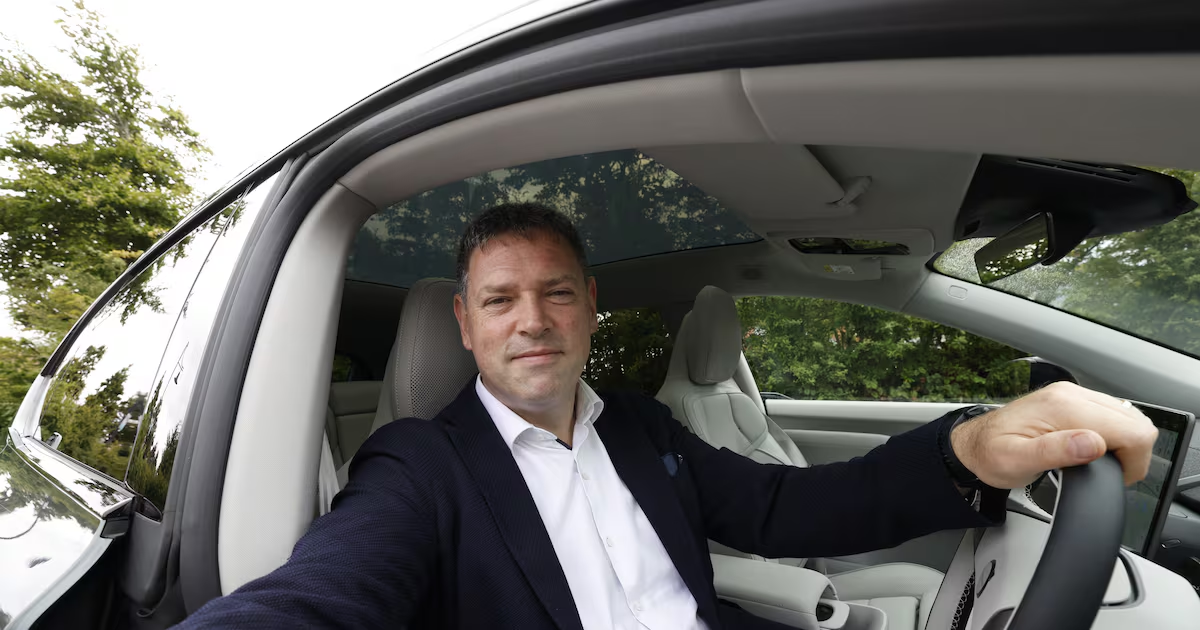
Car maker putting customer first with image revamp but retains long-term EV-only goalVolvo Ireland managing director Alan Cowley: 'It’s still our mission to get to full electric, but it’s a journey – it’s taken some time for the market to catch up.' Photograph: Nick Bradshaw Stephen ConneelyMon Aug 03 2026 - 06:00 • 5 MIN READ“There’s a level of genuine excitement in the network ... a belief that, actually, they’re investing in something that is going to grow and is going to deliver,” Alan Cowley says as he sits in a boardroom at Volvo’s Nordic-inspired office in Citywest, Dublin.The head of the Swedish motor company’s operations in Ireland has spent the last two years rethinking from the ground up its approach to selling cars.On Monday, Volvo Car Ireland announced “a fundamental reimagining” of its business footprint, with an investment of at least €40 million into 10 dealerships across the State.Ground has already been broken on a dealership in Sligo town and work on another in north Dublin begins in the coming months.Most of the investment will be spent on bricks and mortar to redevelop the company’s dealerships to reflect the luxury design and experience expected nowadays of a Swedish-born brand.Comfortable lounges and private meeting rooms where customers can wait while their car is serviced, two technicians on hand at all times to ensure they don’t wait longer than an hour for that service, and ample space for them to park up and for Volvo cars to be displayed are just some of the features Cowley has planned.“We wanted to create a showroom that represented that Scandinavian feel so that we could deliver a much more premium customer experience,” he says, envisaging “a scenario where the customer feels more in control of the sales process”.“Rather than the traditional desk where the salesperson has established themselves and sits behind that desk, becoming a very formal experience, we’re trying to break down those barriers.“The consumer will choose where to sit in the showroom and we can offer that consultation throughout the showroom – whether that be at a high table, over a coffee in the coffee area or in a private meeting room – wherever the customer chooses is what we want to deliver,” Cowley continues.He says the 10 dealerships in the new network will be “marginally down” from the number it currently maintains throughout Ireland – 11 in the Republic and one in Belfast. “Consolidation was important because the investment is very significant. So, we need to make sure the investors can achieve a reasonable return. But, equally, to deliver the kind of customer experience and the quality of showroom [we want], it was reasonable to reduce, somewhat, the number of sites,” he says.While there is no increased employment involved with the investment, the business benefits from the €40 million are intended to extend beyond a simple brand revamp.Supported by 10 investors, who Cowley says are “all Irish-based” and “all family-owned”, Volvo is targeting a 15 per cent share of the premium car market in Ireland by 2030.“We’re really well positioned” to achieve that goal, he adds. “We’ve seen growth this year of close to 10 per cent, and last year close to 10 per cent as well. So, this is not a ‘pie in the sky’ future objective, it’s something we’re living.”The company’s most recent publicly-available financial accounts reveal it generated €112 million in turnover in 2024, a 4.77 per cent increase from the previous year, and earned just under €950,000 in pretax profit, a 37.81 per cent increase from 2023.“I’m entirely convinced that we’ll deliver on what we’ve committed to,” Cowley says.“We won’t do it on our own. We need the retail partners who are making those still significant investments. We need them to do a lot of heavy lifting. They are the people who meet the customer, the ones who build those relationships and make it all happen,” he goes on.In recent years, Volvo’s path to fulfilling its 2021 pledge of selling only electric cars by 2030 has been less than straightforward. It has been difficult to get customers on side with it, leading the parent group to scrap the goal in 2024.“We’re a little less concerned about exactly when we get to full electric,” Cowley says, adding that 90 per cent of Volvo’s cars in Ireland are either electric or hybrid vehicles. “It’s still our mission to get to full electric, but it’s a journey – it’s taken some time for the market to catch up.”It’s not just Volvo. The wider industry-driven approach to go all in on electric vehicles has largely cooled off. “We’ve had to realise that the consumer has a say in this,” Cowley says, “it’s not just about us dictating it; it has to be what the consumer wants and at what speed the customer chooses to move.”Just over 23,600 electric cars were registered in the State last year, according to the Society of the Irish Motor Industry (Simi), accounting for 19 per cent of all registrations – an increase of roughly 35 per cent increase on 2024. Over the first six months of this year, Simi says more than 20,000 EVs have been registered. That’s 48 per cent ahead of the same time last year and puts the sector comfortably in line for record sales this year.“Customers see the value in the electrification journey ... they’re no longer more expensive” than traditional petrol or diesel cars, Cowley says.He points to the more cost-effective approach of charging EVs at home, while adding that “we always would like better infrastructure” in public spaces, which many people living in apartments rely on.The Kildare-born businessman, who has more than 20 years’ experience in the industry, acknowledges “the total market is a very competitive space, and there’s ever-increasing competition”. He joined Volvo from rival Volkswagen in 2018 and still sees the German car brands as the company’s main competitors. At a time when cars are becoming flashier and faster, Volvo is focusing on function and safety. In a nod to its heritage as the inventor of the first three-point seat belt, its most recent EX-60 has an innovative take on the now-staple safety feature: an “adaptive” version which “will sense the weight, the shape of the person and will recognise the tensioning that’s required to keep that person safe in the unlikely event of a collision”, Cowley says.Volvo believes the first safety belt it produced, and chose not to patent, has saved millions of lives. “This innovation will hopefully save another million lives on top of that,” he says.While the path to full electrification appears longer than first expected, the direction Volvo is travelling now appears more straightforward, with a streamlined investment plan taking them through to the next decade. The latest €40 million investment is fuel in the tank to reach its goal on market share, but if recent years are a lesson to the industry, there may yet be unforeseen bumps in the road.IN THIS SECTION
Volvo Ireland invests €40m to bring Nordic touch to dealership network
Car maker putting customer first with image revamp but retains long-term EV-only goal
1,160 words~5 min read