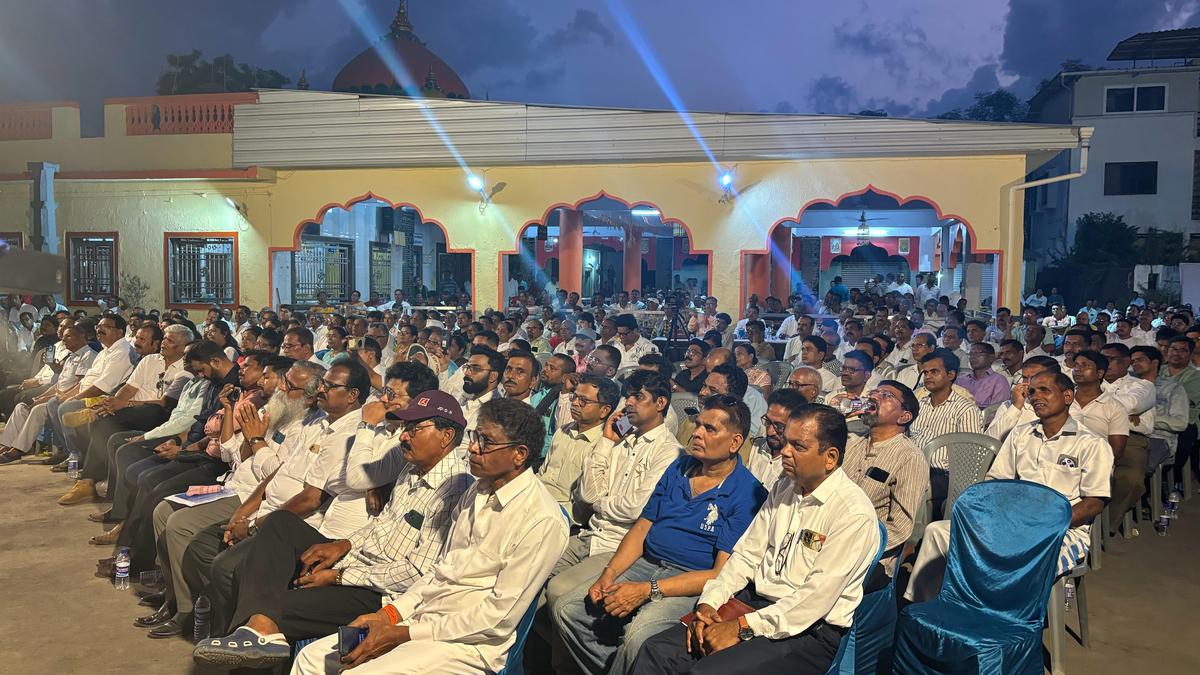
A bead of sweat snakes down 44-year-old Rupesh Patil’s creased forehead as he scans a government notification. His restless gaze shifts abruptly from the still waters of Chirner Lake to the pastoral horizon of the historic village. The lake is near Maharashtra’s 17th-Century Maha Ganpati Temple, and the area is known for its gadhegals — two ancient stones representing land-grant.Chirner is among the 124 villages on the outskirts of Maharashtra’s capital, earmarked for the Third Mumbai project. “Ha navin prayatna ahe amchya jameeni hadapnyacha ani udyaogpatinchya ghashyat ghalnyacha. Kay garaj ahe, jameen ghenya aiwaji development karana. Malki amchich rahudya [This is the third attempt at grabbing all our lands at low prices and putting them in the laps of big conglomerates, contractors, and agents, who are manipulating farmers to sell],” says Patil.He re-examines Mumbai Metropolitan Region Development Authority (MMRDA)’s notification from October 2024. It announces the appointment of the New Town Development Authority (NTDA) as the Third Mumbai project’s special planning authority. The 323-square-kilometre project, also known as Karnala-Sai-Chirner Navanagar (KSC New Town project), is spread across Pen, Panvel, and Uran talukas (or tehsils) of Raigad district.Chirner falls in the Uran taluka. On June 7, hundreds of people gathered in the village to protest, raising slogans to amplify their demand for fair compensation. Three days earlier, the Maharashtra Government had approved the appointment of Singapore-government-owned urban planning consultancy Surbana Jurong Group to prepare a master plan for Mumbai 3.0.The villagers affected by the potential land acquisition are banded together in MMRDA KSC Navnagar Virodhi Samiti, a resistance group formed in April 2025. Their worry has roots in what they say is the Maharashtra government’s four-decade pattern of expanding Mumbai’s urban territory. The government, however, hails the Third Mumbai project as the next frontier of urban expansion.Opposing expectationsThe villagers want to ensure that their agricultural land is not acquired for a fraction of its worth. The government is offering the ready-reckoner rate, used to calculate property registration and stamp duty. The people of Raigad want the market rate, citing the Right to Fair Compensation and Transparency in Land Acquisition, Rehabilitation and Resettlement Act, 2013 (RFCTLARR Act).Atul Mhatre, an architect from Dadargaon (or Dadar) in the Pen taluka of Raigad, is one of hundreds who will be affected. He owns three acres of land. “As per the ready reckoner, I will get ₹1 lakh per gunta, which, as per market price, is ₹5 lakh per gunta.” In Maharashtra, 40 guntas make one acre.Expected to drive rapid urban growth, the Third Mumbai Project aims to decongest nearly 45% of the State’s urban population concentrated in the 4,312-square-kilometre tract of Mumbai Metropolitan Region (MMR). It comprises Mumbai City district, the Mumbai Suburban district area of the Konkan Division, and parts of Thane and Raigad. According to MMRDA’s Final Regional Plan for the Mumbai Metropolitan Region 2016–36, urban areas accounted for 62% of Maharashtra’s population growth in 2025. Estimated at ₹4,000 crore, the Third Mumbai project sits within a 20-kilometre radius of three major economic gateways. With direct road access to South Mumbai, it is about 10-15 kilometres from Atal Setu (Mumbai Trans Harbour Link), 15-20 kilometres from Navi Mumbai International Airport, and 12-18 kilometres from Jawaharlal Nehru Port.Chief Minister Devendra Fadnavis said on the sidelines of the World Economic Forum in Davos this January, “Third Mumbai is an opportunity to create urban agglomeration; it has 60% data centre capacity. It will be a hub for new technology-enabling growth engines. With connectivity, it will bring Mumbai closer.” He said they plan to launch an Orange Gate tunnel, so people from Marine Drive, in the city centre, will be able to reach Navi Mumbai International Airport within 30 minutes. Once the Sewri–Worli Elevated Connector opens, those from the western suburbs can reach the airport in 30-45 minutes. “We are building connectivity. We can create a huge city, like Dubai, here. We have assessed the growth potential of MMR. It can alone become a 1.5 trillion economy.”Priced possessionNearly 60 metres from Chirner Lake, 28-year-old Amey Pitale walks briskly towards the Maha Ganpati Temple and sits on the steps. From his file, he pulls out a dog-eared notification issued by Maharashtra’s Urban Development department in 2019. It outlines the changed boundaries of MMR, extended to the 3 talukas of Raigad. Mr. Pitale’s father owns 2 acres of land, which is likely to be acquired under the project. “We are not against development if it is for us, the people of this land. MMR region, including Raigad, has a history of development at the cost of locals,” he says.
Third Mumbai: New project, old battles
Farmers in Raigad resist the Third Mumbai project, reflecting decades of land acquisition struggles and unfulfilled promises.
1,840 words~8 min read