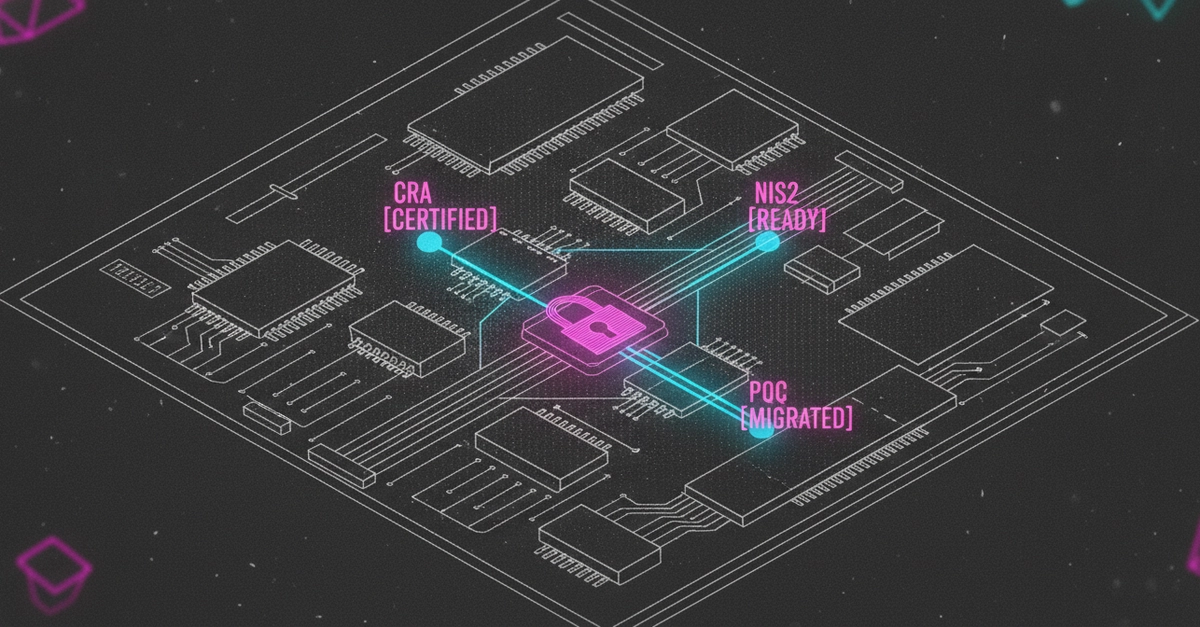
Most conversations about CRA, DORA, and NIS2 compliance for IoT hardware boil down to one uncomfortable binary: redesign the board around newer, security-capable silicon, or accept that your existing product line falls out of compliance on a fixed deadline. For a product with years left in its lifecycle and a BOM that took months to qualify, "just redesign it" is rarely a real answer.
There's a third option that gets far less attention than it deserves: pair the legacy chip with a modern security co-chip that absorbs the cryptographic boundary, while the legacy part keeps doing exactly what it already does well - application logic, peripherals, display, sensor polling. Call it a soft fade-out. The old silicon stays in service until its natural end-of-life; the compliance gap gets closed by a second, much cheaper part sitting next to it, not by replacing it.
The Three Gaps a Legacy Chip Has - and Why a Co-Chip Fixes Them
The regulatory pressure driving all of this isn't abstract. NIST finalized its post-quantum cryptography standards in 2024, and IR 8547 sets real dates: ECDSA and RSA are deprecated after 2030, disallowed after 2035. Germany's BSI has gone further - TR-02102-1 (2026 edition) sets a stricter 2030 deadline for high-protection-need data, and treats the migration as "alternativlos" (without alternative) rather than a recommendation.