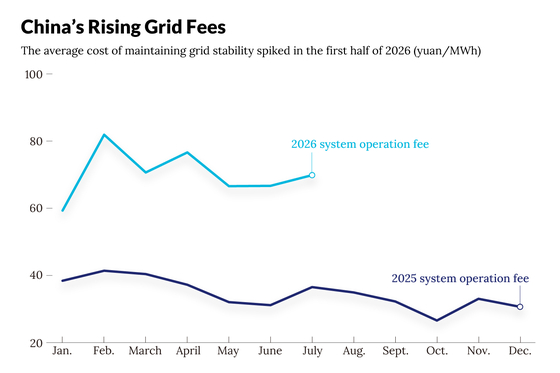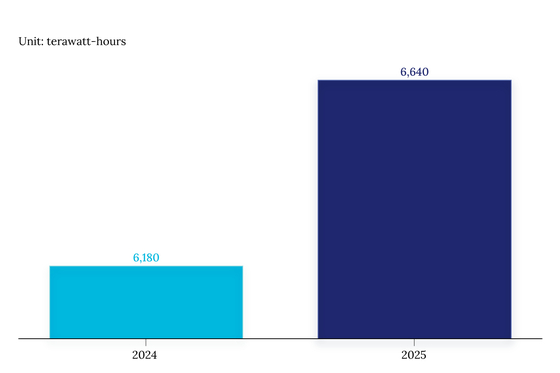
1. Recent surges in Guangdong's electricity spot prices highlight China's shift to a market-driven power sector, exposing industrial users to high volatility.[para. 1]2. On April 11, Guangdong's spot market real-time price reached 0.98 yuan/kWh (14 US cents), over 160% above the 0.37 yuan monthly contract price, staying above 0.6 yuan through Saturday, driven by a 20% LNG price jump from Middle East conflicts and strong export demand.[para. 2]3. As China replaces fixed tariffs with real-time pricing, businesses face costs swayed by weather, global fuels, and renewables' intermittency.[para. 3]4. In 2025, market-traded power hit 6.6 TWh, up 7.4% YoY, comprising 64% of consumption per NEA; nearly two-thirds of kWh were market-traded, per Wang Yunbo.[para. 4][para. 5]5. Marketization lowers costs overall, e.g., Zhejiang/Jiangsu long-term contracts fell 16.5% YoY to 0.3 yuan/kWh for 2026, but emphasizes real-time price signals.[para. 6]6. Local governments speed up scrapping fixed time-of-use tariffs; by mid-April, 13 regions like Guizhou, Hubei, Shanxi canceled them for full market pricing, expected nationwide.[para. 7][para. 8]7. NDRC-NEA rules from March 1 end government tariffs for direct participants; prices follow supply-demand, with 15-minute spot clears linking to events.[para. 9]8. Extreme weather disrupts: December 2025 Shanxi snowstorm capped solar, pushing spot prices to 1.5 yuan/kWh max (130% above day-ahead) in 8 hours.[para. 10]9. Some markets see negative prices; Liaoning hit -0.1 yuan/kWh lower limit for 272+ hours in January, as generators pay to offload surplus.[para. 11]10. Despite negatives, bills don't drop due to shifted costs; Liaoning March spot prices fell >20% YoY, but system fees erased savings.[para. 12][para. 13]11. February 2025 policy ended wind/solar subsidies, market-integrated them with baseline pricing; gaps filled by shared system fees on users.[para. 14]12. Coal plant capacity tariffs rose to 330 yuan/kW-year in 2026 for backup, hiking system costs.[para. 15]13. Spot markets widen regional gaps by energy mix.[para. 16][para. 17]14. Renewables-rich west/northeast see swings; northeast industries pause winter (low prices from coal heat) but ramp summer (wind drops, prices spike), missing lows.[para. 18]15. Hydro provinces (Sichuan, Yunnan) fluctuate with water; coal areas (Shanxi, Shaanxi) fuel-sensitive; import-reliant Guangdong/Zhejiang hit peaks, burdening continuous producers.[para. 19]16. Businesses should match production to local prices, secure retail contracts to hedge, per Xiao Yu of TsIntergy.[para. 20](Word count: 498)AI generated, for reference only
Analysis: China’s Power Reform Exposes Businesses to Wilder Price Swings
As provinces phase out fixed electricity tariffs and expand spot trading, industrial users have been left more vulnerable to energy shocks and extreme weather
367 words~2 min read