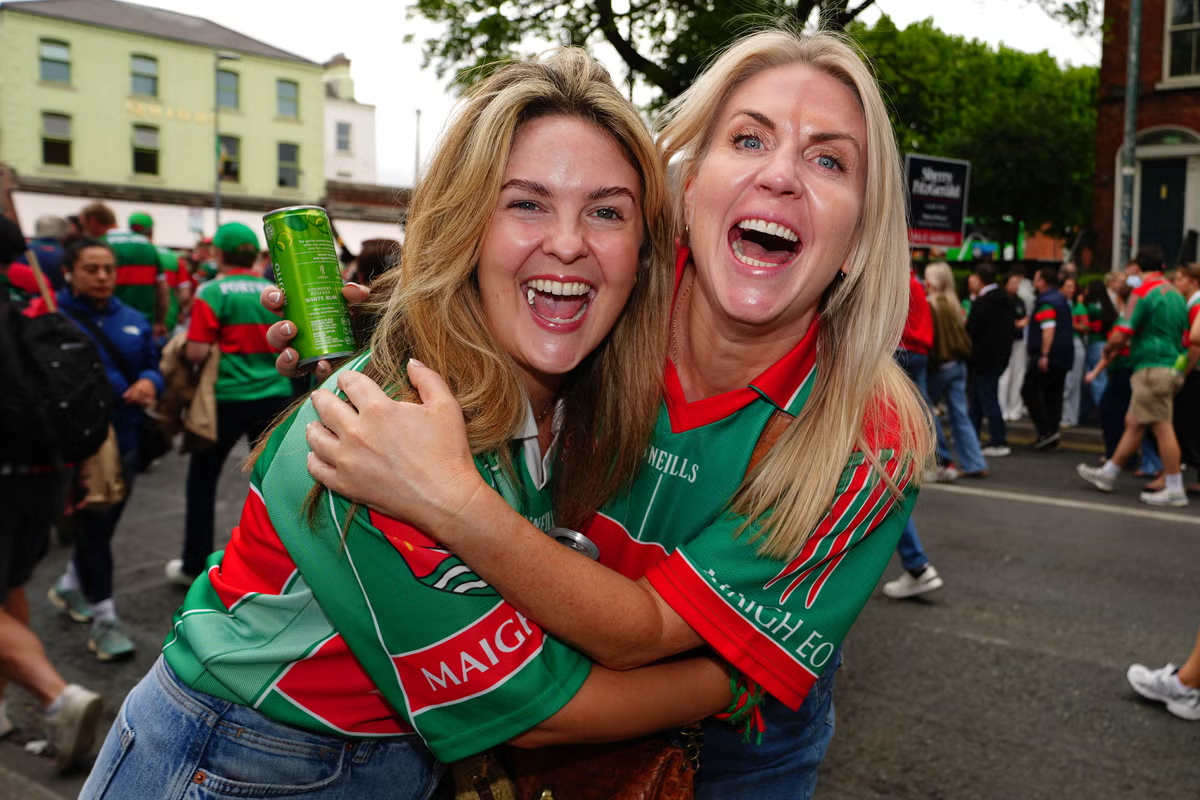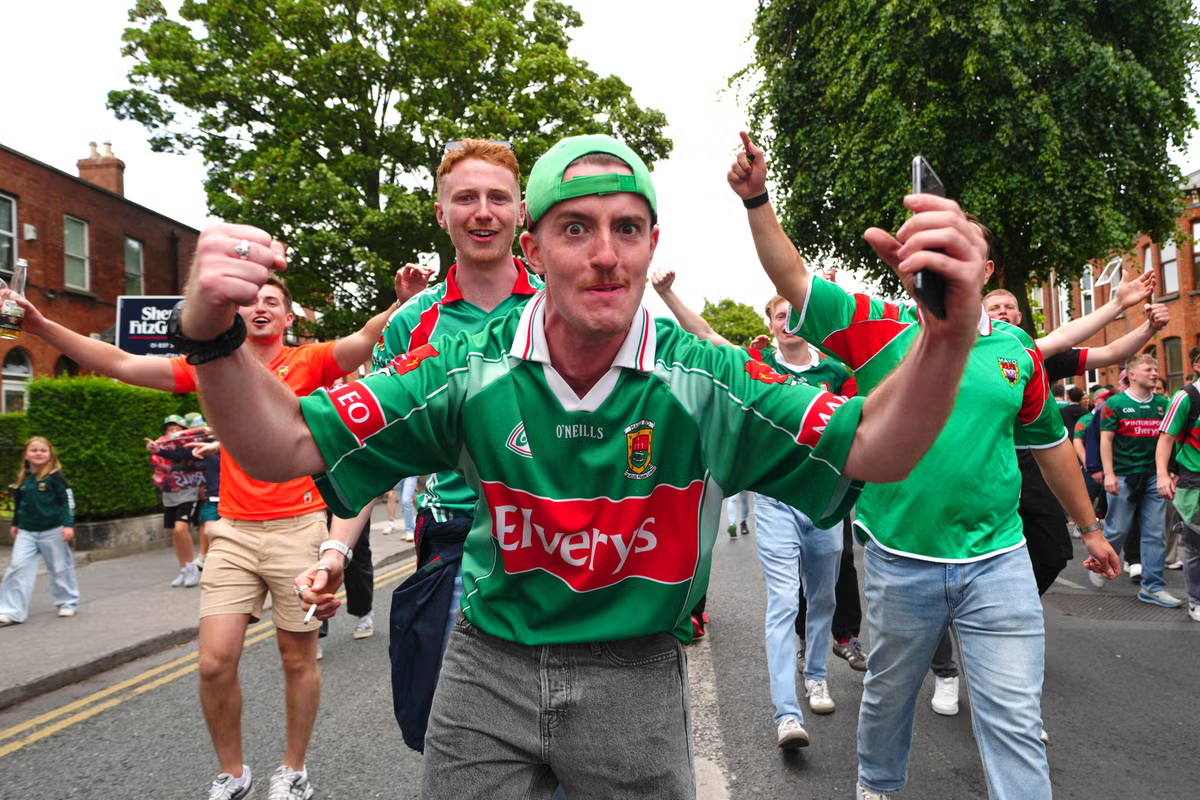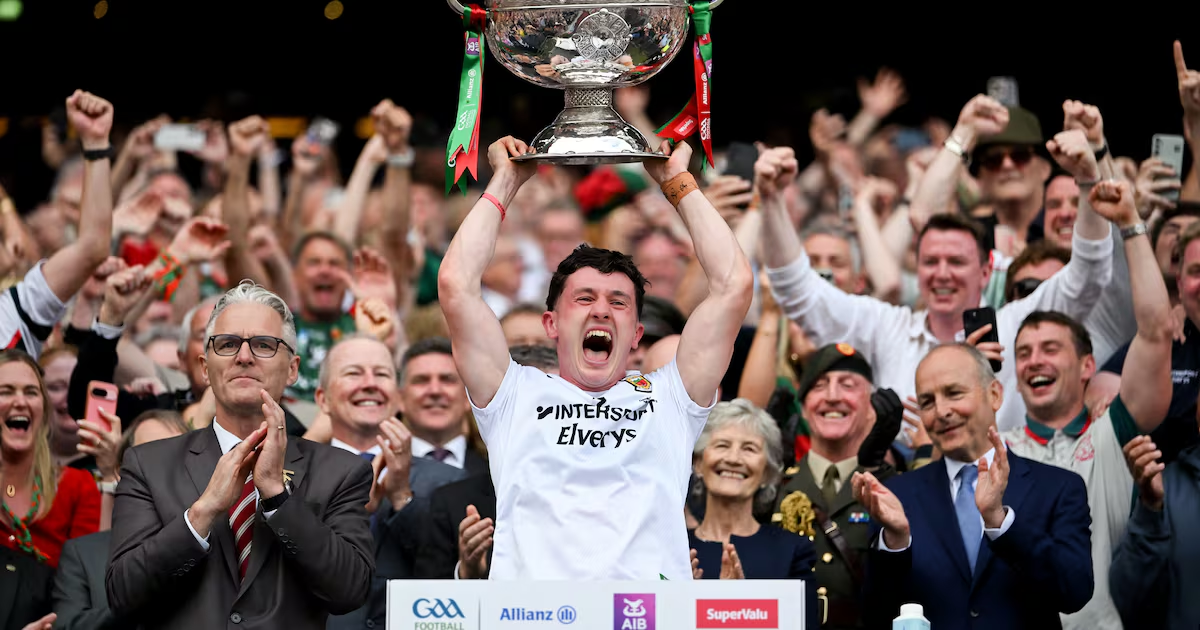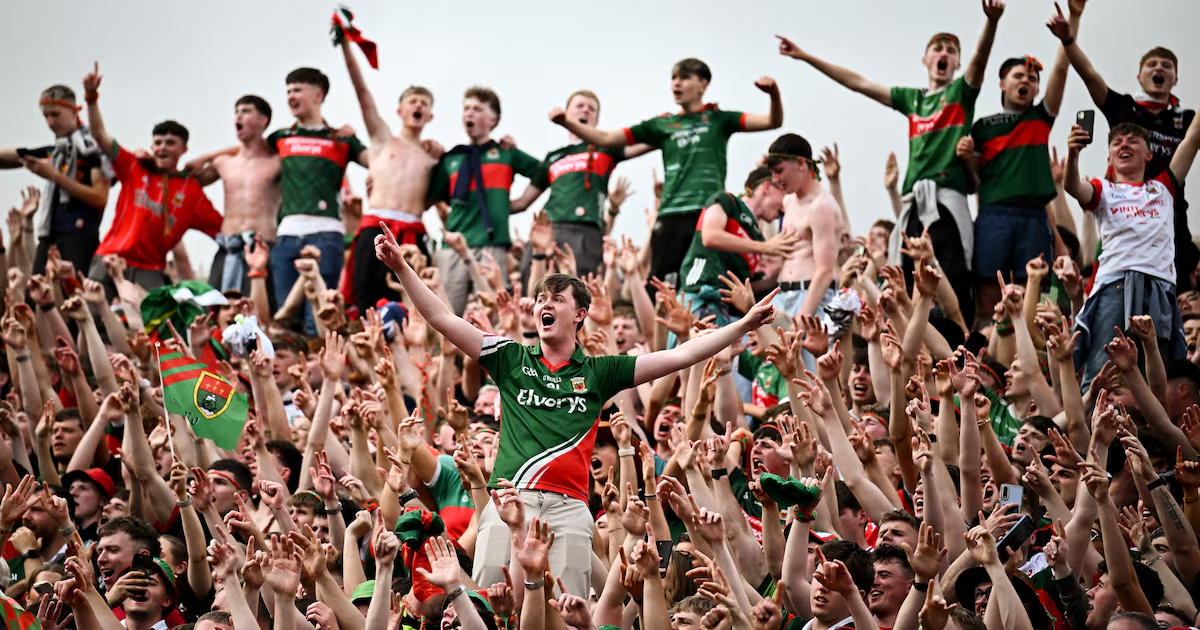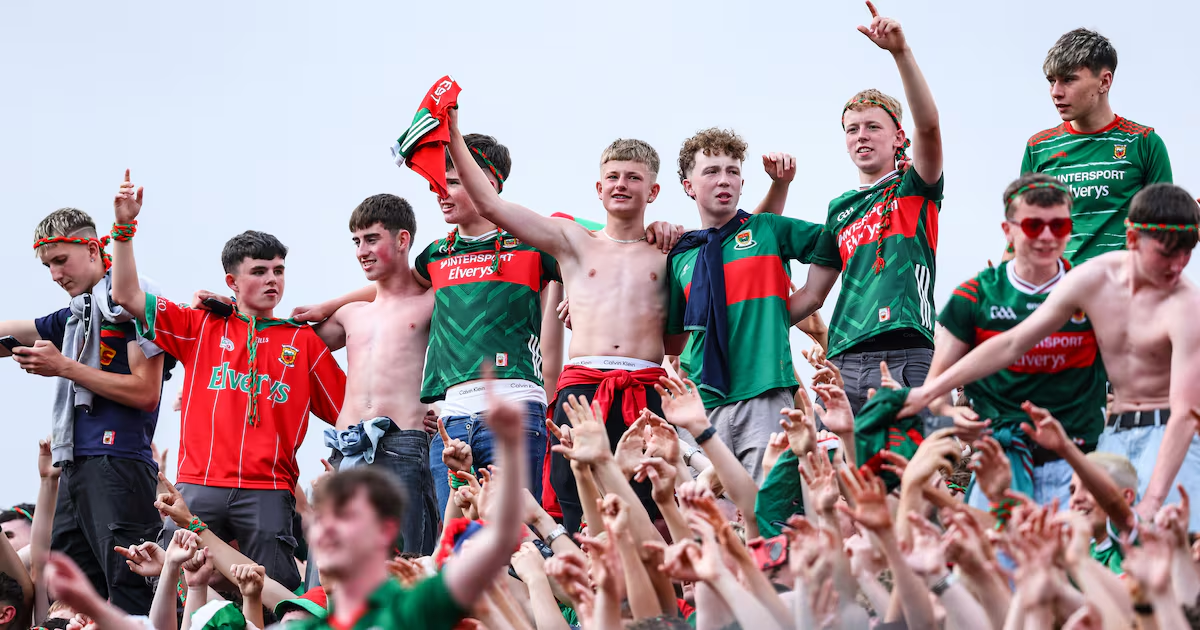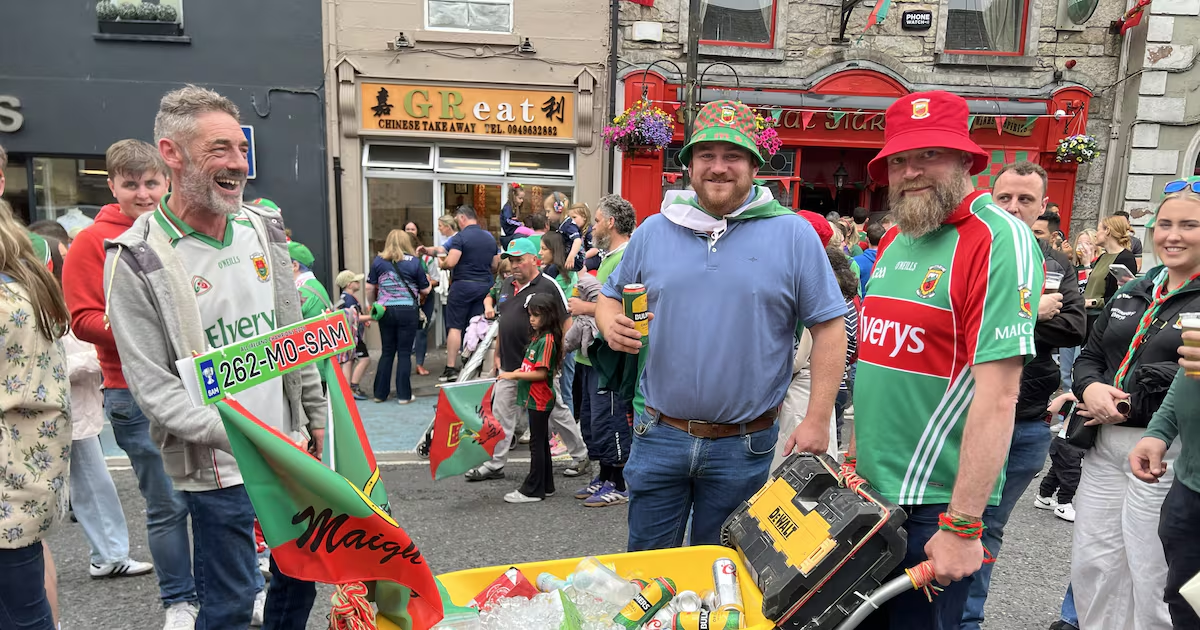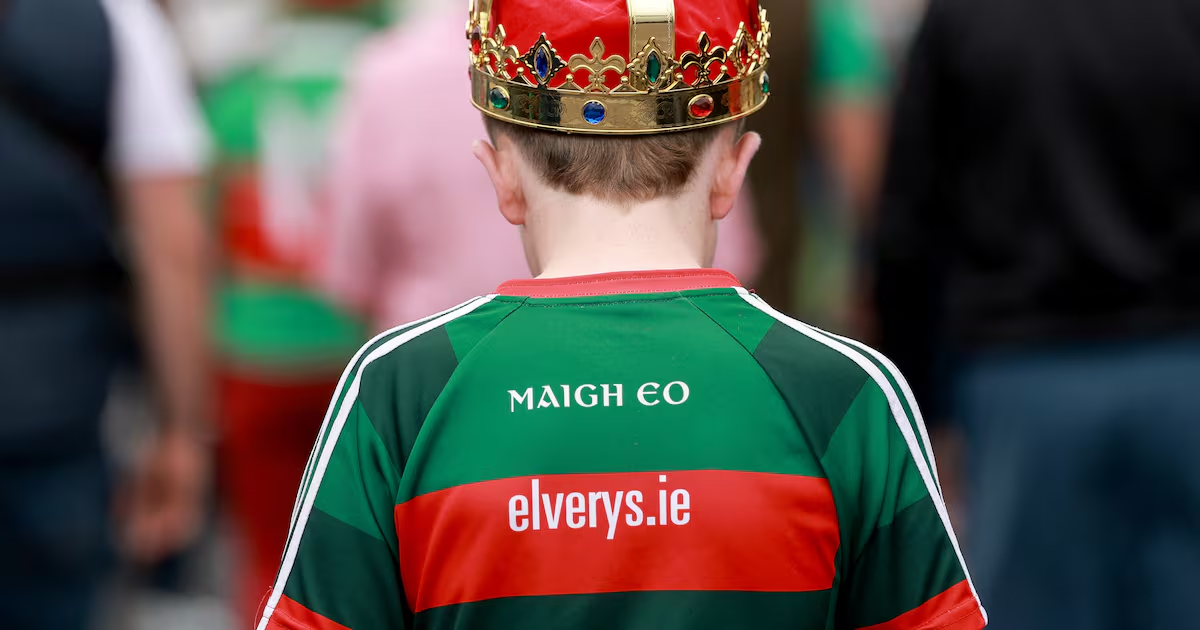
At 6.17pm on Monday evening a roar grew from the back of the Gerry McDonald Stand. From that elevation they could see the roof of the Mayo bus, crawling up McHale Road on the far side. The cheering cascaded on to the packed field in a whitewater rush of sound, and people in the other stand raced up the steps to peer over the back wall. This is what it must have been like when The Beatles landed in New York.By a weird cosmic coincidence, the band on stage was singing Insomnia by Faithless, one of the biggest songs of 1996. That was the year Colm Coyle’s equalising kick for Meath carried on the wind and bounced over the Mayo crossbar with 29 seconds left in the All-Ireland final. Mayo had it in their sweaty hands. “I struggle, fight dark forces in the clear moonlight,” sang the band.The crowd, though, was only listening to its own voice now, decades of want and need and falling down and getting up synthesised into a great cacophony.On Monday evening, Martin Carney stood in the middle of the pitch. A day before, his commentary of the final minutes on MidWest Radio had captured lightning in a bottle. Just at that moment when emotion had rendered language powerless, Carney was holding a microphone with its tongue hanging out, thirsting for words.Croke Park was in a psychedelic trance of noise and hysteria when his co-commentator Stephen Grealis asked Carney to “sum it up”. Somehow, he thought of another celestial breakthrough.“Fifty-seven years ago, Neil Armstrong landed on the moon and he uttered the immortal words, ‘one small step for man, one giant step for mankind’. Today, this is a giant step for Mayo football … This is remarkable. A team of heroes. Invincibles.”“Unconsciously,” he says a couple of days later, “you become an everyman the way you try to describe the fervour and the outpouring. Here, for the first time in a long time, you had happiness displacing despair. The energy generated by the volume of sound could have launched a spaceship.”Martin Carney suffered heartache with Mayo. Photograph: Billy Stickland/Inpho Everybody had their own relationship with the decades of suffering. Carney’s last day in a Mayo jersey was the 1989 All-Ireland final, when he was an unused sub. Over the next six years he brought the Mayo minors and two under-21 teams to All-Ireland finals as manager and all those games were lost; one by two points, one after a replay.His first day as an RTÉ analyst was the drawn All-Ireland final of 1996. That day, of all days. In the men’s shed studio perched in the old Nally Stand, Michael Lyster turned to him for a hot take and, somehow, he found the words again. In a game of just 22 scores, Mayo had led by six points in the middle of the second half. Index-linked to the modern game, that must have been a double-digit lead.“Mayo seemed home and hosed with 15 minutes to go,” said Carney on air, without betraying the churning pain in his stomach. “They seemed to be coasting.”“I remember it in slow motion,” he says now. “I still remember it vividly, the ball bouncing over the bar. Here you are, in the last seconds of the game, Mayo are All-Ireland champions and next thing, Jesus, this freak of nature.”In the days after the game, clips of the MidWest Radio commentary circled the globe. Carney received messages from Australia and America and other points in between where Mayo people had planted a flag. With a microphone in his hand, he wasn’t just speaking to them, he was speaking for them.In Mayo, football has always exerted that elemental power of reunion. Through the decades, All-Ireland finals have sired a million homecomings. When people left, football was like a satellite signal. In speeches and interviews in the days after the final, people spoke about those who are no longer with us, but also those who had gone away and, for whatever reason, had not come back.Carney was born in Donegal, but on his father’s side he can trace his Mayo roots to the 1780s. A few weeks ago he went down to Black Sod, at the very tip of the Mullet Peninsula, close to Drum, where Ryan O’Donoghue has plans to build a house.“There’s an interpretative centre there called Solas,” says Carney. “It’s a restaurant come museum. Go in there and look at the history of emigration from that locality. Particularly in 1883 and 1884, when 3,000 people left there. It shows you the ships they left on and a big map of America to show where they went to. They reckon there are two million plus descendants of those people there now.”In his post-match press conference in Croke Park, Andy Moran spoke about the Mayo people who had made their lives elsewhere in the world. When he was appointed to the job, he reached out to them.Mayo manager Andy Moran arrives for final. Photograph: James Crombie/Inpho “I wear a Chicago Cubs cap,” said Moran. “That’s not for style, I wouldn’t have any style. But we went to Chicago, New York, London back in October, November to try and get our diaspora back involved. One of the most generous men I’ve ever seen insisted on buying me a Chicago Cubs hat. So I wear that just to remind myself of the Mayo people, successful Mayo people who went around the world and made millions of euro, hired heaps of people, hired all the Irish boys when they were going over. If they can do it, why can’t we do it on the football field?”In the lead-up to the final Moran got an email out of the blue from a Mayo emigrant in Melbourne. Patrick Horan didn’t know the Mayo manager, but he had played football years ago with his brother. Horan leads the communications department for the Western Bulldogs AFL team and there was a striking resemblance between their story and Mayo’s tortured history. Everything except the happy ending.In 2016 the Bulldogs won the Premiership for the first time in 62 years. Luke Beveridge was a young, second-season coach back then and he is still at the club now, 10 years later. So, Horan gave Beveridge a potted history of Mayo, he told Moran the story of the Bulldogs, and on the Tuesday before the All-Ireland final he hooked them up on a Zoom call for an hour. In the global network of Mayo football, this was another satellite signal.John Schultz, Luke Beveridge and Robert Murphy of the Western Bulldogs after the 2016 Grand Final. Photograph: Michael Willson/AFL Media/Getty Images “They were everyone’s second-favourite team, a battling working-class club,” says Horan. “They finish seventh on the ladder [table] that season, and nobody had ever won it from outside the top four. Nobody ever thought they’d do it and then they came from the clouds and did it.”Isn’t that way Mayo did? They came from the clouds.♦ ♦ ♦As soon as the hooter sounded in Croke Park, the story was no longer about football. It was about roots and identity and repressed feelings and damaged feelings and everlasting feelings.Outside of Mayo, nobody understood how deeply losing had pierced their flesh. The putdowns, the cheap shots, the exploded hope, the patronising pats on the head, the casual cruelty, all of it was of a piece. They kept pushing the boulder up the mountain and every time it turned and flattened them. On Twitter there was a provocative account called “How many days since Mayo last won Sam?” Until, last Sunday the answer was 27,335 days. What could they say? How could they answer back?Colm Boyle was a brilliant analyst on the Mayo Football Talk podcast before he joined Moran’s management team, and whenever the taunting of Mayo was discussed, he returned to the same answer: until it is won, we bite our tongue.“We were easy targets,” says Mickey Conroy, who appeared in three All-Ireland finals for Mayo. “But don’t get me wrong, there were times when we didn’t help ourselves. It was a thing with us [the taunting]. We’d have spoken about it.”But every year they failed to come with the answer that counted for anything.Paul Flynn and Phily McMahon of Dublin celebrate after 2013 final as Michael Conroy of Mayo sits dejected. Photograph: Donall Farmer/Inpho “You never had a good enough response,” says Jason Doherty, who spent 13 seasons on the Mayo panel. “You can talk about the journey, which was hugely important, but we went back every year to win the Celtic Cross. It was always something that people could throw back at you.“I work in Galway and there was slagging there and you used to laugh it off, even as a player. It got to the point where not many people were saying it in a genuine way. It was like an icebreaker for people. You’d meet someone and you’d say you were from Mayo and they’d say: ‘Will ye ever do it?’ You just wanted to be able to say: ‘We’ve done it.’”It was the first thing Andy Moran addressed when he stepped to the front of the stage at the homecoming in Castlebar. “They sneered at us,” he said. “They laughed at us. But they won’t laugh at us now.”How long had those words been stuck in his throat? “He captured the mood of most Mayo people, home and abroad,” says Carney. “Dear God above, we were all the time being looked on as losers, we were all the time looked upon as chokers, people who can’t look victory in the eye and go and seize it. He spoke perfectly on behalf of his tribe.“After last Sunday there was a kind of outpouring of all the resentment you felt towards people, getting this ould false sympathy, and you knew it had nothing to do with sympathy. You’d be getting these ould sneering remarks.”Jack Coyne’s electrifying victory speech was the first page of another story. “When Jack Coyne said ‘stick out your chest and be proud to be from Mayo’, if there was anyone not crying when he said that they must be made of nails, they must be made of steel,” says Conroy. “I haven’t cried since my last child was born four years ago, but I cried. I couldn’t stop crying on Sunday.”Mayo's Jack Coyne lifts the Sam Maguire Cup. Photograph: James Crombie/Inpho In different ways, and to different degrees, winning brought closure. The Mayo teams who had reached the last game of the season over the years were saluted. Every team stands on the shoulders of others.Doherty watched the match on his own, but one of his old team-mates, Ger Cafferkey, was about 10 seats away. Before they knew it, they were locked in an embrace. A piece of them had not left the pitch.“It’s funny,” says Doherty. “We’re only human. It didn’t last long, but initially there was that little bit of jealousy. It was like, ‘oh God, I wish I had that experience’. I daydreamed about these homecomings.“I got out to the banquet on Sunday night, late, and that jealousy or whatever you want to call it just left when I saw the Aidos [Aidan O’Shea] and the Cillians [Cillian O’Connor] and the Robbies [Robbie Hennelly] that I had probably played with the longest.”[ Mayo’s magnificent quest leaves us wanting more – but who from?Opens in new window ]Moran said on The Sunday Game evening show that he had been at six losing banquets in his time and they had found a way to enjoy them. Doherty remembers those nights too. For days afterwards they would place a temporary injunction on the world outside.“It wasn’t the Monday morning after the match that was the worst, it was the Monday about two weeks later,” says Doherty. “Of course that first Monday was pretty shit, but at least you were with the group. In the early days, it might be a week before we’d break up. In the later years we’d have been breaking up after two or three days and that’s when you’d have to get back to reality and back to work and back into hearing the same, ‘I’m sorry for your loss’, type comments. I used to hate that.Mayo's Jason Doherty playing in 2019. Photograph: James Crombie/Inpho “I saw Mattie Ruane saying that he woke up on Monday morning and he didn’t even have a hangover and the only other time that happened to him was when they won the under-21s back in 2016. He didn’t even entertain it because he was on such a high.”Conroy went to the homecoming in Castlebar and went up the town afterwards with friends. They couldn’t get in to any of the pubs, so they bought a tray of cans in a supermarket and drank on the street. On Wednesday, Doherty met Séamie O’Shea, Chrissie Barrett and Brendan Harrison and they drove to the homecoming in Belmullet, Barrett’s club.“You know, places like Achill Island and Black Sod and Belmullet have always been there and they were always beautiful,” says Conroy, “but the fact that we’re the 2026 All-Ireland champions, the light is coming right down on top of us now.”♦ ♦ ♦They came from the clouds. When the championship reached Croke Park, and just eight teams remained, where did they stand? In the first six? Seven? Until that point nothing had been smooth.“Even going back to the appointment of Andy Moran,” says Carney, “there were a lot of rumblings about that. A lot of people felt that he wasn’t experienced enough and that he was too close to the older players and a number of guys that he would have played with. Some people felt that they should have appointed Tony McEntee.”Carney covered most of their league games and all of their championship games, apart from the trip to London for the opening round of the Connacht championship. For months, the recurring theme was how porous they were, even in games that they won: against Galway in the league they coughed up eight goal chances; against Monaghan in the championship they surrendered 10 goal chances.When they were annihilated at home by Roscommon in the Connacht semi-final, the Gerry McDonald stand that was packed by mid-afternoon for the homecoming was less than two-thirds full. There had been a stink that week about ticket prices, but there was an underlying scepticism too. It felt like a tipping point rather than a turning point.“If you had heard the negativity after the Roscommon defeat, oh my God, people were scathing,” says Carney. “Scathing about the performance, scathing about the result. Mayo were woeful. But that was the makings of Mayo.”John Gunnigan started a Mayo football blog 19 years ago, and over time it has been consolidated into a website with the Mayo Football Talk podcast. “We came up with this tag line: ‘It never stops,’” says Gunnigan. “And then we got this hosing from the Rossies and we were saying, ‘Jesus Christ, it could stop’.Mayo's Enda Hession and Paddy Durcan in Roscommon defeat. Photograph: Tom O’Hanlon/Inpho “We played Meath five weeks ago and for the first 20 minutes of that game we were an utter shambles. That game went way out of control, and we just came back strong. Nobody left MacHale Park that day thinking we’ve just seen the coming All-Ireland champions.”But they had pillars of conviction too. From the beginning, they were adamant about the value of two-pointers. The Mayo players were not just emboldened to shoot, they were enlisted to shoot.Conroy is manager of the Mayo under-19 development squad, and they spent a day shadowing the seniors. It was a challenge match against Offaly, four days before Christmas.“We were in the dressingroom,” says Conroy, “and the message was: ‘How many shots are we getting off? How many shots are you giving me today? How many twos are we getting?’“But shots was the big one. ‘You miss the first one, what are you doing? I’m taking another one. You miss the second one, what are you doing? I’m taking another one.’ These were the answers that Andy was after. ‘Until I tell you to stop, you keep pulling.’ This was in December, their first match, and they were talking about this stuff.“One of the mantras for the team on Sunday was: ‘Keep Swinging.’ We always said to win big you’ve got to be brave. F**k me, they were brave everywhere.”Mayo players take to the stage in MacHale Park. Photograph: James Crombie/Inpho So many times over the years, when Mayo lost, people said that they were upended by doubt. Whether it was true or partly true it became a self-fulfilling prophesy. This time, though, their convictions propelled them.“We shot 32 two-pointers [in the championship, having only shot three the previous season],” says Gunnigan, “which was more than everyone else, and we conceded fewer two-pointers than everyone else. We went after two-pointers, and we went after stopping two-pointers.”During the week, Gunnigan did an interview with a Canadian radio station and at the homecoming on Monday he took a call on air from a radio station in Melbourne. The story had circled the globe. They wanted to ask about Kobe McDonald, who will soon be landing in their laps, but they had other questions too.“They said: ‘What do your guys get for winning the All-Ireland?’ I had a think about it, and I said I’ll answer your question in one word.“Immortality.”
As soon as the hooter sounded in Croke Park, the story was no longer about football
Mayo’s joyous All-Ireland win was also about roots and identity and a rebuttal of the past
2,906 words~13 min read