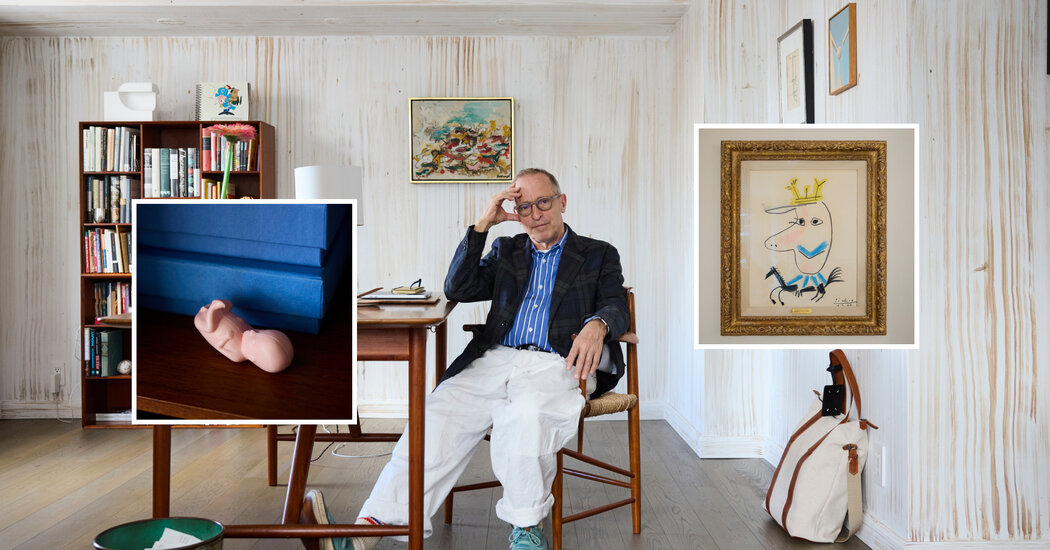
A few days after I interview David Sedaris, I receive a thank-you postcard featuring an image from 1897 of two skeletons holding a baby skeleton above the caption “The First Tooth.” It’s funny and dark. It is, in fact, perfectly David Sedaris. He has been publishing beautifully written, blackly hilarious essays about his life since his first book, Naked, in 1997. His new one, The Land and its People, contains 28 essays, some on serious subjects (ageing, all the dead friends in his address book, his late mother, convalescence), some seemingly slighter (giving someone a lift, helping a stranger carry a piece of furniture, ChatGPT), all very funny.I call him in his home in England (he has another in New York) where I can hear him potter away as we talk. He is forthcoming, mischievously shocking and very happy to talk about the serious business of being funny on the page and at his live readings. “I want the audience to make a sound,” he says. “And I want the sound to be laughter.”It wasn’t always like that, he says. “I wasted a lot of time – everybody does – writing like other people. Trying to be Raymond Carver and trying to be Truman Capote … I just felt if you were writing humour, you would never get any respect.” Why is humour writing disrespected? “I think people conflate it with stand-up,” he says. “People will say, ‘Oh, I really like your stand-up’ and I say, ‘I’ve never in my life done stand-up.’ Everything I read was written down. I chose this word over that one. I deliberated. I didn’t just talk it.”He discovered his métier a little accidentally. He was writing fiction when renowned US broadcaster Ira Glass saw him reading from his diary at an event and began having him on his radio show. The brief was that he read non-fiction. “I just started writing about my life, but not in a way that I think I’m important [or] even necessarily interesting. I think it’s more like the way Cindy Sherman photographs herself to talk about the world… I feel like that’s what I do.” Underneath the jokes there’s often serious material. In this book he has an essay about buying his sister an expensive cape after she gets a cancer diagnosis. “[That] gets some really outsized laughs, but it gets them because it follows a harrowing part. The audience thinks that my sister Gretchen died of cancer. I do everything to make them think it. When I read it out loud, I choke up a little bit, and then when they find out that she’s fine, and then I want the cape back and I say, ‘Oh, I’ll get it back eventually’ it gets a laugh because it’s like a pressure valve.”Is he a softie at heart who’s hiding his emotions in the humour? “There are certain essays that I [read], like the essay about my friend Dawn, about my friendship with her, and it’s really hard for me not to cry at the end of that essay,” he says. “I just don’t like sentimentality. I’m not afraid of feeling. I just don’t want to be cheap about it. “There’s a book that I really love by Calvin Trillin ... [His wife, Alice] was a character in so many of his more lighthearted books. And then she died and he wrote a very slim book, About Alice, and he never wrote in the book that he loved her. He never said the words. He never says, ‘I miss her every day.’ He shows it to you ... He doesn’t need to poke us to get us to feel something. He trusts us to feel something.”He goes on a riff about American sentimentality. “You could go right now to Arkansas and you could ask a straight man about 9/11 and he’ll say,” Sedaris says, through fake tears, in an exaggerated Arkansas accent, “And I saw an American flag on fire …”Author David Sedaris being interviewed on Late Night with Seth Meyers last month. Photograph: Paula Lobo/NBC/Getty He laughs. He also loves bad wedding toasts and a show called Intervention in which families confront addicts. “[Americans] cry at the drop of a hat.”His family were “allergic” to “performative feeling,” he says. “I don’t remember any of us crying when my father died. When my mother died, we did, but I don’t remember a lot of cliches being passed around … We all had a similar sensibility and we just really like to make each other laugh.”Where did his own humour come from? “I think it started off as a defence mechanism,” he says. “I wasn’t popular in school [but] I wasn’t bullied. There was always someone lower than me. [Humour] was a way that I could get attention. There are kings and queens [at school] and they sit atop their thrones, and everyone else is just at their feet … And I just tried to get through my days without being found out as gay. I’m 69, so no one even really imagined then that anyone could be anything that awful back then. You might call somebody ‘gay’, but you didn’t imagine they actually were.”Is he constantly looking for material? “I never turn it off,” he says. “I wrote that essay about being bitten by a dog in the book. Then six months later, I got bitten by another dog, and I was like, ‘F**k. I already wrote about it.’ That time it really hurt because there was nothing I could do. I started feeding crows. I was just in the park this morning feeding them raw turkey breast and a guy came up and said, ‘Be careful.’ He said, ‘I was feeding crows, and they attacked me.’ And then I thought, ‘Oh, I don’t want to be attacked by crows.’ And then I thought …” He literally sings this bit: “I can write about it’!”What makes someone a good “character” for his books? “I think good characters are sure of themselves,” he says. “My father was sure of himself. In my opinion, he was always wrong but he was just brimming with confidence, and so he would tell you what to do with your life, or he would shout at somebody … “I don’t like extremists in politics, I can’t stand the far right and I can’t stand the far left either. But I like them as characters. I like how tenaciously they cling to their beliefs and how they’re motivated by this mistaken faith in themselves. I find that thrilling.”David Sedaris: 'I actually find it much more rewarding to write about nothing.' Photograph: Leonardo Cendamo/Getty What does he leave out of his stories? “There are certain things you can’t talk about. You can’t talk about good things that you do because you just sound like an asshole. So people just assume that all you care about is, in my case, shopping.” He laughs. “Which is pretty true.”He also plays up extremes, he says. “I pit myself against people. When I write about Hugh [Hamrick, his husband], Hugh is like the voice of reason. Hugh is the person who makes the right decisions and who takes care of things. And I’m the buffoon. That’s not that terribly far off the mark. I don’t know how to buy a plane ticket. I don’t open any mail that doesn’t look like fan mail. They can write ‘urgent’ outside of it all they want, and I’m not going to open it. So it’s one person in the relationship being kind of self-obsessed and bumbling, and the other person being steady and capable … Hugh has some qualities that I don’t mention because they contradict his image.”Do his subjects ever get annoyed with what he’s written? “The New York Times has this column called At Home With. They come into your home and take pictures. Hugh said ‘absolutely not’ and I said, ‘I have a book coming out and I cannot say to my publicist, ‘Forget it. I don’t want publicity in The New York Times.’ In the interview, when you look at it in the paper, it can sound like you’re just boasting, because they ask, ‘How much did your apartment cost?’ ‘How much did that Picasso painting cost?’ [they own two Picassos]. He, anyway, he will never forgive me for that, and he’s made that very clear.” He laughs. “But then on most other things, Hugh trusts me. Hugh needs me in his life to make fun of him because he can be really serious and I can get him to see himself and to laugh at himself and he knows he needs it. So I fulfil a purpose that way.”What about the rest of his family? “My brother and I, we had an argument over something, maybe in 2016, following an election. Huh. I wonder what we argued about? And then he said he didn’t want me writing about him any more … I respected his decision and I didn’t write about him. And then I went to North Carolina a couple months ago on a lecture tour, and everything I read ... had my brother in it, and he was so happy, but none of it was about what he feared that I was going to write about.”I tell him about a recent Onion headline: “Author wishes she hadn’t blown personal trauma on first book.” He laughs. “I did waste a lot of trauma in my first book … I actually find it much more rewarding to write about nothing ... or to write about sneezing, a cough drop shooting out of my mouth and landing on the lap of the woman next to me on a plane.”His writing is very linked to live performance. “When I was young, I was living in Chicago, and I would read out loud a lot. I’d be invited to be one of five people who read on a night. So I’d sit in the audience, and I’d realise, Oh, I stopped listening to that person. Why did I stop listening? ... because the character doesn’t want anything. Or the person’s just broken up with someone, and they’re just talking about their feelings or nobody has a name or no one has been described. I was paying attention to why I stopped listening.”[ Why humour is a serious matter when it comes to wellbeingOpens in new window ]He sometimes glides without much comment over sad and unsettling material in his work. He also does so as we’re speaking. “Someone asked me recently, ‘What’s your central trauma?’ And I thought, I don’t have one. And I was raped twice. And I don’t have a sexual trauma. Maybe because [back] when it happened, if you were a gay man, it would be like saying that somebody robbed you in prison. ‘You’re in prison. Shut the f**k up. That’s what you get.’ So you couldn’t complain about it ... So it wasn’t traumatising to me because there wasn’t a structure for it. And it’s not like I need now to go to a therapist and deal with it. I think I’m fine. And I’m not saying that other people who were raped don’t have every right to be upset about it. It’s just that for me personally, you would just get on with it.”This is upsetting but he does seem to just get on with things. He writes a daily diary and he’s started publishing collections of his diaries in recent years. “Over the years, I see things … things I was tearing at my breast over, breaking up with somebody or something like that. And now it’s funny to me.”How does he explain to strangers what he does? “A lot of times, if I’m in a car and I’m being driven, the driver will say, ‘What do you do?’ And I say, ‘I write’ and they say, ‘What kind of things do you write about?’ And I’ll often say, ‘If you turned around and stabbed me in my eye, I would wait until it was funny, and then I would write about it. I wouldn’t write about it before it’s funny because that doesn’t interest me. And eventually it will be funny.’” The Land and Its People by David Sedaris is published by Abacus.The 24-hour national rape crisis helpline can be reached on 1800 77 88 88
David Sedaris at 69: I tried to get through my school days without being found out as gay
The US writer and humorist talks about the serious business of being funny on the page and at his live readings
2,063 words~9 min read