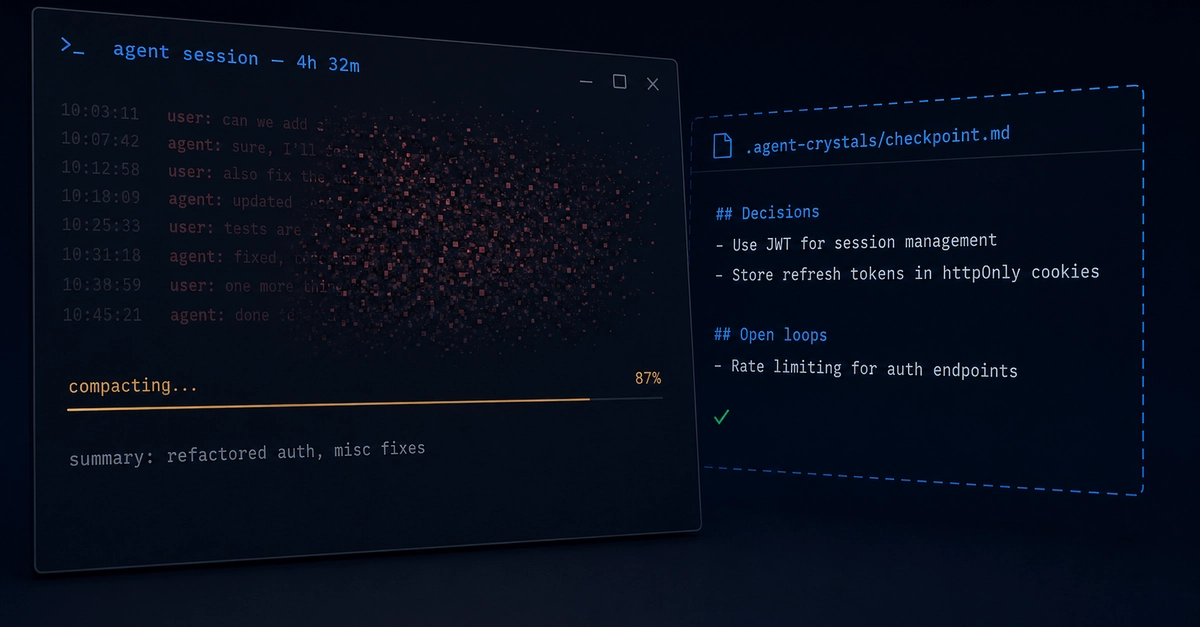
Every long AI session ends the same way. The context window fills up, and something has to give.
Most tools handle this moment for you. A summarizer wakes up, rewrites your history into a paragraph you never see, and the conversation carries on as if nothing happened. Coding agents call it auto-compact. Agent frameworks call it a condenser. The names differ; the shape is the same: the most consequential edit of your session is made by a machine, in the dark, and you were not in the room.
What did it keep? What did it drop? Was the decision you spent twenty minutes reaching preserved, or was it flattened into "the user explored several options"? You cannot answer any of these questions, because there is nothing to look at.
I have been building ThoughtDAG around one rule that makes this unacceptable: a wire is context. Your conversation lives as a graph on an infinite canvas. Every answer is a node; the wires between nodes decide exactly what the model sees on the next question. Delete one edge, get a different answer. I wrote about that rule here.
This post is about what that rule forces you to do when the map itself grows too heavy. Compaction has to happen somewhere. The question is whether it happens where you can see it.