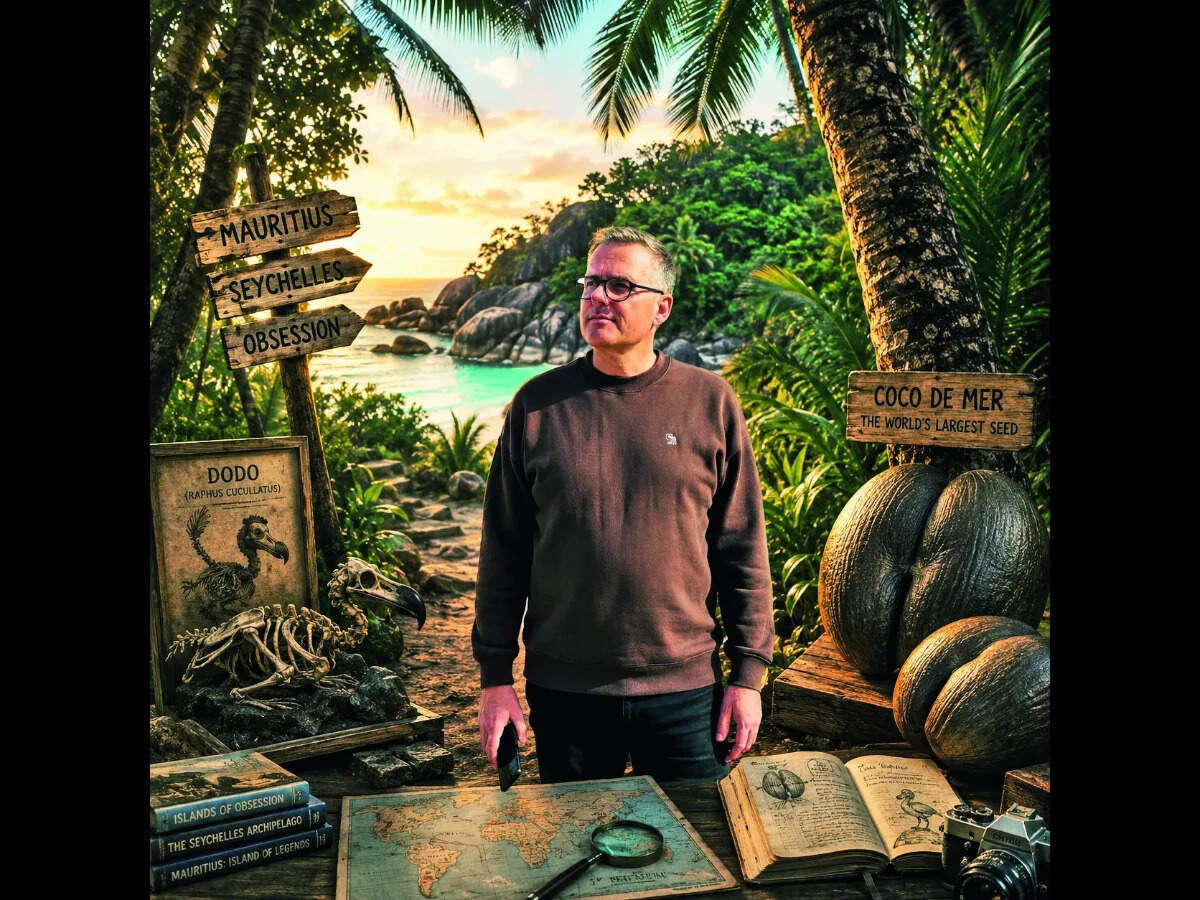
As my partner and I are neither beach people nor enthusiastic swimmers, we find ourselves remarkably often on islands surrounded by nothing but endless ocean. We already paid the price for this once by getting stranded on New Caledonia, a French territory comprising dozens of islands in the South Pacific, during a riot, only to be evacuated two weeks later by the French army.It makes for a good story - and a column on this page two years ago. But once safely home, we solemnly vowed to stick to megacities with boutique cafes, serving organically sourced single-origin coffee. So, when we announced we were off to the Seychelles, eyebrows were raised. Not interested in resorts, what exactly possessed us then? The answer can be summarised in one word: coconut.The island of Praslin is one of the few places where the 'coco de mer' still grows in the wild. Its French name translates as sea coconut, although, of course, it's not the sea that produces them, but improbably tall palms.Read More: Can AI replace teachers? Why human educators still matterThe Seychelles entered the European colonial imagination surprisingly late. Portuguese sailors mapped the islands in 1502, but for centuries they remained uninhabited. Arab seafarers had long known of them, using the archipelago, much like the islands of Mauritius and Reunion, as a stopping point without ever settling there. It was only in 1756 that France formally claimed the islands, by which time their extraordinary flora had evolved largely undisturbed by human hands.Curiously, coco de mer was already famous. For centuries, its enormous nuts washed up on beaches in the Maldives, giving rise to myths of a mysterious tree growing beneath the sea. Sailors carried them back to Europe, where their unmistakably female shape - somewhere between voluptuous buttocks and a vulva - fuelled endless fantasies about their origin. After repeatedly stumbling across them in Amsterdam antique shops, I eventually concluded that I could no longer live without owning one myself. The obvious solution was to travel to its place of origin.This turned out to be easier imagined than accomplished. Coco de mer is among the world's most tightly protected botanical treasures. Every nut sold legally is individually certified, and the prices are appropriately eye-watering for what is, in the end, an absurdly oversized coconut.ET Bureau
Going totally nuts over coco de mer: A very long journey for a very unusual coconut - The Economic Times
The author and partner journeyed to Praslin in the Seychelles seeking the unique coco de mer nut. This rare fruit grows on tall palms and has a fascinating history of myths. They visited shops and a nature park to find an authentic specimen. The coco de mer nut is a protected botanical treasure with a high price. Their successful acquisition now adorns their living room as a travel memento.
691 words~3 min read