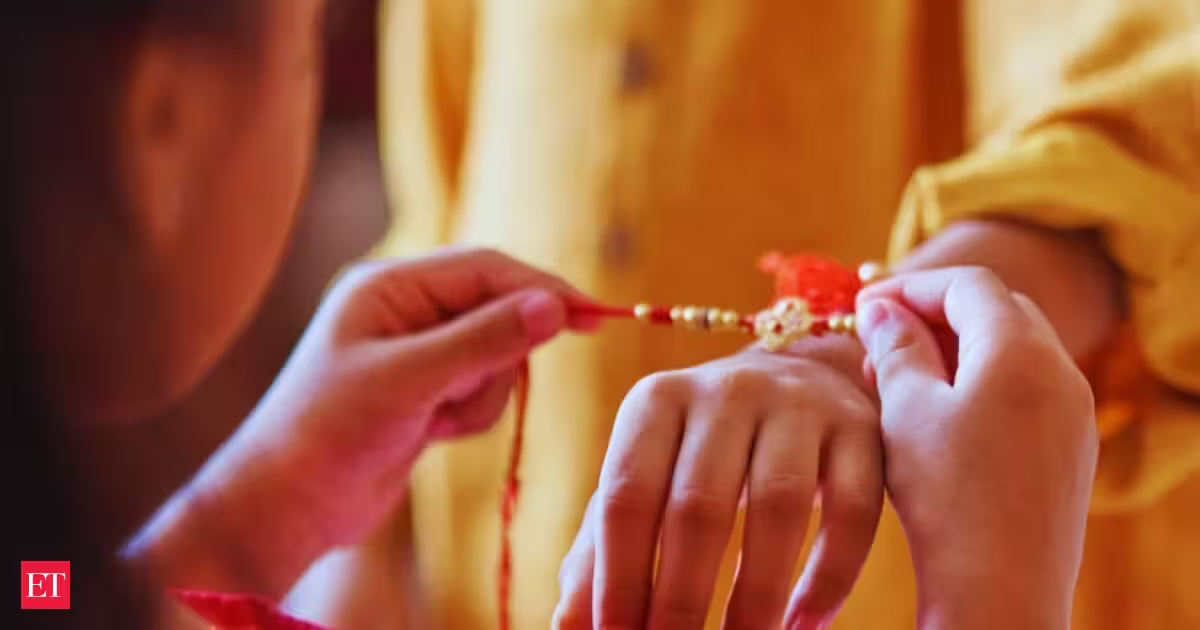
Mark your calendars; Friendship Day 2026 falls on Sunday, August 2, going by the tradition that has stuck for nearly three decades now, the first Sunday of August. If that date feels slightly off compared to what a quick Google search told you a few days ago, you're not imagining things. There are, in fact, two Friendship Days on the calendar, and almost nobody in India remembers that until this week rolls around.Friendship Day 2026 date: Two Friendship Days?Yes. The United Nations recognises July 30 as the official International Day of Friendship, a resolution passed back in 2011. But long before that UN declaration existed, India, along with the US and much of South Asia, had already settled into a different rhythm: celebrating friendship on the first Sunday of August, every single year.Also Read: August 2026 Festival Calendar: Dates for Raksha Bandhan, Hariyali Teej, Onam, Nag Panchami and all other festivals this monthSo while the UN's calendar says July 30, chances are your college WhatsApp group, your office friend circle, and your neighbourhood will be busy on August 2 instead. Both are technically "Friendship Day." India just prefers its own version.Where This Sunday Tradition Even Came FromThe story goes back further than most people assume. An American greeting card businessman named Joyce Hall floated the idea of a friendship-themed holiday all the way back in 1930, and it was meant to fall on August 2. Over the decades the idea faded in the US but somehow found new legs elsewhere. A Paraguayan doctor, Dr Ramón Artemio Bracho, pushed a similar idea in 1958, believing that friendship between people could quietly do the work that politics often fails at, building peace and understanding across borders.None of this, though, is why Indians actually celebrate it the way they do. That credit goes almost entirely to a Bollywood film.The Kuch Kuch Hota Hai EffectAsk anyone above the age of 30 how Friendship Day became a thing in Indian schools and colleges, and there's a decent chance they'll bring up Kuch Kuch Hota Hai. The 1998 film, with its friendship-band motif running through the story, landed at exactly the moment when Indian teenagers were looking for a reason to exchange bracelets and pledge undying loyalty to their best friends. Schools picked it up, colleges ran with it, and by the early 2000s the first Sunday of August had become an unofficial national tradition, no government notification required.That's also roughly when the friendship band itself became the defining symbol of the day in India, more so than greeting cards, which is what the Americans had originally built the occasion around.So, How Do People Actually Celebrate It?Nothing about Friendship Day is elaborate, and that's kind of the point. A few ways it typically plays out across Indian cities and towns:Friends still tie coloured threads or beaded bands on each other's wrists, a habit that refuses to die even in the age of Instagram. Local markets and stationery stores near schools and colleges usually see a small spike in band sales in the days leading up to it.WhatsApp, unsurprisingly, does the heaviest lifting now. Forwarded messages, group photos, throwback pictures, the app tends to be flooded starting early Sunday morning, which is also why anything you send tends to get lost unless you send it the night before, on August 1, when timelines are quieter.Since it falls on a Sunday this year, plenty of friend groups will simply use the day to meet up properly, a long breakfast, a movie, a trip to a café, or just an evening spent doing nothing in particular together. No elaborate planning needed; the day works well precisely because it doesn't ask for much.Gifting has also moved on from the usual chocolates-and-cards combo. A growing number of people now put together something more personal, a photo collage, a short voice note, a small handwritten letter, instead of a generic forwarded message that fifty other people are also sending.A Quick Reality Check on the DateBecause there's genuine confusion every year, here's the simplest way to remember it: July 30 is the UN's global date. August 2 is India's date. If someone wishes you on either day, they're not wrong, they're just following a different calendar. And if you're the sort of person who forgets both, there's no real harm in celebrating friendship on August 3 either. Nobody's checking.At its core, none of this is really about a fixed date on a calendar. It's a nudge, a socially sanctioned excuse to tell the people who've stuck around that you noticed, and that it mattered. The band, the message, the coffee catch-up, they're just the delivery mechanism. The rest is on you.
Friendship Day 2026 Date: When and how to celebrate in India
Friendship Day 2026 falls on Sunday, August 2, following India's established tradition. The United Nations officially recognizes July 30 as International Day of Friendship. Bollywood's Kuch Kuch Hota Hai popularized the August date for exchanging friendship bands. Modern celebrations involve digital messages and personal gifts among friends. Both dates are valid, with India preferring its own August observance.
778 words~4 min read