Ji Da-gyum
For over a decade, I’ve navigated the complexities of North Korean affairs, security, and foreign policy from both Seoul and Washington, D.C. As the National Desk Political Team Lead, I track the pulse of geopolitics, closely following developments from the Unification Ministry and the Foreign Ministry. My mornings start with Rodong Sinmun—North Korea’s state mouthpiece—before diving into the day’s headlines from Seoul and Washington.
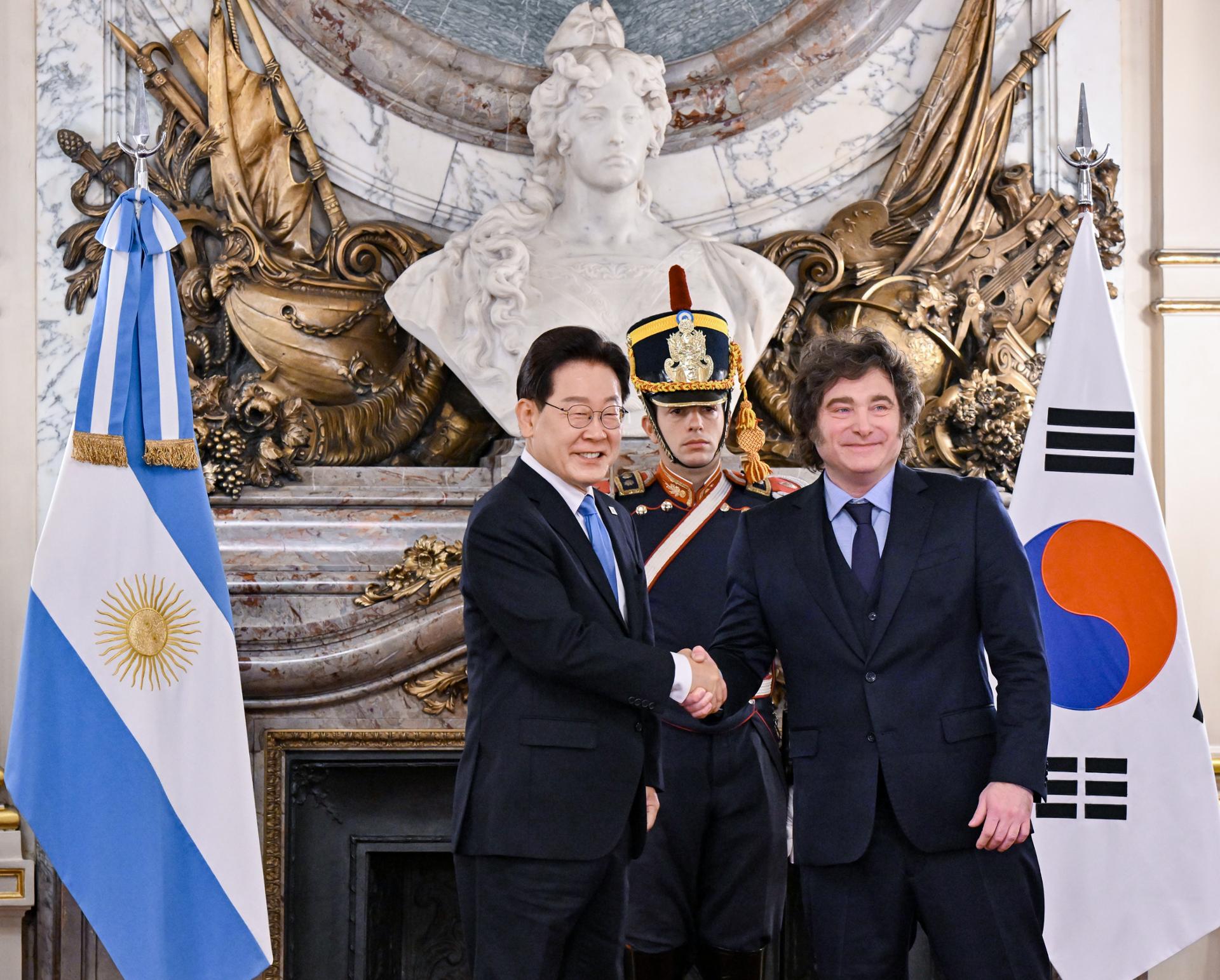
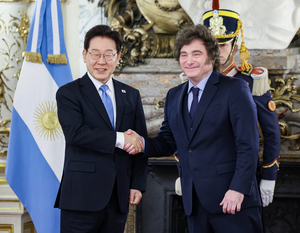
Seoul, Buenos Aires finalize double-taxation avoidance agreement to ease burden on Korean firms President Lee Jae Myung (left) and Argentine President Javier Milei pose for a photo ahead of their summit at the Argentine presidential palace, Casa Rosada, in Buenos Aires on Friday. (Yonhap) South Korea will begin regular imports of Argentine crude starting next year, expanding its oil supply network beyond the Middle East amid the war with Iran, Cheong Wa Dae said after the countries’ leaders met Friday.National Security Adviser Wi Sung-lac announced the agreement after talks between President Lee Jae Myung and Argentine President Javier Milei at the Casa Rosada in Buenos Aires on Friday. Lee’s trip marks the first visit to Argentina by a South Korean president since 2004.Wi said the summit had “created a meaningful opening for Korea to expand its crude oil supply network into South America.”“A Korean company conducted a trial import of Argentine crude oil this year and plans to begin importing it regularly next year,” Wi said. “Through this visit, the two governments agreed to cooperate to ensure that the planned imports proceed smoothly and reliably.”Wi underscored the importance of securing Argentine crude as South Korea seeks to guard against energy shocks stemming from the closure of the Strait of Hormuz, a vital route for Middle Eastern energy shipments, amid the war with Iran.“This is expected to provide an opportunity to diversify our crude oil supply sources, which are currently concentrated in the Middle East, by expanding them into South America, reducing geopolitical risks and strengthening the resilience of our energy supply,” Wi said.“The two countries also agreed to broaden energy cooperation beyond crude oil to areas including natural gas and nuclear power while jointly identifying concrete projects,” he added.South Korea has arranged trial imports totaling 880,000 barrels of Argentine crude this year, with the shipments expected to arrive in the country by August. The volume of imports planned for next year has yet to be determined. HD Hyundai Oilbank, for instance, made its first purchase of Argentine crude this year.Wi said Argentina was rapidly expanding its oil and gas production and planned to raise output to about five times its current level, significantly increasing its export capacity.“That means there will be greater scope for cooperation between our two countries,” he said.Critical minerals partnership expandsThe summit also established a framework for cooperation on supply chains for critical minerals needed in future industries, Wi said.During Lee’s visit, the two countries signed a memorandum of understanding on critical minerals. Under the agreement, they will share information on relevant policies and investment frameworks while promoting corporate investment and joint projects across the lithium value chain, including exploration and mining.“We also reaffirmed the Argentine government’s commitment to continued support for a lithium project being pursued by a Korean company and plan to expand investment opportunities for our companies in other critical-mineral sectors, including copper,” Wi said.One major Korean investment already underway is Posco Holdings’ Sal de Oro project, a lithium extraction and processing venture in Argentina. President Lee Jae Myung and Argentine President Javier Milei pose for a group photo with their delegations ahead of an expanded summit at the Casa Rosada in Buenos Aires on Friday. (Yonhap) Double-tax treaty negotiations concludedWi also announced that South Korea and Argentina had concluded negotiations on a double taxation avoidance agreement, strengthening the institutional framework for Korean companies investing in or entering the Argentine market.“The agreement is expected to ease the double-taxation burden on Korean companies operating in Argentina and make the investment environment more predictable,” Wi said.Wi said the summit helped break the deadlock in negotiations by prompting both sides to reassess their respective demands and potential concessions.“When a major event such as a summit takes place, it gives both sides an opportunity to revisit the issues and reconsider what they need to secure and what they can concede,” Wi said. “That can sometimes lead stalled negotiations to advance rapidly, and this was one such case.”The agreement will take effect once South Korea completes its domestic procedures, including Cabinet approval, the president’s signature and parliamentary ratification, Wi said.“We will work to bring that date forward as much as possible,” he added.Wi said Argentina had also agreed to provide Posco with a range of tax benefits, resolving another long-running issue, although he did not disclose further details.“That can also be seen as one of the summit’s positive outcomes,” he said.Push to revive Korea-Mercosur talksThe two countries further agreed to seek an early resumption of negotiations on a trade agreement between South Korea and Mercosur, with the aim of expanding Korean companies’ access to South American markets, Wi said.Negotiations between South Korea and the four founding members of the South American trade bloc — Argentina, Brazil, Paraguay and Uruguay — have been stalled since 2021.During his summit with Brazilian President Luiz Inacio Lula da Silva on Monday, Lee agreed to establish a working group to assess trade opportunities and sensitive sectors in an effort to restart the negotiations. Lee and Lula aim to announce their resumption at the 69th Mercosur Summit in December.Asked whether tensions between Lula and Milei could complicate efforts to resume the negotiations in December, Wi said Brazil and Argentina did not appear to have any significant differences over the issue.“Although Brazil and Argentina have several outstanding issues between them, there does not appear to be any particular disagreement or gap in their positions regarding a Korea-Mercosur trade agreement,” Wi said.He added that Argentina appeared to be “slightly more proactive” about restarting the negotiations.Argentina is the final stop on Lee’s Latin American tour, following visits to Brazil from July 26 through Wednesday and Chile from Wednesday through Thursday. Lee is scheduled to return to Seoul on Monday after a brief stopover in Frankfurt, Germany, on Saturday.