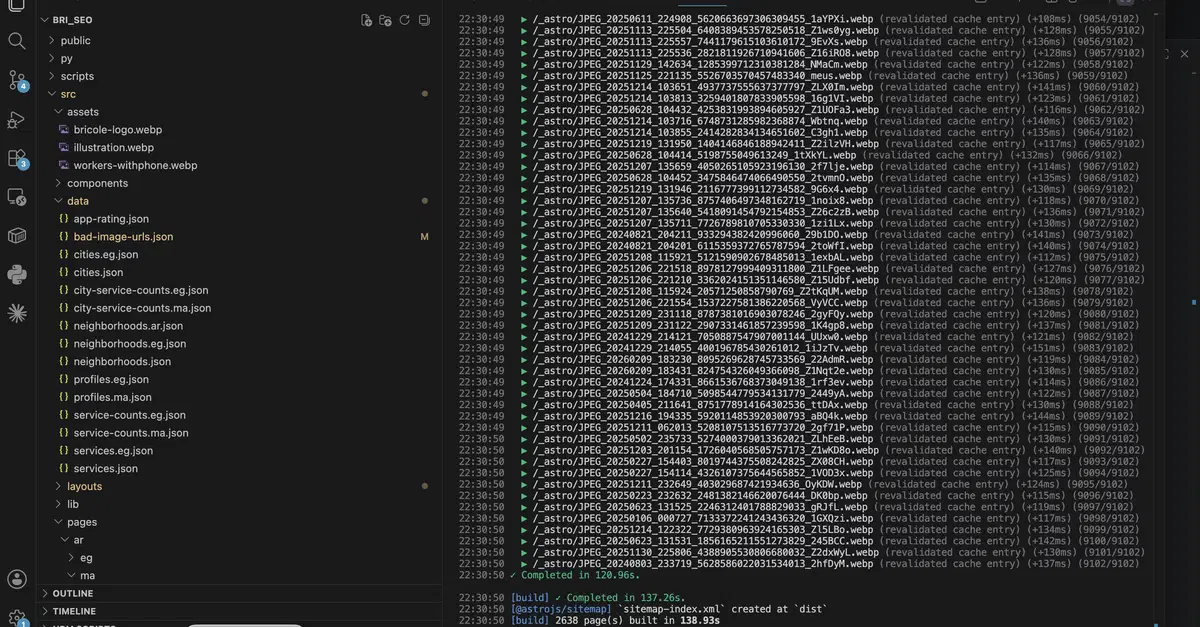
Most Astro content I come across falls into one of two buckets: "here's a nice website I built" or "here's how Astro compares to Next.js for a marketing page." Both fair, both true. But the site I work on doesn't look like either of those, and it's the use case I almost never see written about: hundreds of near-identical, dynamically generated pages, all needing to rank in search, all needing to load fast, in two languages and two markets.
Concretely: a home-services marketplace with city pages, service pages, and city × service combination page — the kind of programmatic SEO structure where the page count isn't in the dozens, it's in the hundreds today and headed toward tens of thouisands as the underlying data grows. That's a genuinely different problem than "make one fast landing page," and it turns out Astro is unusually well suited to it — better suited, in some concrete ways, than the frameworks that get all the programmatic-SEO blog posts.
The default that actually matters: zero JS unless you ask for it
Every "why Astro" post mentions the islands architecture. What gets undersold is what that means specifically for a large templated site: a city × service page — heading, worker cards, an FAQ block, some internal links — ships as plain HTML with no JavaScript bundle at all, by default. Not "a smaller bundle." None.