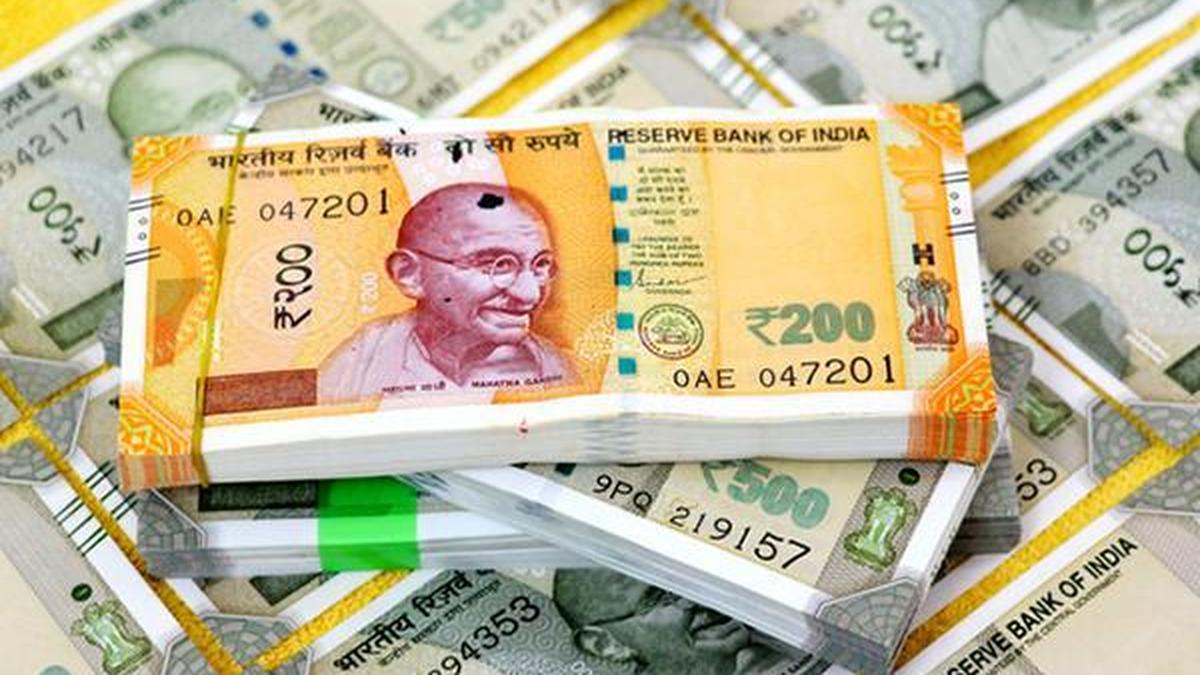
Properly arranged of new indian currency notes rupees 50,100,200 and 500
| Photo Credit:
Deepak Verma
Capital expenditure showed a strong growth of over 23 per cent during April-June quarter of current fiscal, data released by Controller General of Accounts on Friday showed. Since revenue receipt growth was low at over 11 per cent, this pushed the fiscal deficit higher by around 9 per cent.The deficit, as percentage of annual target, prescribed in the Budget, reached 18.2 per cent during the first quarter, slightly higher than 17.9 per cent during last fiscal. The Centre has set a fiscal deficit target of 4.3 per cent of the GDP or ₹16.96 lakh crore in the current fiscal.According to the CGA, the Centre’s net tax revenue was ₹6.36 lakh crore, or 22.2 per cent of the corresponding BE 2026-27 of total receipts, up to June 2026. In the corresponding period of the previous fiscal year, the net tax revenue was at 19 per cent of that year’s BE. The data on monthly accounts showed that the total expenditure during the first quarter was at ₹13.57 lakh crore, or 25.4 per cent of BE. In the year-ago period, it was at 24.1 per cent of BE.According to DK Srivastava, Chief Policy Advisor, EY India, CGA’s fiscal data for the first quarter of 2026-27 show relatively buoyant performance of direct taxes, especially the corporate income tax which shows a growth of 19.7 per cent. In contrast, GST revenues continue to show contraction at (-) 11 per cent as a result of which indirect taxes contracted by (-) 7.6 per cent. Gross tax revenues show a growth only of 3.7 per cent, but net tax revenues show a growth of 17.8 per cent.“This implies a contraction in the assignment of Central taxes to the States to the extent of (-) 19.5 per cent in 1Q 2026-27. Centre’s net tax revenues supplemented by non-tax revenues which contributed 37 per cent of Centre’s net revenue receipts enabled the Centre to frontload its capital expenditure in the first quarter showing a growth of 23.7 per cent while limiting first quarter fiscal deficit to 18.2 per cent of the annual budgeted target,” he said.War impactMadan Sabnavis, Chief Economist at Bank of Baroda, feels the balances are under control. This is significant because Q1 was the time when there was major disruption on account of the war where there was additional pressure on the fertilizer subsidy front as well as tax revenue when the excise duty was lowered on fuel products.“Depending on how the war pans out and crude oil plays, it does look like that the expenditure on revenue account could be higher; and in case capex is maintained, there can be pressure on the fiscal deficit ratio. In the stressed case there can be a slippage of 0.3-0.4 per cent of GDP. Higher growth in GDP will provide statistical cushion, however,” he said.Published on July 31, 2026